
PSER Survey Punjab 2026 — Easy Online Registration, Status Check & Benefits
This is not an official Government of Punjab website. This guide is independent, general information about the PSER survey Punjab. For official information, always check the Punjab Socio-Economic Registry at pser.punjab.gov.pk before you register. PSER registration is free — never pay an agent.
What Is the PSER Survey Punjab?
The PSER survey Punjab is the Punjab government’s way of knowing which families need help. PSER stands for Punjab Socio-Economic Registry, and it is a single verified database that now decides eligibility for most Punjab welfare schemes — the Ration Card, the Nigehban Ramadan Package, Kisan Card checks, and others. Register once, and the same record is used everywhere. You do not need a separate survey for every scheme.
The most important fact about the PSER survey Punjab is what it is NOT. It is not itself a cash scheme. Completing the PSER survey does not guarantee you a card, a ration, or a payment. It puts your family’s details into the registry, and each scheme then checks that registry to decide who qualifies. A family that has completed PSER is in the system; a family that has not is invisible to the schemes that use it.
The PSER survey Punjab collects your household’s details: your income, your family members, your health, and your housing. The survey asks for B-Forms for children under 18, so that children are counted in the household. The details are checked against government records, and the result is a household record that the province uses to target its help at the families that need it most.
Example — the family that registered once and used it everywhere: A family in Multan completed the PSER survey Punjab at their Union Council office. Months later, when the Ration Card list was made, their name was already in the registry, and they qualified without a new survey. When the Nigehban Package was announced, the same record was used again. One survey, three uses — because the registry is shared.
Example — the family that paid an agent for nothing: A daily-wage worker in Faisalabad paid Rs 500 to an agent who promised to “register” him for PSER and get him a Ration Card. The agent took his CNIC copy and disappeared. PSER registration is free, and it is done on the official portal or at a registration centre — no agent is needed, and no agent can get you a card. Completing PSER does not guarantee a card in any case.
PSER Survey Punjab — How to Register
Registration for the PSER survey Punjab is free, and there are three ways to do it: online on the official portal, at a registration centre, or through a door-to-door survey team. The table below gives the routes.
| Way to register | How |
|---|---|
| Online portal | pser.punjab.gov.pk (registration) |
| Status / login portal | portal-pser.punjab.gov.pk |
| Registration centres | 5,000+ centres including E-Khidmat Markaz and Union Council offices |
| Door-to-door teams | Survey teams visiting homes |
| Helpline | 0800-02345 |
The online route works like this. First, create an account on pser.punjab.gov.pk with your full name, your 13-digit CNIC, a mobile number registered on your own CNIC, your email address, and a password. You will get an OTP on your mobile — enter it to verify the account. Then open a New Application and fill in the household survey: your income, your family members, your health, and your housing. For children under 18, you need their B-Forms. Submit the form, and you will get a tracking ID and an SMS confirmation.
To check your status, log in again on portal-pser.punjab.gov.pk with the same account. Do NOT register twice — a second registration creates a duplicate record, and duplicates slow the system down and can cause your record to be flagged. If you have already registered, check the status of the first registration instead of starting a new one.
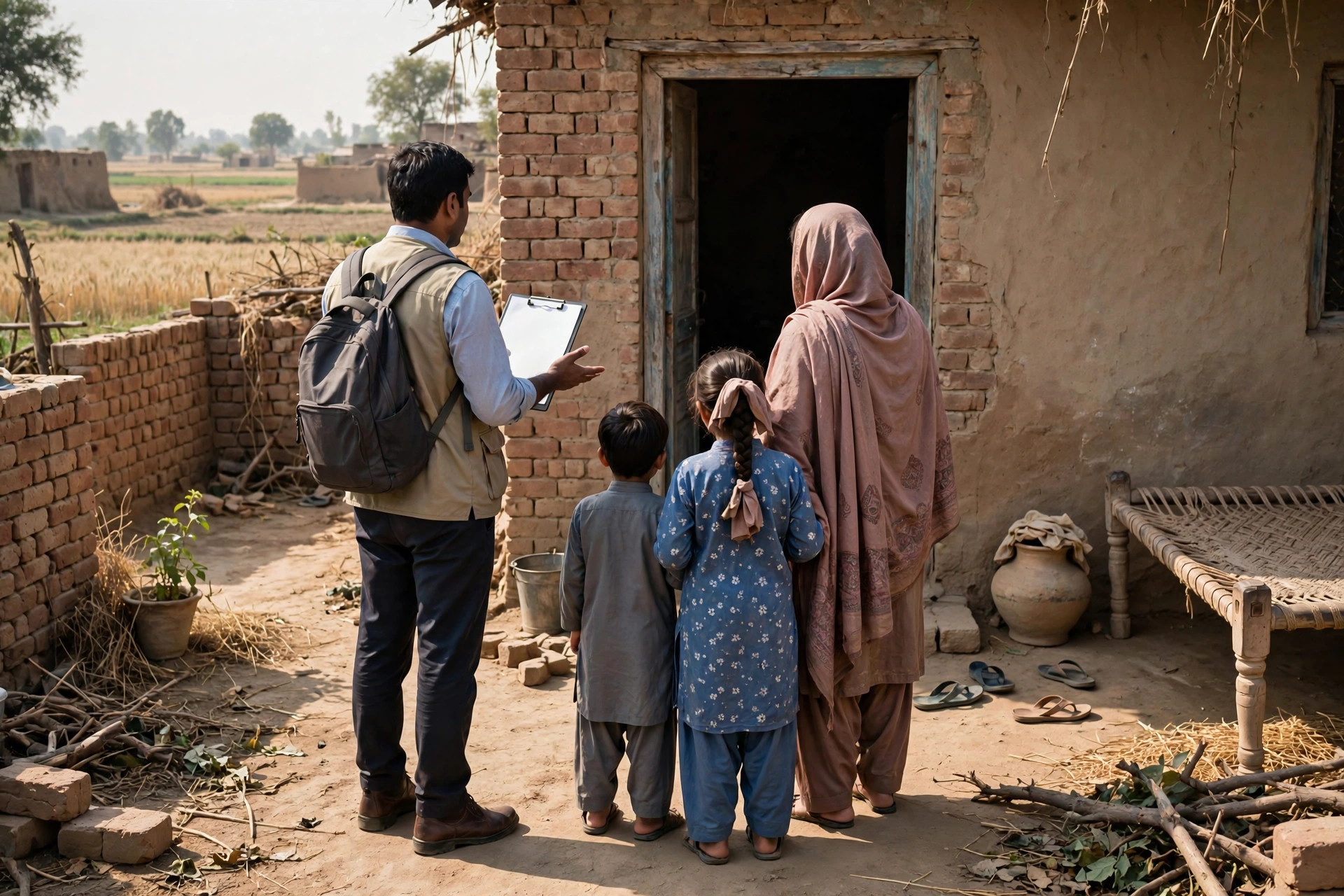
If you cannot register online, go to a registration centre. There are more than 5,000 centres, including E-Khidmat Markaz and Union Council offices. Take your CNIC and your family’s B-Forms. The staff will fill in the survey with you. Door-to-door survey teams also visit homes in some areas — if a team comes to your door, check that they are genuine before you give them your details, and never pay them.
PSER Survey Punjab — What the Registry Is Used For
The PSER survey Punjab is the gateway to Punjab’s welfare schemes, and the table below shows the main ones that use it. The list grows as more schemes link to the registry.
| Scheme | What it gives | How PSER is used |
|---|---|---|
| Punjab Ration Card | Monthly ration support | Eligibility checked against the PSER record |
| Nigehban Ramadan Package | Ramadan relief package | Beneficiaries drawn from the PSER record |
| CM Punjab Kisan Card | Farmer support and priority payment | PSER record used in checks |
| Other Punjab schemes | Various supports | Registry used as the eligibility database |
The Punjab Ration Card is the scheme most families ask about first. The ration card’s eligibility is checked against the PSER record — a family that is not in the registry cannot be checked, and a family that is in it is checked automatically. Our ration card guide explains the income rules and the application route in detail.
The Nigehban Ramadan Package works the same way. The package is distributed to families whose PSER record shows they qualify, so a family that completed the survey before Ramadan is already in line. A family that waits until Ramadan to register may find the list is already made.
The PM Kisan Card uses the PSER record in its checks too, and the Punjab Zakat Rashan Card is a separate Zakat-funded support with its own rules — the two cards are different programmes, and being in PSER does not automatically qualify you for either one. Each scheme has its own eligibility rules; PSER is the record, not the decision.
PSER Survey Punjab — No Single Deadline
There is no single last date for the PSER survey Punjab, and this guide does not invent one. PSER is an ongoing registry, not a one-time form with a fixed deadline. Registration runs in phases, and new phases open as the government updates the registry. If someone tells you the last date is tomorrow, or next week, they are guessing — or lying to get your money.
Because there is no fixed last date, the right time to register is now. A family that registers today is in the registry when the next scheme list is made. A family that waits for a deadline announcement may find the list is already closed. The registry rewards early registration, and it costs nothing — so there is no reason to wait.
The same warning applies to social media posts that claim a PSER last date. The posts are invented, and the dates are invented with them. Check the official portal, pser.punjab.gov.pk, or call the helpline 0800-02345, for the real status. Do not trust a date from a WhatsApp forward, a Facebook post, or an agent.
PSER Survey Punjab — What Happens After You Register
A PSER survey Punjab registration does not give you money, and it does not give you a card. What it gives you is a place in the registry — and the registry is what the schemes use when they choose who gets help. After you register, your record sits in the PSER database with your family’s details, your income, and your PMT score. When a new scheme opens — a ration card, a cash transfer, a solar panel, a scholarship — the government checks the registry first. A family that is registered is visible. A family that is not registered is invisible, and an invisible family gets nothing.
The second thing that happens after registration is verification. The PSER team, or the scheme’s own team, may check your details against NADRA, against the BISP record, and against the field survey. If your details are correct, the verification passes and your record stays active. If your details are wrong — a CNIC number with a digit wrong, a family member missing, an income figure that does not match — the verification can fail, and the record can be marked for correction. That is why the survey matters: a correct record is a usable record, and a wrong record is a blocked one.
The third thing is that registration is not a one-time event. Your family’s circumstances change — a child is born, a member dies, an income rises or falls — and the registry should change with them. If your circumstances change, update your record at a PSER centre or on the portal. A PSER survey Punjab record that is five years out of date is a record that no longer describes your family, and a scheme that uses it will make the wrong decision about you.
Common Problems — and What to Do
Your OTP Did Not Arrive
If the OTP does not arrive when you create your account, first check that the mobile number is registered on your own CNIC — the portal sends the OTP to a number linked to your CNIC, and a number in someone else’s name will not work. Check your signal, wait a few minutes, and ask for the OTP again. If it still does not arrive, try a different browser or go to a registration centre, where the staff can help you.
You Registered Twice by Mistake
If you registered twice, do not register a third time. Log in on portal-pser.punjab.gov.pk and check which registration is active. If both show, call the helpline 0800-02345 and ask them to merge or cancel the duplicate. A duplicate record can delay your eligibility checks, so fix it as soon as you notice it.
Your Status Has Not Changed for Weeks
PSER is a registry, not a payment, so there is no “approved” message to wait for. Your status shows that your survey is submitted and in the system. The schemes that use PSER check the registry when they make their lists — that is when your record matters. If your survey shows as submitted, you are in the system. If it shows as incomplete, log in and finish it.
Someone Offered to Register You for a Fee
PSER registration is free. Anyone who asks for money to register you is running a scam. The only routes are the official portal, the registration centres, and the door-to-door teams — and none of them charges a fee. Do not pay anyone, and do not hand your CNIC copy to an agent.
Your Registration Went Through, But No Scheme Has Contacted You
Registration is not selection. A PSER survey Punjab registration puts you in the registry, but each scheme has its own eligibility rules, its own budget, and its own timeline. The Ration Card has its own criteria. The Nigehban Package is seasonal. A scholarship has its own merit list. Being registered means you are eligible to be considered — it does not mean you are selected. If no scheme has contacted you, check the scheme’s own criteria first, and check whether it is even open. A closed scheme contacts no one, and a scheme with a different target group will not select you no matter how long you wait.
You Registered Twice — Once at a Centre, Once Online
If you registered twice — once at a centre and once online, or once with an old CNIC and once with a new one — your record may be duplicated, and a duplicated record can block a scheme’s verification. Go to a PSER centre with your CNIC and ask them to merge the records. Take both registration receipts if you have them. Do not create a third registration to fix the problem — a third record makes it worse. One record, one CNIC, one family — that is the rule, and the centre staff can fix a duplicate if you tell them about it.
PSER Survey Punjab — Mistakes That Cost You
The first mistake is not registering at all. A family that is not in the registry is invisible to the schemes that use it. Registration is free, it takes one visit, and it is the gateway to every Punjab scheme that follows.
The second mistake is registering twice. A duplicate record slows the system and can flag your household. Register once, keep your tracking ID, and check your status by logging in — never by registering again.
The third mistake is giving wrong details. Your income, your family members, and your housing are checked against government records. A wrong income figure, a missing child, or a wrong address can make your record useless — or worse, can look like a false declaration. Fill in the survey honestly, and check it before you submit.
The fourth mistake is trusting a fake website. Only `.punjab.gov.pk` addresses are official. A website that looks like the PSER portal but ends in `.com`, `.online`, or anything else is a fake, and it will steal your CNIC details. Type pser.punjab.gov.pk yourself — do not follow a link from a message.
The fifth mistake is thinking PSER itself pays you. It does not. PSER is the record. The schemes pay — and only if you qualify under their rules. A family that completes PSER and then waits for money will wait forever. Check which schemes you qualify for, and apply for those separately.
How PSER Differs from the NSER Survey
Many families confuse the PSER survey Punjab with the NSER survey, and the confusion is understandable — both are household surveys, and both are used to decide who gets help. But they are different registries, run by different governments, for different schemes.
NSER — the National Socio-Economic Registry — is the federal registry run by BISP. It decides eligibility for federal schemes, above all the Benazir Kafaalat programme. PSER is the Punjab registry, run by the Government of Punjab. It decides eligibility for Punjab schemes — the Ration Card, the Nigehban Package, and the others listed above.
A family can be in both registries, and most poor families in Punjab should be. Completing PSER does not complete NSER, and completing NSER does not complete PSER. If you are in one and not the other, you are visible to one government and invisible to the other. Register for both, and keep both records up to date.
PSER Survey Punjab — Keep Your Record Updated
A PSER survey Punjab record is only useful if it is current. Families change: a child is born, a member dies, an income rises or falls, a phone number changes. If your record does not change with your family, it stops describing you — and a scheme that uses it will make the wrong decision about you. Check your record once a year at a PSER centre or on the portal, and update it whenever something changes. A scheme that tries to contact you on a dead phone number will move on to the next family, and your registration will not save you.
Your PSER Survey Punjab Checklist
- I have registered for the PSER survey Punjab — once, not twice.
- I registered free, on pser.punjab.gov.pk or at a registration centre — no agent, no fee.
- My mobile number is registered on my own CNIC, so the OTP reaches me.
- I have my tracking ID and SMS confirmation saved.
- I know PSER is a registry, not a payment — it does not guarantee any card or cash.
- I know there is no single last date — registration runs in phases.
- I will check my status by logging in on portal-pser.punjab.gov.pk, not by re-registering.
- I will only trust .punjab.gov.pk addresses, never a link from a message.
Common Questions
What is the PSER survey Punjab? PSER is the Punjab Socio-Economic Registry, the Government of Punjab’s single verified database of household details. It decides eligibility for most Punjab welfare schemes, including the Ration Card and the Nigehban Package.
How do I register for the PSER survey Punjab? Register free on pser.punjab.gov.pk (create an account, fill in the household survey, submit, and save your tracking ID), or at one of 5,000+ registration centres, or through a door-to-door survey team. The helpline is 0800-02345.
Is PSER registration free? Yes. Registration is completely free. Anyone who asks for money to register you is running a scam.
What is the last date for PSER registration? There is no single last date. PSER is an ongoing registry that runs in phases. Do not trust any last date from social media or an agent — check pser.punjab.gov.pk or call 0800-02345.
How do I check my PSER status? Log in on portal-pser.punjab.gov.pk with the account you created. Do not register again to check your status.
Does completing PSER guarantee me a Ration Card or payment? No. PSER is the record, not the decision. Each scheme checks the registry against its own eligibility rules. Completing PSER puts you in the system; it does not guarantee any card or payment.
What is the difference between PSER and NSER? PSER is Punjab’s registry for Punjab schemes. NSER is the federal BISP registry for federal schemes like Kafaalat. A family should be in both.
What documents do I need for PSER? Your CNIC, a mobile number registered on your own CNIC, an email address, and B-Forms for children under 18. No fee, no agent.
Conclusion
The PSER survey Punjab is the single most useful free step a poor family in Punjab can take: one registration, and your household is in the system that decides eligibility for the Ration Card, the Nigehban Package, and every Punjab scheme that follows. It costs nothing, it takes one visit or one online form, and it never expires into a missed deadline — because there is no single deadline to miss.
Register once, register honestly, and keep your tracking ID. Then check the schemes you qualify for — starting with our Punjab Ration Card guide and our Nigehban Ramadan Package guide — and apply for those separately. The registry opens the door; the schemes decide who walks through it.


One Comment