Punjab School Meal Programme 2026 — Free Milk & Biscuits in 7,294 Schools
This is not an official Government of Punjab website. This guide is independent, general information about the Punjab School Meal Programme. For official information, always check the Punjab School Education Department before you act on anything here. The programme has no parent application and no fee — never pay anyone for it.
What Is the Punjab School Meal Programme?
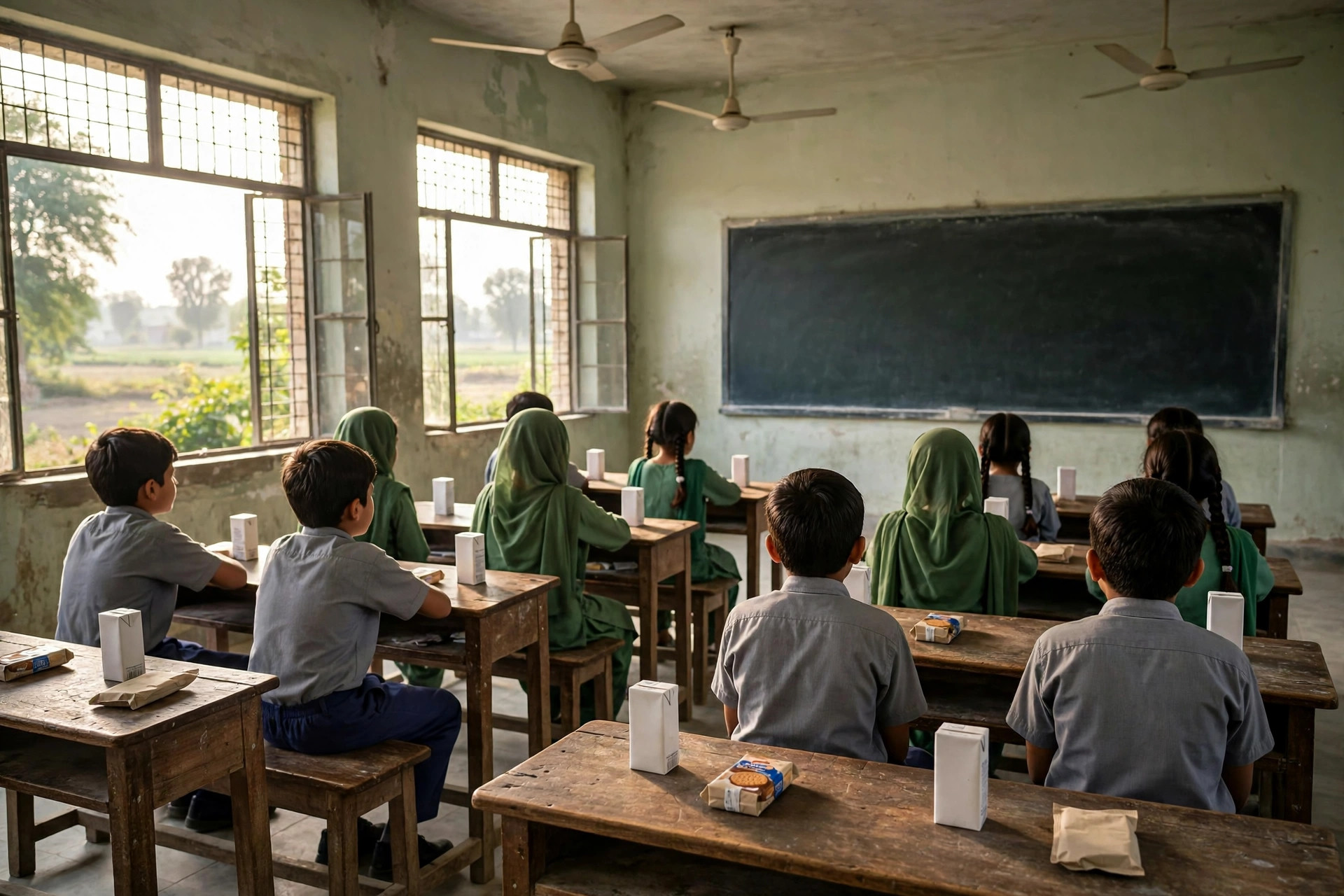
The Punjab School Meal Programme is the Punjab government’s free food programme for children in government schools. It gives packaged milk three days a week, and milk plus fortified biscuits one day a week — four serving days in total — to about 1.028 million students in 7,294 government schools across 13 districts. It was approved in late August 2026 by Chief Minister Maryam Nawaz, is implemented by the Punjab School Education Department, and the current phase launched in September 2026 with a budget of Rs 6.87 billion for the current financial year.
The Punjab School Meal Programme is a supplement, not a full lunch. The milk and biscuits are an addition to the child’s day, not a replacement for the food the family provides at home. No cash is given to families, and no food is sent home. The child eats at school, on the serving days, in the classroom.
The 13 districts covered in the current phase are Bahawalnagar, Bhakkar, Chiniot, Dera Ghazi Khan, Kot Addu, Layyah, Lodhran, Mianwali, Muzaffargarh, Rahim Yar Khan, Rajanpur, Taunsa and Vehari. These are the districts where the programme runs now. A school in one of these districts may still not be covered — the district being on the list does not mean every school in it is in the programme. Parents should ask the school head or the teacher whether their child’s school is covered.
Example — the child who finally eats at school: A girl in a government primary school in Muzaffargarh used to leave home without breakfast, because her family could not afford it every day. On milk days, she gets a pack of milk at school. On the fourth day, she gets milk and fortified biscuits. It is not a full meal, but it is food she would not otherwise have had, and she stays in class instead of going home hungry.
Example — the parent who was asked to pay: A father in Layyah was told by a man outside the school that he had to pay Rs 200 a month for his son’s school meals. There is no fee for the Punjab School Meal Programme. The milk and biscuits are free, there is no form, and no one can charge for them. The father reported the man to the school head, and the charge stopped.
Punjab School Meal Programme — Who Gets It and How
There is no parent application, no portal, no fee, and no form for the Punjab School Meal Programme. A child who is enrolled and attending a covered government school in one of the 13 districts is covered. Private schools are NOT covered, and schools outside the 13 districts are NOT covered. That is the whole rule — there is nothing to apply for, and nothing to fill in.
The table below gives the coverage of the Punjab School Meal Programme in the current phase.
| Detail | Current phase |
|---|---|
| Districts | 13 |
| Government schools | 7,294 |
| Students | About 1.028 million |
| Budget (current financial year) | Rs 6.87 billion |
| Milk days | 3 days a week |
| Milk + fortified biscuits | 1 day a week |
| Total serving days | 4 days a week |
| Cash to families | None |
The programme’s history matters, because the figures from the pilot are often mixed up with the current figures. The school meal idea was piloted in three districts in 2023–24 — Rajanpur, Muzaffargarh and Dera Ghazi Khan — covering more than 400,000 primary students. The formal launch event was on 1 February 2026 at Government Primary School Kisanwala in Bhakkar. The current phase, launched in September 2026, is much bigger: 13 districts, 7,294 schools, about 1.028 million students. Do not mix the pilot figures with the current-phase figures — they describe different stages of the same programme.
If your child’s school is in one of the 13 districts, ask the school head or the teacher whether the school is in the programme. The head will know, because the school receives the milk and biscuits. If the school is not covered, there is no application to make — coverage is decided by the department, not by parents. The useful step is to make sure your child is enrolled and attending regularly, so that when the programme reaches the school, the child is there to receive it.
Punjab School Meal Programme vs Benazir Taleemi Wazaif — Do Not Mix Them
Families often confuse the Punjab School Meal Programme with Benazir Taleemi Wazaif, because both help schoolchildren from poor families. They are different programmes, run by different departments, with different rules. The table below separates them.
| Feature | Punjab School Meal Programme | Benazir Taleemi Wazaif |
|---|---|---|
| Run by | Punjab School Education Department | BISP (federal) |
| What the child gets | Milk and biscuits at school | Cash stipend to the family |
| Application | None — enrolment in a covered school is enough | Registration through BISP, linked to Kafaalat |
| Attendance rule | Child must attend school | 70% attendance rule applies |
| Coverage | 13 districts, government schools only | Nationwide, for Kafaalat families |
| Cash to families | None | Yes — quarterly stipend |
The Punjab School Meal Programme gives food at school, and it asks nothing of the parent except that the child is enrolled and attending. Benazir Taleemi Wazaif gives cash to the family, and it requires BISP registration and 70% attendance. A child can benefit from both — a child in a covered government school who is also in a Kafaalat family can get the milk at school and the stipend at home. But they are separate programmes, and qualifying for one does not automatically qualify you for the other.
What Happens If Your Child’s School Is Not on the List?
If your child’s school is not in the 13 districts, or not among the 7,294 schools, your child does not get the meal — and there is no application form to change that. The programme covers specific districts and specific schools, and the list is fixed by the department. A parent cannot add a school to the list, and a teacher cannot add a class to it.
The only thing a parent can do is ask: ask the school head whether the school is on the list, ask the district education office whether the district is covered, and ask whether the next phase will include your area. The list is published by the department, and the school head has it — ask to see it, and check whether your child’s school is named on it.
The programme is a phase, not a finished scheme. It started as a pilot in 3 districts, and it grew to 13 districts and 7,294 schools. The next phase may add more districts and more schools, and the districts that are not covered now may be covered later. The way to know is to check the department’s announcements — and to keep asking. A district that asks loudly is a district that gets noticed, and a school that asks is a school that gets counted.
If your child’s school is on the list but your child is not getting the meal, the problem is different. Ask the teacher first — the meal may be served on specific days, and your child may be absent on those days. Ask the school head whether the milk and biscuits are arriving regularly. If the supply is not arriving, the school head should report it to the district office. The meal is free, the supply is the government’s responsibility, and a child on the list who is not eating is a problem worth reporting.
How the Meal Programme Handles Special Cases
A child with a milk allergy cannot drink the milk, and a child with a wheat allergy cannot eat the biscuit. The programme’s menu is fixed — milk three days a week, milk and biscuits on the fourth — and there is no separate menu for allergies. A parent whose child has an allergy should tell the teacher, so that the child is not given food that harms them. The teacher cannot change the menu, but the teacher can make sure the child is not served what they cannot eat. The meal is meant to help a child, not to hurt one.
A child who is absent on a meal day does not get the meal that day, and there is no take-home portion. The meal is served at school, during the school day, and it is eaten at school. A child who is sick, or whose family keeps them home, misses that day’s meal. The way to make sure your child gets it is to make sure your child is at school on the meal days — and to ask the teacher which days those are, so that you can plan around them.
A child in a school that is on the list but in a different shift — a morning shift and an evening shift — should still get the meal, because the meal is for the school, not for one shift. If your child’s shift is not being served, ask the school head. The programme covers the school, and the school covers all its shifts.
Common Problems — and What to Do
Your Child’s School Is in a Covered District but Gets No Meals
A district being on the list does not mean every school in it is covered. Ask the school head directly whether the school is in the programme. If it is not, there is no form to fill in — coverage is decided by the School Education Department. Ask the head when the school might be added, and make sure your child stays enrolled and attending.
Your Child Is in a Private School
The Punjab School Meal Programme covers government schools only. A child in a private school is not covered, whatever the family’s income. If the family cannot afford the private school, the options are the government school system — where the meal programme runs — or the PEF Education Voucher Scheme, which gives free private schooling to poor children through a voucher card. Our voucher guide explains how that works.
Someone Asked You to Pay for the Meals
There is no fee for the Punjab School Meal Programme. Anyone who asks for money for the milk, the biscuits, or a “registration” is running a scam. Report the person to the school head or the district education office, and do not pay.
The Milk or Biscuits Stopped Arriving
If the meals stop at your child’s school, ask the school head first. Supplies can be delayed, and the head will know whether it is a delay or a stop. If the head cannot answer, contact the district education office. Do not assume the programme has ended — a supply delay is not a cancellation.
Punjab School Meal Programme — Mistakes That Cost Your Child
The first mistake is not checking whether the school is covered. A parent who assumes the programme is everywhere will be disappointed. Ask the school head — one question, one answer, and you know where you stand.
The second mistake is confusing the meal programme with a cash scheme. The Punjab School Meal Programme gives food at school. It does not give money to the family. A parent who waits for a payment will wait forever — the payment belongs to a different programme, and it has its own rules.
The third mistake is keeping a child out of school. The meal is served at school, to children who attend. A child who does not attend does not eat. Enrolment and attendance are the only conditions, and they are also the conditions for every other education support — including the Punjab Honhaar Scholarship for older students who do well.
The fourth mistake is paying an agent. There is no application, no form, and no fee. An agent who offers to “register” your child for the meal programme is selling you something that does not exist.
Why the Programme Exists — Hunger and School Attendance
The Punjab School Meal Programme exists for a simple reason: a hungry child does not learn well, and a child who does not eat at school is more likely to leave school altogether. In the districts the programme covers, many families cannot afford a meal before school. The child arrives hungry, cannot concentrate, and sometimes does not come back the next day.
The milk and biscuits do not solve hunger by themselves. Four serving days a week, a pack of milk and a biscuit, is a supplement — the family still has to feed the child at home. But the supplement does two things: it gives the child energy for the school day, and it gives the family one more reason to send the child to school. A child who eats at school is a child who stays in school, and a child who stays in school is a child who learns.
The programme also helps the schools. A school that serves food has better attendance, and better attendance means the teachers can teach a full class instead of half a class. The Rs 6.87 billion budget is large, but it is spent on food that goes directly to children — there is no cash in the chain to be diverted, and no form for a family to fill in wrong.
What Parents Should Not Expect from the Meal Programme
The meal programme is a school meal, not a family ration. It feeds the child at school, on school days, and it does not feed the family at home. A parent who expects a monthly ration, a cash payment, or a take-home bag will be disappointed — and the disappointment is the result of a wrong expectation, not a broken promise. The programme’s job is to feed a child at school so that the child can learn. It does that, and it does it well. It does not do anything else, and it should not be judged for what it never promised.
The meal is also not a substitute for breakfast at home. A child who comes to school hungry and waits for the mid-morning milk is a child who is already behind for the first hours of the day. The meal is a supplement — an extra — not a replacement for the food a child needs at home. A parent should still feed the child breakfast, and treat the school meal as what it is: a bonus, not a baseline.
And the meal is not a reason to choose a school. A parent should choose a school for its teaching, not for its milk. The meal is a help, not a reason — and a good school without a meal is better than a bad school with one. The programme is a support for learning, and learning is the point.
Your Punjab School Meal Programme Checklist
- I know the Punjab School Meal Programme gives free milk and biscuits at school — no cash, no fee, no form.
- I know it covers 13 districts, 7,294 government schools, about 1.028 million students.
- I have asked my child’s school head whether the school is covered.
- I know private schools are NOT covered.
- I know the serving days are 4 a week — milk 3 days, milk + biscuits 1 day.
- I will not pay anyone for the meals — anyone asking for money is running a scam.
- I know the meal programme is different from Benazir Taleemi Wazaif (cash stipend, BISP).
- I will keep my child enrolled and attending, so the meals reach them.
Common Questions
What is the Punjab School Meal Programme? The Punjab School Meal Programme is the Punjab School Education Department’s free food programme for children in government schools: packaged milk 3 days a week and milk plus fortified biscuits 1 day a week, for about 1.028 million students in 7,294 schools across 13 districts.
Which districts are covered by the Punjab School Meal Programme? Bahawalnagar, Bhakkar, Chiniot, Dera Ghazi Khan, Kot Addu, Layyah, Lodhran, Mianwali, Muzaffargarh, Rahim Yar Khan, Rajanpur, Taunsa and Vehari — 13 districts in the current phase, launched September 2026.
How do I apply for the Punjab School Meal Programme? There is no application. A child enrolled and attending a covered government school in one of the 13 districts is covered automatically. There is no portal, no form, and no fee.
Is the Punjab School Meal Programme free? Yes. The milk and biscuits are completely free. Anyone who asks for money for them is running a scam.
Does the programme give cash to families? No. It gives food at school only — milk and biscuits, served to the child. No cash is paid to families.
Is my child’s private school covered? No. The programme covers government schools only. For free private schooling, see the PEF Education Voucher Scheme.
What is the difference between the school meal programme and Taleemi Wazaif? The meal programme gives food at school through the Punjab School Education Department, with no application. Taleemi Wazaif gives a cash stipend through BISP to Kafaalat families, with a 70% attendance rule. A child can benefit from both.
What should I do if the meals stop at my child’s school? Ask the school head first — it may be a supply delay. If the head cannot answer, contact the district education office.
Conclusion
The Punjab School Meal Programme is food, not money, and that is its strength: milk and biscuits, served at school, four days a week, to more than a million children in 13 districts, with no form to fill in and no fee to pay. A child who is enrolled and attending a covered government school is covered — and the only thing a parent has to do is ask the school head whether the school is in the programme.
If your child is in a covered school, the meals are already theirs. If not, keep the child enrolled and attending, and check the other supports — the PEF Education Voucher Scheme for free private schooling, and the Punjab Daanish School admission guide for free boarding school — so that the child’s education never depends on one programme alone.