BISP App 2026 – Official Download & Login Guide
BISP App: What Pakistani Families Actually Need to Know
Quick Facts
- 13,500 — quarterly payment amount (since January 2025)
- 10 million+ families currently supported
- PMT score 32 — the eligibility cut-off
- 8171 — free SMS check, send your CNIC right now
The Real Problem — And Why This Guide Exists
You’ve heard about BISP. Maybe your neighbor gets the payment every quarter. Maybe someone at the bazaar told you to “just send your CNIC to 8171.” Maybe you tried — and nothing happened. Or you waited hours at a BISP office and came home with no clear answer. Most websites just copy official press releases. They say “registration is easy” without ever explaining why your application might be rejected, what the PMT score actually means, or why a woman living in a katcha house gets declared ineligible while someone better off receives payments every quarter.
This guide is different. It explains what’s actually happening — including the parts nobody wants to talk about. If you’re trying to register, check your eligibility, understand a rejection, or protect yourself from agents stealing your money — this is for you.
Do this first: Send your 13-digit CNIC number (no dashes, no spaces) as an SMS to 8171. It’s completely free. You’ll know within seconds whether your household is in the BISP database.
Background: Why BISP Exists and How It Actually Works
BISP the Benazir Income Support Programme was launched in July 2008 to help families being crushed by rising food and fuel prices. Named after former Prime Minister Benazir Bhutto, it has grown into Pakistan’s largest welfare program. The government’s 2025–26 budget allocated Rs. 716 billion to BISP the country’s third-largest budgetary item. Around 10 million families are currently supported.
Here’s what most articles skip: BISP doesn’t hand out money based on who walks into an office. It uses a massive national database — the National Socio-Economic Registry (NSER) — that contains household-level data on virtually every family in Pakistan. Your eligibility is determined by a calculated poverty score, not by anything you say or claim.
The BISP app and the 8171 portal are simply windows into this database. Before any payment can happen, your household must be in the system — and your score must be low enough. Understanding this one thing explains most of the confusion people experience.
Who Actually Qualifies — With the Real Exceptions
The official income limits:
| Area | Maximum monthly income |
|---|---|
| Urban families | Less than Rs. 25,000 per month |
| Rural families | Less than Rs. 20,000 per month |
The PMT score — the real gatekeeper most people don’t know about:
BISP uses a Proxy Means Test (PMT) score — a number between 0 and 100 that measures your household’s poverty level. Lower score means more poverty, and more chance of qualifying. To receive Benazir Kafaalat payments, your household PMT score must be 32 or below. For families with a differently-abled member, the threshold is 37.
The score is calculated using more than 20 data points collected during a home survey:
| Factor | How it affects your score |
| Monthly household income | Lower income brings score down |
| Number of family members and dependents | More dependents brings score down |
| Housing type — katcha vs. pakka | Katcha house brings score down |
| Owning a motorcycle, AC, TV, or freezer | Each one raises your score |
| Electricity and gas bills | High bills raise your score |
| Owning agricultural land or property | Raises your score significantly |
The hidden trap many families fall into: A family that scraped together money to buy a motorcycle for daily-wage work may score just above 32 — and be declared ineligible — even though they are genuinely struggling. BISP sees the motorcycle as an asset.
Who is automatically disqualified — no exceptions:
- Any family member employed by the government or military at any level
- Anyone receiving a government pension
- Families owning more than 3 acres of farmland or more than 80 square yards of residential land
This matters more than people realize. A government peon earning Rs. 18,000 per month — less than the official income limit — is still completely disqualified because of government employment. This is one of BISP’s genuine unfairnesses, and there is no appeal for it.
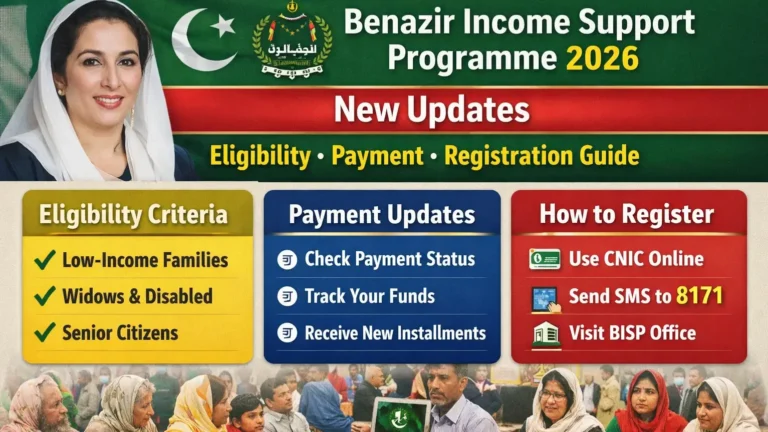
The program also primarily targets women as the registered beneficiary. To qualify, the applicant should be a female head of household — widowed, divorced, separated, or the primary financial decision-maker in the family — with a valid CNIC.
The Real Process — Step by Step, With the Why
Step 1: Check if your household is in the NSER database
Before doing anything else, check whether your household was ever surveyed. Send your 13-digit CNIC (no dashes) to 8171 as an SMS. You can also check at the official web portal: 8171.bisp.gov.pk
If your household was never surveyed, you have no PMT score and no eligibility — no matter how poor you are. Many rural and flood-affected families were never captured in the original surveys.
Step 2: Understand your status Status
| message | What it means | What to do |
| Eligible | Your PMT score is 32 or below | Visit BISP Tehsil Office for biometric activation |
| Ineligible | Your score is above the threshold | Request a dynamic re-survey — see Step 5 |
| Under Verification | Your survey is still being processed | Wait 2–3 weeks and check again |
| Not Found | Your CNIC is not in the database | Register at your nearest BISP center |
Step 3: Use the BISP app
The official BISP app is available on Google Play Store and Apple App Store. Search “BISP” and download only the version published by the Government of Pakistan. Do not download any third-party app claiming to be BISP. Once installed, register using your CNIC. The app shows your PMT score, payment history, eligibility status, upcoming payment dates, and allows you to update your contact number.
What the app cannot do: it cannot change your eligibility, fast-track your payment, or register you for the first time. It is a tracking and notification tool, not a registration tool.
Step 4: Documents to bring for registration
| Document | Why it matters |
| Original CNIC of the female head of household | Must be valid and not expired |
| B-Form for every child under 18 | More dependents helps lower your PMT score |
| Recent electricity and gas bills | Low bills can lower your PMT score |
| Rental agreement if you are renting | Proves you do not own property |
| Landlord’s CNIC copy if you are renting | Supports your rental claim |
Biometric verification is mandatory at the BISP Tehsil Office and cannot be skipped. This exists for a reason: in 2023, it was discovered that Rs. 19 billion had been illegally distributed to 143,000 government officials who registered their wives and relatives in the BISP system to claim payments meant for the poor. Biometrics are BISP’s main defense against this. They will not bypass it, and they should not.
Step 5: If you are declared ineligible — this is not the end
This is the most important thing most websites never mention. “Ineligible” is often correctable. Visit your nearest BISP Tehsil Office — specifically the Tehsil office, not a general payment center — and request a Dynamic Survey re-assessment in writing. When you go, explain your actual household situation: real income, number of people living in the house, the fact that you rent, any financial hardships. After the re-survey, your updated PMT score typically appears in the system within 3 to 6 weeks.
Before going, also visit NADRA to update your records. If your NADRA file has an old address, incorrect marital status, or missing children, your PMT score can be artificially inflated — making you appear better off than you actually are.
One more thing: the eligibility threshold of 32 is a budget decision made by the BISP Board, not a permanent law. When the government increases BISP’s budget, more families become eligible without anything changing on their end. This is why checking your status every few months makes sense even if you were previously rejected.
Step 6: Collecting your payment
Payments are made quarterly. Since January 2025, each quarterly payment is Rs. 13,500. BISP staggers payments by region to reduce crowding at payment centers. Payment can be collected at your designated BISP payment center using biometrics, through a linked bank account, or through mobile wallets including JazzCash. After registering, check the BISP app for your scheduled payment date and your nearest collection point.
Real timeline vs. official timeline:
- SMS status check — instant
- New registration processing — 4 to 8 weeks typically
- Re-survey PMT score update — 3 to 6 weeks
- First payment after approval — next quarterly cycle
What Other Articles Don’t Tell You
Agent fees are illegal — and widespread
In some provinces, payment centers charge a minimum of Rs. 500 just to process a withdrawal. Agents also charge Rs. 300 to 500 to “help” people withdraw their money. This is completely illegal. Your full BISP payment belongs to you. You should never pay anyone to access it. If someone at a payment center demands a fee, report it immediately using the complaint system described below.
Your SIM card must be registered under your own CNIC
If your mobile number is registered under a family member’s CNIC rather than your own, you will not receive OTP codes or SMS notifications, which can block you at the biometric stage. Check this before you apply. You can verify at any Telenor, Jazz, Zong, or Ufone franchise.
Outdated NADRA records can make you look ineligible
If your NADRA file has an old address, missing children, or wrong marital status, your PMT score can be higher than it should be. Fix your NADRA records before requesting a resurvey — it can make the difference between a score of 29 and a score of 35.
Many fake websites copy the 8171 portal
Fraudulent websites mimic the official 8171 portal and collect CNIC data for scams. Always use only the exact official URL: https://8171.bisp.gov.pk — and check that the address is exactly right before entering your CNIC.
The complaint system now works better than before
In 2025, BISP launched a new Integrated Grievance Management System (IGMS). Complaints can now be filed online, tracked in real time, or submitted by SMS to 8171 or in person at any BISP Tehsil Office. Each complaint gets a tracking ID. This is a real improvement — use it if you face any problem.
Three Real Pakistani Families
Case 1 — The straightforward case
Fatima is a widow in rural Punjab. Four children, no assets beyond basic household items, katcha house, active CNIC. Her household was surveyed and her PMT score is 28. She texts 8171, receives “Eligible,” visits the BISP Tehsil Office for biometric registration, and collects Rs. 13,500 every quarter. She uses the BISP app to check when her next payment is due and which center to visit.
Timeline: 3 to 5 weeks from first SMS check to first payment.
Case 2 — The correctable rejection
Rehana lives in a rented apartment in Karachi. Her husband is a daily-wage laborer who owns a motorcycle. Her PMT score came back at 38 — just above the threshold — because the motorcycle counted as an asset and the urban address triggered higher assumptions about her cost of living. She visits the BISP Tehsil Office, requests a Dynamic Survey reassessment, and brings her rental agreement, recent utility bills, and B-Forms for her children. The surveyor updates her records. Six weeks later, her PMT score drops to 29. She becomes eligible.
Timeline: 2 to 4 months total.
Case 3 — The permanent rejection
Naseem’s husband works as a government peon at Basic Pay Scale-5, earning Rs. 18,000 per month. Below the official income limit — but automatically disqualified from BISP because of government employment. No re-survey changes this. No appeal exists. Naseem should explore the Ehsaas Rashan program and provincial-level welfare schemes in her area instead.
Why the System Works This Way — Surprising Insights
BISP is more scientifically designed than most people realize. The PMT scoring system was developed with World Bank assistance. During the NSER surveys, trained enumerators visited homes across the country using Android tablets with automated data sampling, Bluetooth verification, and supervisor oversight. The database now covers 35 million households — the largest socio-economic dataset in Pakistan’s history.
But the design has a blind spot: it was built on survey data collected between 2019 and 2021. Families whose circumstances changed after the survey — who lost their jobs, whose assets wore out, or who moved to a smaller house — may still be scored on old information. This is exactly why requesting a Dynamic Survey re-assessment matters. You have the right to ask BISP to update your records.
Honest Limitations — What BISP Does Not Solve
Rs. 13,500 per quarter equals roughly Rs. 4,500 per month. According to BISP’s own figures, this covers approximately 20 to 25 days of flour for a family of five or six. It is a supplement, not a salary. It helps — but it cannot replace income. Government employees at any pay grade are permanently excluded. A peon, a sanitation worker, a low-level clerk — all disqualified. This leaves many genuinely poor families with no access to BISP and no alternative pathway through the program.
Corruption remains real. A 2023–24 government audit found Rs. 141 billion in financial irregularities within BISP. The digital reforms and IGMS complaint system help, but ground level corruption — especially at payment centers — has not been fully eliminated.
NADRA record errors can stall your application for months. Fixing records takes time, and BISP cannot process your case until NADRA data is corrected.
Practical Checklist — Do This in Order
At home before going anywhere:
- Send your CNIC to 8171 and note the exact reply
- Confirm your CNIC is not expired
- Confirm your SIM card is registered under your own CNIC
- Collect B-Forms for all children under 18
- Gather your most recent electricity and gas bills
At the BISP Tehsil Office:
- Bring original CNIC plus all the above documents
- If ineligible or not found: request a Dynamic Survey re-assessment in writing
- Ask for a written acknowledgment slip with a date
- Never pay any fee to any staff member or agent — report anyone who asks
After registration:
- Download the official BISP app from Google Play or App Store
- Confirm your mobile number is correctly recorded in the system
- Save the free BISP helpline: 0800-26477 If you face any problem:
- File a complaint at bisp.gov.pk/complaints
- Or send your CNIC to 8171 and follow the grievance prompts
- Keep your complaint tracking ID until the issue is resolved
What to Do Right Now
Send your 13-digit CNIC — no dashes, no spaces — as an SMS to 8171. It costs nothing. It takes thirty seconds. It will tell you whether your household is in the BISP database right now.
- If the reply is Eligible: visit your nearest BISP Tehsil Office with your documents to complete biometric registration.
- If the reply is Ineligible: do not give up. Visit the BISP Tehsil Office specifically to request a Dynamic Survey re-assessment. Update your NADRA
records first if they are outdated. Check again in 6 to 8 weeks. - If the reply is Not Found: visit the BISP Tehsil Office or a BISP mobile registration unit with your CNIC, B-Forms, and utility bills to register for the first time.
- If you are defrauded, overcharged, or face corrupt behavior — report it at bisp.gov.pk/complaints or call 0800-26477 (free). You have rights. Use them.
Official contacts:
- SMS eligibility check: send CNIC to 8171
- Web portal: 8171
- Free helpline: 0800-26477
- Complaints: bisp.gov.pk/complaints
- Official website: bisp.gov.pk
About This Guide
This is an independent research guide written to help Pakistani families understand BISP — not to generate traffic or sell anything. It draws on official BISP government documentation, the BISP Wikipedia article citing World Bank and academic sources, an investigative report by The Diplomat (July 2025), Punjab Information Technology Board NSER documentation, and Pakistan government audit reports for 2023–24. The goal was simple: write the guide that a low-income Pakistani family actually needs — honest about the system’s strengths and honest about its failures.
Always verify important details at bisp.gov.pk or by calling 0800-26477 before making decisions. This guide is a starting point, not a substitute for official information.
This article may be shared freely with anyone who needs it.
About the Author
This guide was researched and written by an independent content researcher focused on Pakistani government schemes, personal finance topics, and practical consumer guides. The goal is to turn complex official information into simple, accurate, and useful advice for everyday families.
Content is reviewed regularly to reflect policy updates, eligibility changes, and new application processes whenever reliable information becomes available.