
PMT Score Check Online 2026 – Verify Your BISP Eligibility in Minutes
PMT Score Check Online in 3 Ways
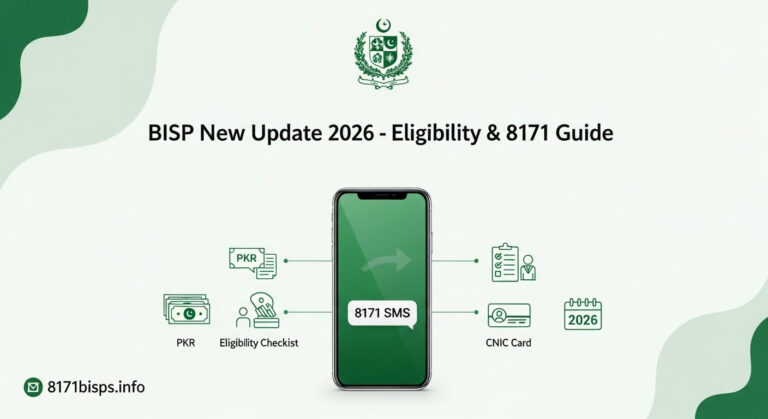
Method 1 — SMS (Fastest): Send your 13-digit CNIC number (no dashes) to 8171. Result arrives in seconds. Free of charge.
Method 2 — Online Portal: Visit 8171 enter your CNIC, complete the CAPTCHA, click Submit. Instant result.
Method 3 — In Person: Visit your nearest BISP Tehsil Office with your original CNIC. Staff will show your full score and record.
The one rule to know: Your PMT score must be 32 or below to qualify for BISP cash assistance. Lower score = more poverty = higher priority. It works the opposite of exam marks.
BISP Helpline (free): 0800-26477
Why PMT Score Check Online Confuses So Many Families
You send your CNIC to 8171. The reply says “Not Eligible.” But you know your family is struggling. So what does this number actually mean? Nobody explains it.
Or the screen says “Under Verification” and you wait for weeks with no payment and no answer.
This guide does not just explain how to do a PMT Score Check Online — it explains why your score is what it is, when it is wrong, and exactly what you can do about it.
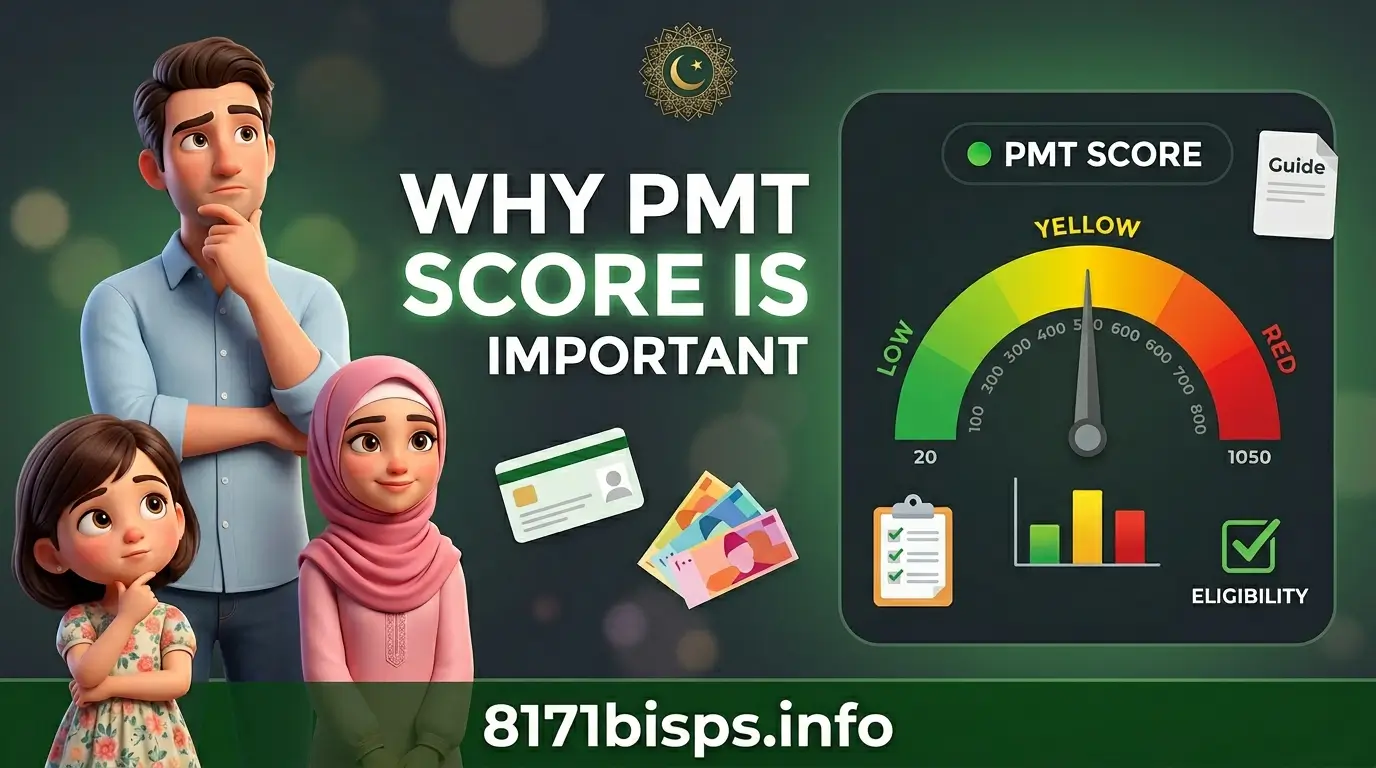
What Is a PMT Score?
PMT stands for Proxy Means Test. It is a number between 0 and 100 that measures your household’s poverty level. The data behind it comes from the NSER (National SocioEconomic Registry) — the survey BISP field workers conducted when they visited homes across Pakistan.
The most important thing most people get backwards: a lower score means more poverty and higher eligibility. This is not like school marks. A score of 20 means extreme need. A score of 50 means the system considers your household financially stable.
The government uses this indirect measurement — rather than simply asking your income — because declared income is easy to misreport. Proxy indicators like home structure, assets owned, and number of dependents are harder to fake.
PMT Score Ranges at a Glance:
| PMT Score | What It Means | BISP Eligibility |
| 0 – 22 | Extreme poverty | Fully eligible |
| 23 – 32 | Significant poverty | Eligible |
| 33 – 40 | Borderline Sirf Taleemi Wazaif | Sirf Taleemi Wazaif |
| 33 – 40 | stable | Eligible nahi |
How to Do a PMT Score Check Online — All 3 Methods in Detail
Method 1: SMS via 8171 (Best for Rural Areas)
Step 1: Open your phone’s messaging app.
Step 2: Type your 13-digit CNIC number with no dashes and no spaces. Example: 4210112345678
Step 3: Send to 8171. This is completely free on all networks.
Step 4: Read the reply carefully. It arrives within seconds.
What each reply means:
- “Eligible” — Your PMT score is within range. Wait for payment cycle notification.
- “Not Eligible” — Your score is above the threshold, or your survey data has errors. These are two very different situations — see Section 5.
- “Under Verification” — Your NSER dynamic survey is still being processed. If this continues beyond one month, visit the tehsil office in person.
- “Survey Incomplete” — You must visit a BISP Tehsil Office to complete your registration. The SMS check alone cannot fix this.
Method 2: PMT Score Check Online at 8171.bisp.gov.pk
Step 1: Open your browser and go to 8171.bisp.gov.pk — this is the only official portal. Any other website claiming to show your PMT score is unofficial.
Step 2: Enter your 13-digit CNIC without dashes. Double-check every digit. One wrong number returns someone else’s record.
Step 3: Complete the CAPTCHA verification. If the image is unclear, refresh the page and try again.
Step 4: Click Submit. Your PMT score, eligibility status, and survey completion status will appear on screen.
Method 3: Visit BISP Tehsil Office (Most Reliable)
Use this method when the online result is unclear, when you want to correct wrong data, or when you have been “under verification” for more than a month.
Bring with you: your original CNIC and a photocopy, basic household information (number of members, ages), and any supporting documents such as a disability certificate, widow’s death certificate, or recent utility bill.
The staff can pull up your complete NSER record, show you the exact score, identify data errors, and initiate a re-survey if your information is outdated or incorrect.
Realistic timelines:
- SMS and online portal result: instant
- Data update or re-survey: officially 7–14 working days, realistically 3–6 weeks
- Formal appeal decision: expect 4–8 weeks in most cases
PMT Score Check Online Shows “Not Eligible” — 6 Hidden Reasons Nobody Mentions
Getting a “not eligible” result does not always mean you are genuinely ineligible. Here are the real reasons your score may be higher than it should be — and what to do about each.
- Your survey data is years old. The NSER survey was done at different times in different districts. If your household’s situation has worsened since then — job loss, death of a breadwinner, new dependents — the system does not know unless you request a dynamic survey update. This is free and is your right.
- Old assets are still counted. A motorcycle, freezer, old television, or air conditioner recorded during the original survey still raises your PMT score — even if broken, sold, or no longer in the household. Request a data correction at BISP with any proof you have.
- A previous household member’s assets were counted. If a brother, relative, or tenant was living with you during the survey and owned a vehicle or other assets, those were counted as part of your household. If they have since moved out, this is correctable.
- Someone answered the survey on your behalf — incorrectly. If you were not home when the field worker came and a neighbor or relative provided information, the data may contain errors — including assets or land that don’t belong to you. You can file a correction.
- A family member who worked abroad was recorded. Even temporary overseas employment is treated as a higher-income indicator in the NSER data. If that situation has changed, you can contest it with documentation.
- The formula is secret — so small details matter more than you realize. BISP has never publicly released the exact PMT formula. It uses over 23 variables, and the weight assigned to each is not disclosed. This is why seemingly minor details — province of residence, number of children in school, type of cooking fuel — can affect your score in ways that are not obvious.
Who Qualifies for BISP — The Exceptions Most Guides Miss
The standard threshold is a PMT score of 32 or below. But there are important exceptions.
Widows: If your husband has passed away and you have a death certificate, BISP can assess you under a relaxed threshold of up to 35. You must bring the death certificate to the BISP Tehsil Office to apply this exception — it does not happen automatically.
Disabled household members: A registered disability through NADRA significantly lowers the PMT score in the system. A valid disability certificate is required. If a family member is disabled but not registered with NADRA, that benefit is lost.
Children’s education stipends (Taleemi Wazaif): If your PMT score falls between 33 and
40 — above the cash assistance threshold — your school-age children may still qualify for Taleemi Wazaif education stipends. The eligibility threshold for this program is slightly higher than for direct cash payments. Do not assume a borderline score means no benefit at all.
Real Scenarios — How PMT Score Check Online Plays Out
Scenario A — Straightforward success:
Amna is a widow in Sindh with four children, no income, and a rented home. Her NSER survey was done 18 months ago and recorded her situation accurately. Her PMT score is 21. She sends her CNIC to 8171, gets “eligible,” completes biometric verification at her local BISP office, and begins receiving quarterly payments. Her survey was recent, accurate, and included her death certificate for the widow’s exemption.
Scenario B — Complicated but fixable:
Khalid is a daily wage laborer in Punjab earning Rs. 15,000–20,000 per month with no steady employment. Three years ago during the NSER survey, his brother was temporarily living with him and owned a motorcycle. That motorcycle was recorded as a household asset. His brother moved out a year later, but the record was never updated. Khalid’s current PMT score is 38 — just above the threshold. His children still qualify for Taleemi Wazaif, but he cannot receive cash assistance. He visits the tehsil office, requests a dynamic survey update removing his brother from the household, and waits five weeks for his corrected score to drop below 32.
Scenario C — Rejected due to data error:
Rubina lives in a rural area in KPK with genuine poverty — no income, a mud-built home, no appliances. When the field worker came, Rubina was not home. Her neighbor provided information and accidentally mentioned farmland that belongs to a distant relative, not Rubina’s household. This pushed her PMT score to 44. She checks 8171 and gets “not eligible” with no explanation. Her path forward is to visit the BISP Tehsil Office with any land records proving she is not the owner, file a formal written complaint, and request a re-survey. The process takes 2–3 months, but it is the only legitimate route. She keeps a copy of every document she submits.
Surprising Insight — Why “Under Verification” Is Sometimes Protecting You
Most people assume “under verification” is purely a bureaucratic delay. It is sometimes that — but it is also a safeguard. When the system detects a mismatch, such as a CNIC number that does not align with NADRA records, it pauses payments rather than approving them incorrectly. A wrongly approved payment can later result in a fraud flag and permanent disqualification. The frustration of waiting is real, but the pause often protects you from a worse outcome.
Similarly, the PMT formula being secret is not just a bureaucratic quirk. It is deliberately designed to prevent gaming. If the exact weights were public, people would know precisely which assets to hide or misreport. The indirect measurement system — looking at roof material, cooking fuel, number of school-age children — is harder to fake than a simple income declaration.
What PMT Score Check Online Cannot Solve — Honest Limitations
The PMT system has real gaps that are worth knowing before you put all your hope into it.
It does not respond to sudden crises. A flood, a medical emergency, or a sudden job loss does not update your PMT score. The system reflects your situation from the last survey, not today.
It does not guarantee payment timing. Being eligible and receiving payment on schedule are two separate things. Biometric failures, payment backlogs, and processing delays affect even fully eligible households.
It cannot help those without CNICs. Some of Pakistan’s poorest individuals — elderly people, those with unregistered births — have no CNIC and cannot enter the system at all.
Corrections take time. There is no emergency channel. If your data is wrong, the correction process takes weeks to months regardless of how urgent your situation is.
PMT Score Check Online — Your Action Checklist
- Send your 13-digit CNIC (no dashes) to 8171 right now — it takes 30 seconds and costs nothing
- If “not eligible,” do not accept it as final — check whether your NSER data is accurate
- If “under verification” for more than one month — visit the BISP Tehsil Office in person
- Gather documents before going to the office: CNIC, household details, utility bills, any disability or death certificates
- Request a dynamic survey update at the tehsil office if your data is outdated — this is free
- File a written complaint if your score seems incorrect — ask for a receipt and follow up in 3–4 weeks
- If eligible but no payment — complete your biometric verification at the BISP office. Many approved families miss this final step.
- Call the free helpline if stuck: 0800-26477
- Never pay anyone to change your score — no agent can do this, and trying will get you permanently disqualified
Related Guides
- How to Check BISP Payment Status Online by CNIC
- Benazir Taleemi Wazaif 2026 — Eligibility and How to Apply
- BISP Dynamic Survey — What It Is and When to Request One
- 8171 Web Portal — Complete Walkthrough for New Users
- What to Do If Your BISP Payment Is Blocked or Delayed
About This Guide
This article is based on research into official BISP documentation, NSER framework materials, and government-published eligibility guidelines as of May 2026. I am not a BISP official or government advisor. This guide exists to help ordinary Pakistani families understand a system that affects millions of lives but is rarely explained clearly. For your specific situation, the BISP Tehsil Office in your district and the official helpline at 080026477 are always your most reliable sources. Program details can change — verify current information through official channels before acting.
About the Author
This guide was researched and written by an independent content researcher focused on Pakistani government schemes, personal finance topics, and practical consumer guides. The goal is to turn complex official information into simple, accurate, and useful advice for everyday families.
Content is reviewed regularly to reflect policy updates, eligibility changes, and new application processes whenever reliable information becomes available.