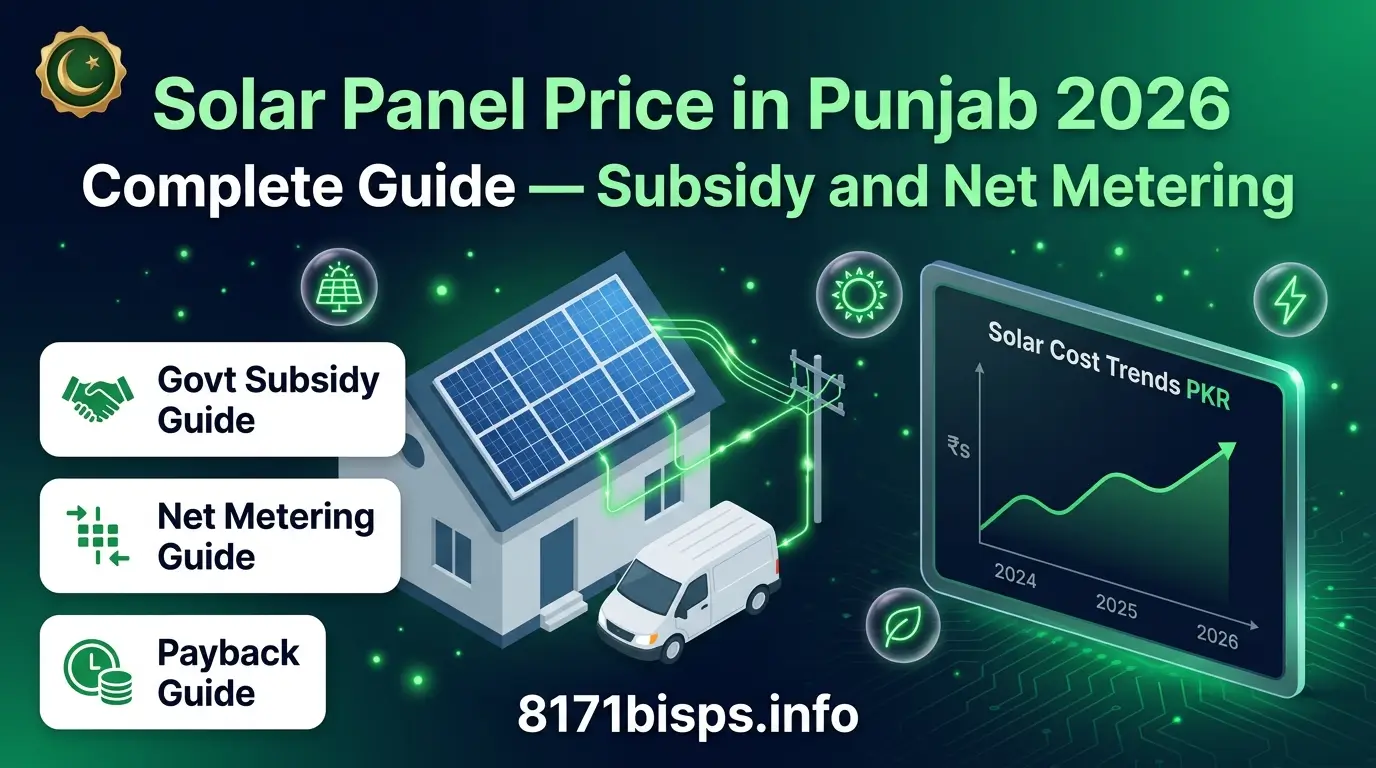
Solar Panel Price in Punjab 2026 – Complete Guide with Subsidy & Net Metering
Solar Panel Price in Punjab 2026: Real Costs & Hidden Challenges
Quick Price Overview (April 2026)
| System Size | Price Range | Monthly Savings | Payback Period |
| 3kW Hybrid | Rs. 420,000–550,000 | Rs. 5,000–8,000 | 5.5–9 years |
| 5kW On-Grid | Rs. 600,000–800,000 | Rs. 10,000–15,000 | 2.5–3.5 years |
| 5kW Hybrid | Rs. 850,000–1,100,000 | Rs. 10,000–15,000 | 3.5–4.5 years |
| 10kW On-Grid | Rs. 900,000–1,200,000 | Rs. 25,000–35,000 | 2.5–3.5 years |
Bottom line: Tier-1 solar panels cost Rs. 28–40 per watt in Punjab (April 2026). A complete 5kW system pays back in 2.5–3.5 years through electricity bill savings alone.
The Real Problem: Why Families Are Confused
Your electricity bill keeps climbing. Load shedding frustrates you daily. You start researching solar, and you find prices ranging wildly. One dealer quotes Rs. 600,000. Another quotes Rs. 900,000 for the same thing.
The confusion costs you money. Families either overpay or choose cheap systems that fail in 2–3 years.
This guide explains what actually drives solar prices in Punjab, based on real market data from April 2026, NEPRA regulations, and actual customer experiences.
Why Solar Became Critical in Pakistan
Timeline & Growth:
- 2015: Pakistan introduced net metering policy
- 2024–2025:2 million kilowatts of rooftop solar installed
- June 2025: Over 6 gigawatts feeding into national grid (NEPRA data)
- Today: Punjab leads all provinces in solar adoption
Two reasons electricity pushed people to solar:
- Electricity became unsustainable: WAPDA rates increased 155% between 2021–2024. A family using 500 units/month now pays Rs. 25,000–30,000 monthly.
- Solar got affordable: Panel prices dropped 40% since 2022. Tier-1 panels that cost Rs. 60+/watt in 2022 now cost Rs. 28–40/watt.
How net metering works:
You generate power during day → Export excess to grid → WAPDA credits you at Rs. 19–26 per unit → Use credit at night → Lower bills.
Who Qualifies for Solar
Official Eligibility
✓ You have a DISCO electricity connection (LESCO, IESCO, FESCO, etc.)
✓ You consume grid electricity (off-grid doesn’t qualify for net metering)
✓ You have roof/ground space for panels
✓ Your roof is structurally sound
Best Candidates
Monthly electricity consumption: 300–1,000+ units
Why: Monthly bills justify upfront cost. Low consumption = weak ROI.
Common Misconceptions (Truth Check)
| Myth | Reality |
| “Solar only works in summer” | Winter output is 40–50% of summer. Still generates in December. |
| “I need batteries for solar” | Optional. Net metering lets you export daytime, import night. Batteries only needed if you want zero grid dependency. |
| “All solar systems are expensive” | Start with 3kW (Rs. 420,000+). Expand later if needed. |
| “Solar works during cloudy days” | Yes, but output drops 20–40%. Still generates. |
| “N-Type panels are mandatory” | No. Standard monocrystalline works fine. N-Type better for extreme heat (45°C+). |
The Hidden Bottleneck
Net metering approval takes 60–90 days in Punjab. Applications sometimes get stuck or rejected because:
- Transformer can’t handle bidirectional power flow (rare)
- Neighborhood load already high
- DISCO has approval backlog (4,000+ pending as of June 2025)
Solar Panel Prices in Punjab (April 2026)
Per-Watt Cost by Brand & Technology
| Brand | Technology | Wattage | Price/Watt | Best For |
| Longi | Monocrystalline PERC | 585W | Rs. 32–35 | South Punjab (extreme heat) |
| Jinko Tiger Neo | N-Type Bifacial | 585W | Rs. 35–40 | Punjab (high efficiency) |
| Canadian Solar | Monocrystalline | 585W | Rs. 37–42 | Long warranty needs |
| JA Solar | N-Type HPBC | 580W | Rs. 34–38 | Balance of cost & efficiency |
Key insight: Longi excels in extreme heat (45°C+). Jinko has best availability in Lahore and Rawalpindi.
Price Variations by City (Punjab)
| City | Panel Type | Price Range |
| Lahore | Longi 585W | Rs. 23,500–25,000 |
| Lahore | Jinko Tiger 585W | Rs. 24,000–26,000 |
| Rawalpindi | Longi 585W | Rs. 24,500–25,500 |
| Peshawar | Longi 585W | Rs. 24,500–25,500 |
| Multan | Longi 585W | Rs. 25,000–26,000 |
Why variation? Transport costs, importer presence, local demand.
Complete System Costs
Panels are only 30–35% of total cost. Inverter, wiring, structure, labor, and approvals make up the rest.
3kW Hybrid System
- Price: 420,000–550,000
- Components: 5–6 panels, 3kW inverter, basic wiring, battery bank
- Powers: One inverter AC, fans, lights, water pump (daytime), battery backup (nighttime)
- Monthly savings: 5,000–8,000
- Best for: Homes using 250–400 units/month
5kW On-Grid System (Most Popular)
- Price: 600,000–800,000
- Components: 9 panels, 5kW string inverter, metal structure, DC wiring, net metering setup
- Powers: One 1.5-ton inverter AC, refrigerator, water pump, fans, lights
- Monthly savings: 10,000–15,000
- Payback:5–3.5 years
- Best for: Average families (400–700 units/month)
5kW Hybrid System (Grid + Backup)
- Price: 850,000–1,100,000
- Additional cost: Battery bank (Rs. 250,000–350,000)
- Backup time: 3–5 hours during outages
- Payback:5–4.5 years (batteries delay ROI)
- Best for: Families wanting backup power
10kW On-Grid System (High Consumption)
- Price: 900,000–1,200,000
- Components: 18 panels, 10kW inverter, commercial-grade wiring
- Powers: 2–4 inverter ACs, kitchen appliances, office equipment
- Monthly savings: 25,000–35,000
- Payback:5–3.5 years
- Best for: Large homes (1,000+ units/month), small shops
Installation Process
Site Assessment
Proper installers measure:
- Roof space free of shadows
- Structural capacity
- Load calculation
- East-west orientation
Real problem: Many installers skip this and oversize systems. You pay for capacity you don’t use.
Component Selection
Panels: Buy Tier-1 brands. Avoid B-grade (degrade 40% faster despite 15–20% cost saving).
Inverter options:
- String inverter (Rs. 80,000–120,000): Cheapest, most common. Single failure stops system.
- Microinverter (Rs. 120,000–180,000): Each panel independent. Better for shaded roofs.
- Hybrid inverter (Rs. 150,000–250,000): For hybrid systems with batteries.
Budget for rest: Rs. 80,000–120,000 (wiring, structure, meter, labor)
Installation Timeline
Actual timeline (not dealer promises):
- Days 1–2: Structural work
- Days 3–5: Panel installation
- Days 6–8: Inverter setup, safety testing
- Days 9–15: DISCO inspection & paperwork
- Weeks 3–12: Approval waiting (60–90 days)
Pro tip: Install in winter (October–March). Summer installations face thermal stress and installer delays.
Net Metering Approval
After installation, DISCO issues “green meter” (bidirectional meter). Process:
- Submit installation certificate
- DISCO conducts site inspection
- DISCO issues green meter agreement
- Net metering becomes active
Hidden reality: 60–90 days typical. Some areas: 6+ months.
What Other Articles Don’t Mention
Policy Uncertainty
Net metering buyback rates are under government review. Proposed change: reduce rate from Rs. 26/unit to Rs. 10/unit.
Impact: Would stretch payback from 2.5 years to 5+ years.
Status: Delayed after public backlash, still being debated.
What to do: Get approval quickly. Existing approvals won’t change. New approvals may face lower rates.
Roof Space Reality
5kW system needs 200–250 sq ft shadow-free space.
Common issues:
- Flat roofs seem ideal but aren’t (drainage problems)
- Old concrete roofs can’t handle weight (Rs. 30,000–50,000 repairs needed)
- Trees/water tanks create unexpected shadows
Summer Overproduction
June–July: 10kW system can generate 50+ units daily. If consuming only 20, 30 units exported at Rs. 19–26/unit.
But: Grid instability in South Punjab causes inverters to auto-disconnect. You lose export credit those days.
Installer Quality
No mandatory certification exists in Pakistan. Bad installations cause:
- Inverter failure within 2–3 years (wrong DC wiring)
- 20–30% underperformance (poor connections)
- Roof leaks (bad mounting seals)
How to avoid: Get AEDB registration, previous customer references, written labor warranty, insurance certificate.
Challenge 5: Battery Misconception
Lithium batteries cost Rs. 300,000–400,000 but last 10+ years. Lead-acid cost Rs. 80,000–120,000 but last 5 years.
Real choice: Skip batteries. Use net metering for nighttime power. Batteries only needed if you want zero grid dependency.
Real Examples (Success, Difficult, Rejection)
Case 1: Success Story (Lahore)
Family: Middle-class, Defence, 600 units/month = Rs. 28,000 bill
| Metric | Details |
| System | 5kW on-grid |
| Cost | Rs. 700,000 |
| Installation | 8 days |
| Approval | 75 days |
| Current bill | Rs. 4,000–6,000 |
| Monthly savings | Rs. 22,000 |
| Payback period | 31 months (2.6 years) |
| 25-year savings | Rs. 6.6 million |
Outcome: Typical success. Most middle-class Lahore families see this result.
Case 2: Difficult Installation (Multan)
Property: 30-year-old house, 700 units/month
Complications:
- Roof needed structural repair: Rs. 40,000
- Transformer upgrade needed: Rs. 25,000
- Monthly cleaning contract: Rs. 2,000/month (dust)
| Metric | Details |
| Total cost | Rs. 1,050,000 (with repairs) |
| Monthly savings | Rs. 25,000 |
| Payback period | 42 months (3.5 years) |
| Challenge | Old infrastructure adds 20–30% extra cost |
Lesson: Budget extra for old houses. South Punjab faces more dust issues.
Case 3: Rejection Scenario (Peshawar)
Situation: Installed 5kW system (Rs. 650,000), DISCO rejected net metering.
Reason: Neighborhood transformer couldn’t handle bidirectional flow. DISCO required transformer upgrade (6+ months wait).
Current status: System only uses self-consumed power (≈2kW). Doesn’t pay for itself. Will take 6+ years when transformer upgrades.
Lesson: Rare, but real. Some neighborhoods can’t approve systems immediately.
Why This System Actually Works
Most people calculate payback using today’s electricity rates. They think: “Okay, neutral after 2.6 years.”
Wrong calculation. Here’s the real math:
WAPDA rates increase 10–15% annually. Your solar cost is fixed.
| Year | Annual Bill (Without Solar) | Annual Savings (With Solar) |
| Year 1 | Rs. 336,000 | Rs. 132,000 |
| Year 2 | Rs. 387,000 (15% increase) | Rs. 152,000 (15% increase) |
| Year 3 | Rs. 445,000 (15% increase) | Rs. 175,000 (15% increase) |
| Year 4 | Rs. 512,000 (15% increase) | Rs. 201,000 (15% increase) |
| Year 5 | Rs. 590,000 (15% increase) | Rs. 231,000 (15% increase) |
After 2.6 years, payback is done. But system keeps making money.
Over 25 years, that 5kW system saves Rs. 6.6 million (accounting for rising rates).
Another hidden benefit: Load shedding relief. Grid down = solar still powers you. This reliability isn’t in numbers.
What Solar Doesn’t Solve
| Limitation | Reality |
| Night electricity | Solar doesn’t work at night. Need net metering or batteries. |
| Backup during grid outage | On-grid system (cheapest) provides zero backup. Need hybrid. |
| High simultaneous loads | Running 3 inverter ACs together exceeds 5kW capacity. Need 7.5–10kW. |
| Industrial use | Factories need special equipment (harmonic distortion). Costs 30% more. |
| Winter water pumping | Winter sun weaker. Pumps needing 2kW might only get 0.8kW. |
Your Action Checklist
Before Contacting Installers
- Measure shadow-free roof space
- Get 3 months electricity bills
- Identify your DISCO (LESCO, IESCO, FESCO, etc.)
- Check if neighbor has solar (approval speed indicator)
Getting Quotes
- Contact 3 installers
- Request written specifications (not just price)
- Ask for site assessment (most free)
- Add 20% buffer to quoted price
Installer Verification
- Confirm AEDB registration
- Call 2 previous customers
- Get insurance certificate
- Request 5-year installation warranty (in writing)
- Ask about monitoring app
Before Installation
- Structural roof survey (especially if older than 15 years)
- Confirm DISCO net metering eligibility
- Check if transformer has spare capacity
- Document everything in writing
After Installation
- Get completion certificate
- Apply for net metering immediately
- Set up monitoring to track daily output
- Keep all warranty documents
Frequently Asked Questions
Q: Will solar work during monsoon?
A: Yes, but output drops 30–50%. Panels still generate. Monsoon season (July–August) sees reduced production in Punjab.
Q: What if I move house? Can I take solar with me?
A: Panels can be removed, but labor cost (Rs. 30,000–50,000) and installation at new location (Rs. 50,000+) make it expensive. Usually not worth it.
Q: Do panels need maintenance?
A: Minimal. Dust accumulation in summer can reduce output 10–20%. Annual cleaning (or monthly in dusty areas) helps. Cost: Rs. 1,500–3,000/month for professional cleaning.
Q: What if my roof is south-facing instead of north?
A: Both work fine in Pakistan. North-facing loses 5–10% output but still viable. East or west-facing roofs are optimal.
Q: Can I install solar if I’m renting?
A: No. Net metering requires property ownership proof. Installers won’t proceed without it.
Q: What’s the difference between on-grid and hybrid?
A: On-grid (cheaper): No backup. Grid down = no power. Hybrid: Has battery backup (Rs. 250,000+ extra). Powers you during outages.
Q: Will my electricity bill disappear?
A: For 5kW system: Bill reduces 70–90%, rarely drops to zero. Night consumption still costs. Hybrid + larger system (10kW+) gets closest to zero.
Q: How often do panels fail?
A: Tier-1 panels last 25+ years. Failure rate <1%. Main risk: bad installation (wrong wiring, poor connections).
Q: Can NEPRA change net metering rules for existing customers?
A: No. You keep current rates for your agreement period (typically 10 years). New approvals may face lower rates.
Q: Is solar still worth it if net metering rates drop to Rs. 10/unit?
A: Yes. Payback extends to 4–5 years instead of 2.5 years, but still profitable. Grid rates rising 10–15% annually makes solar viable long-term.
The Bottom Line
Solar panel prices in Punjab are at historic lows. A quality 5kW system costs Rs. 600,000–800,000 and pays back in 2.5–3.5 years.
This isn’t speculation—it’s math based on:
- Current WAPDA rates (Rs. 45–65 per unit)
- Current panel prices (Rs. 28–40/watt)
- Real customer installations (2025–2026)
The catch: Don’t expect installers to explain all this. They quote price. You need to understand the full picture.
Best next step: Get site assessment from 3 installers (free). Compare specifications, not just price. Verify their track record with previous customers. Then decide.
Your Next Move
This week:
- Call 2–3 local installers and request site visit
- Get written quote with component details
- Call previous customers of each installer
- Check DISCO for net metering eligibility
This is too important a decision to rush. Take 2 weeks to gather information. The payback difference between a good installation and a bad one is Rs. 200,000+ over 25 years.
Questions about solar in Punjab? Get answers from actual users. Reddit communities, Facebook groups (search “Solar Panel Pakistan”), and local installer forums have real experiences. Read multiple sources before committing.
Your electricity bills aren’t going down. Solar is the most practical hedge against rising costs. Start today.
Last updated: April 2026
Data sources: NEPRA Regulations, AEDB, market surveys from 4 major solar platforms, real customer installations
This article: Research-based, no affiliate links, honest about limitations
About the Author
This guide was researched and written by an independent content researcher focused on Pakistani government schemes, personal finance topics, and practical consumer guides. The goal is to turn complex official information into simple, accurate, and useful advice for everyday families.
Content is reviewed regularly to reflect policy updates, eligibility changes, and new application processes whenever reliable information becomes available.