BISP Registration Check by CNIC 2026 – Step-by-Step Online & SMS Guide
The Frustration Every Eligible Family Knows
You have heard of BISP. Maybe a neighbour is already collecting payments every quarter. You wonder: does our family qualify? You search online. You find a list of requirements that sounds simple. But when you actually try — the survey team never arrives, the office staff speak too fast, the 8171 SMS returns a confusing code, or you wait months and hear nothing back. That gap between how BISP sounds on paper and how it actually works in real life is exactly what this guide addresses.
This is not a marketing article. There are no exaggerated promises here. This guide is based on research across official BISP documents, World Bank social protection reports, and documented community experiences — and it will tell you the things most other guides leave out.
By the end, you will know:
- How the 8171 eligibility check actually works
- What the PMT score is and why it matters more than any official list
- Why so many deserving families get rejected — and what to do about it The realistic timeline, not the official one
What Is BISP and Why Does It Exist?
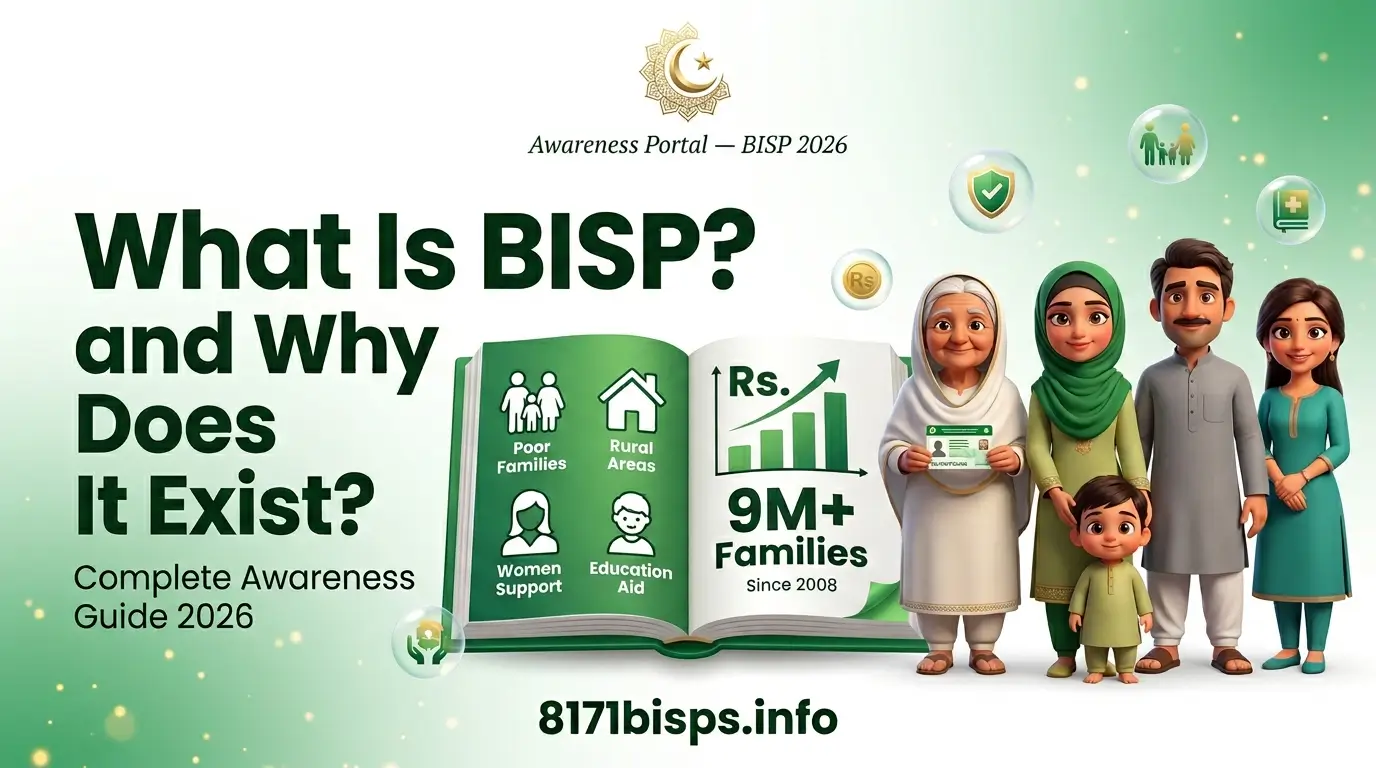
The Benazir Income Support Programme (BISP) is Pakistan’s largest federal cash transfer programme for low-income families. It was launched in 2008, named after Shaheed Mohtarma Benazir Bhutto, against a backdrop of rising food prices and inflation that had seriously weakened the purchasing power of poor households since around 2005.
One thing most guides skip: BISP was designed from the beginning to be women-first. Payments go directly to the female member of the household — not the male head. This was a deliberate policy decision, grounded in research showing that money given to women is more likely to be spent on children’s food, health, and education.
The programme has survived multiple government changes — PPP, PML-N, PTI, back to PML-N — which is itself a sign of its institutional stability. Budget allocations have grown steadily over the years. According to recent budget documents, BISP’s allocation for 2025– 26 is reportedly around Rs. 716 billion, approximately a 20% increase over the prior year — though exact figures may be revised as budget implementation progresses.
Today, BISP is estimated to serve somewhere around 9 million families, with the government targeting roughly 10 million by the end of 2025.
BISP 8171 Eligibility Check — Start Here Before Anything Else
Before visiting any office, check your status first. Send your 13-digit CNIC number via SMS to 8171. Or visit the official portal at 8171.bisp.gov.pk. Enter your CNIC and check whether your household is registered, eligible, or flagged for any issue. This one step saves thousands of families unnecessary trips to offices. Many households are already in the system — they just need an update, not a fresh application.
What your SMS response might mean:
- Eligible / Payment Pending” — you are registered and approved; check your payment schedule
- Not Registered” — you need to complete the NSER survey; see the steps below
- Under Verification” — your survey is being processed; this is normal, not a rejection
- 933 Error” — your CNIC or household record is incomplete; visit your Tehsil office with original documents to resolve it
The 933 error is one of the most misunderstood responses. It is not a permanent rejection. Most cases can be resolved at the office within a single visit.
Who Actually Qualifies for BISP Kafaalat And the Hidden Layer
The official eligibility criteria list is straightforward enough. But there is a layer underneath it that almost no guide properly explains: the PMT score.
What Is the PMT Score?
PMT stands for Proxy Means Test. When a survey team visits your home — or when you complete the NSER survey at a Tehsil office — they collect data on your household. Income, housing quality, utilities used, assets owned, number of dependents, education level, and more. This data goes into a formula. The formula produces a score roughly between 0 and 100. A lower score indicates greater poverty. Your eligibility for BISP is decided almost entirely by where your score lands. Based on available information, the approximate score ranges work roughly like this:
| Situation | Estimated PMT Score | Eligible? |
| Widow, no assets, several children | Around 18–22 | Yes |
| Low-income renting family, informal work | Around 26–32 | Likely yes |
| Borderline — some assets or income | Around 32–37 | Only if disabled member |
| Government employee in household | Above 40 | No |
These ranges are approximate and based on reported examples. Your actual score depends on your specific household data. The current eligibility cutoff is generally reported as 32 for regular families, and around 37 for households with a differently-abled member — though BISP reserves the right to revise this based on available budget.
Who Is Formally Excluded
According to BISP policy, households are typically ineligible if any member:
- Is employed by the government, military, or any government-affiliated agency
- Draws a pension or post-retirement government benefit
- Owns more than approximately 3 acres of farmland
- Owns more than roughly 80 square yards of residential land
- Holds a valid passport or visa (used as a proxy for economic capacity)
Note that these rules are applied as declared at the time of survey. If your circumstances change after registration — in either direction — it must be reported.
Who Often Doesn’t Realise They Can Qualify
- Widows and divorced women — with relaxed application pathways
- Registered disabled individuals — with a higher PMT cutoff of approximately 37
- Transgender citizens — BISP Board policy now includes them with fully relaxed PMT restrictions
- Previously rejected families — if circumstances have genuinely changed, reapplication is possible
How to Apply for BISP — Step by Step
Step 1: Confirm CNIC Is Current at NADRA
Before anything else, ensure your CNIC accurately reflects your current marital status, address, and family composition. A mismatch between your CNIC and your actual situation is one of the most common silent reasons applications fail. Women who became widowed, divorced, or married since their last CNIC update — please priorities this step.
Step 2: Gather Your Documents
Bring to the office:
- CNICs of all adult household members
- B-forms for children
- Any documentation of special circumstances (disability, widowhood, divorce)
Step 3: Complete the NSER Survey in Person
BISP registration cannot be done online. Anyone offering online registration for a fee is running a scam.
The survey must be completed either through a BISP field team visiting your home, or by going in person to a Benazir Registration Centre at your nearest BISP Tehsil office. The surveyor will ask about income, housing, assets, and family members. Answer honestly and consistently — inconsistencies are cross-checked against NADRA data and can trigger rejection.
One practical challenge nobody mentions: field survey teams do not always reach remote areas promptly. In many cases, visiting the Tehsil office yourself is faster than waiting for a team to come to you.
Step 4: Wait for PMT Score and Eligibility Decision
Your household data is analysed and cross-verified with NADRA. This is not instant. Most families receive an SMS notification at the mobile number registered during the survey. Check 8171 periodically. “Under Verification” is a normal status — it means processing is ongoing.
Step 5: Biometric Verification and Bank Setup
If approved, you will be called for biometric verification. Payments are disbursed through partner banks — reportedly HBL in Punjab, Sindh, and Balochistan, and Bank Alfalah in KPK, GB, and AJK — via a smart card and biometric thumb impression system.
Step 6: Collect Quarterly Payments
The current quarterly payment under Benazir Kafaalat is Rs. 13,500 (raised from Rs. 10,500 as of approximately January 2025), which works out to around Rs. 4,500 per month. The stipend is nominally linked to the Consumer Price Index, though the adjustment has historically lagged real inflation.
Realistic Timeline — Not the Official Version
| Phase | Realistic Duration |
| CNIC correction at NADRA (if needed) | 1–3 weeks |
| NSER survey completion | 2–6 weeks depending on location |
| PMT scoring and NADRA verification | 6–14 weeks |
| Bank setup and biometric | 2–4 weeks |
| Total (best case) | 2–3 months |
| Total (typical) | 4–6 months |
Plan for the realistic range. Families who expect a few weeks and experience months often assume something went wrong — when in fact the process is simply slow.
What Most BISP Guides Don’t Tell You
Awareness is the biggest barrier — not eligibility.
Research suggests that close to half of unregistered eligible households simply don’t know how to register, and only around one in four know how to contact BISP directly. You are not alone in being confused.
A single asset can change your score.
One documented pattern: a family receives payments, a son buys a motorbike, the motorbike is registered in the family name, the PMT score rises above the cutoff, and payments stop — with no explanation sent. Any new asset, even a working vehicle, can affect your score. Report changes proactively.
Geographic access is unequal.
Available data suggests Sindh has historically had a much higher ratio of beneficiaries per capita than Punjab. This reflects both real poverty differences and political factors that have been publicly documented and criticised. If you are in a remote area, the process may simply take longer — this is a systemic issue, not something you have done wrong.
The NSER database still has gaps.
Based on World Bank reporting, approximately 2.2 million households in the bottom 40% of Pakistan’s population are still not included in NSER at all — meaning millions of genuinely eligible families have never even been surveyed. If you have never been approached for a survey, you may need to initiate contact yourself.
Scams are widespread.
There is no official third-party registration service. Anyone asking for money to help you apply, or sending you an unofficial app or SMS, is committing fraud. Report to FIA Cybercrime at 1991 or the PTA Complaint Portal.
Three Real-World Cases
Case 1 The Smooth Application (Rukhsana, rural Sindh)
Rukhsana’s husband works as a daily-wage labourer. They rent a small home with three children. No government employment in the family, no land, no vehicle. She sends her CNIC to 8171, receives “Not Registered,” and visits the local Tehsil office. A Dynamic Registration Centre is active that week. Six weeks later, an SMS confirms eligibility. Biometric verification at HBL follows. First payment collected approximately two months after her first office visit.
This smooth scenario exists. It requires that the CNIC is current, the survey happens quickly, and no data issues arise.
Case 2 The Stopped Payments (Nasreen, 52, KPK widow)
Nasreen had been receiving payments for two years when they suddenly stopped. Her son had purchased a small motorbike — registered in the household’s name — which the system flagged as an asset. Her PMT score crossed the cutoff. She had not been notified. After visiting the Tehsil office, she underwent a re-survey and provided documentation showing the motorbike is a working income tool. Her score was recalculated and payments resumed approximately three months after they stopped.
The lesson: report any new asset before the system flags it. Waiting for an SMS that may never come is riskier than being proactive.
Case 3 The Genuine Rejection (Farida, 44, Lahore)
Farida’s husband suffered a stroke and cannot work. The family is genuinely struggling. But her eldest son is a government school teacher. Under current BISP policy, any household member in government employment disqualifies the entire household — regardless of how much that person actually contributes to family income. Farida’s application was rejected. She could explore whether her son qualifies to formally separate his household record through NADRA — but this is complex and not always practical. BISP is likely not the right programme for her situation. She should look at provincial-level welfare programmes and disability support pathways instead. Knowing when to stop pursuing one door and look for another is itself useful knowledge.
Surprising Insights Most People Miss
The female-recipient policy is based on evidence, not politics.
Research on cash transfer programmes across multiple countries consistently shows that money received by women is more likely to reach children. BISP’s design reflects that body of evidence, not just political optics.
Before NSER, parliamentarians nominated their own constituents for payments.
There was no formula, no survey, no data. The PMT system replaced that entirely. It is imperfect — some genuinely poor households score higher than expected due to how the formula weights certain factors — but it is dramatically fairer than political nomination.
The school enrolment connection.
BISP is reportedly developing conditional payments tied to children’s primary school enrolment under the Waseela-e-Taleem initiative. If you are an existing Kafaalat beneficiary, enrolling your children and reporting enrolment to BISP may eventually unlock additional payments. Ask at your Tehsil office about the current status of this initiative.
Honest Limitations What BISP Cannot Do
It is worth being clear about what this programme does not solve:
- 13,500 per quarter is not enough to move a family out of poverty — it was designed as a supplement, not a replacement for income
- BISP does not provide housing, healthcare, or job training (though Taleemi Wazaif offers some educational support — ask separately)
- If any household member holds a government job, the entire family is ineligible — even if that member lives separately
- There is no emergency payment mechanism — BISP cannot respond faster than the quarterly cycle
- Rural and remote families face longer waits due to uneven surveyor coverage
For healthcare needs, look separately at the Sehat Card Plus programme. For employment support, provincial government programmes may be more relevant.
Frequently Asked Questions
Q: Can I apply for BISP online?
No. BISP registration requires an in-person NSER survey — either at a Tehsil office or through a field team. Any website or service offering paid online registration is a scam.
Q: How do I check my BISP 8171 eligibility?
Send your 13-digit CNIC to 8171 via SMS, or visit 8171.bisp.gov.pk. The response will tell you your current registration status.
Q: What is the current BISP payment amount in 2025?
The quarterly payment under Benazir Kafaalat is currently reported at Rs. 13,500, raised from Rs. 10,500 as of approximately January 2025. This figure may be subject to revision.
Q: Why was my BISP payment stopped?
Common reasons include: a household member entering government employment, a new asset being registered in the family name, CNIC data mismatches, or failure to complete a re-survey when required. Visit your Tehsil office for a specific explanation.
Q: Can I reapply if I was rejected before?
Yes if your circumstances have genuinely changed. A re-survey will be required.
Q: What does the 933 error mean?
It means your CNIC or household record is incomplete or unverified. Visit your nearest BISP Tehsil office with original documents. It is not a permanent rejection.
Q: Can a widow apply without a male family member present?
Yes. Widows have a distinct and somewhat relaxed pathway. A female applicant can complete the process independently.
Q: Does owning a motorbike disqualify you?
Not automatically — but it contributes to your PMT score as an asset. Depending on other household factors, it could push your score above the eligibility cutoff.
Your Action Plan What to Do Right Now
- Tonight: Send your CNIC to 8171. Note the exact response.
- This week: If “Not Registered” — gather documents and plan your Tehsil office visit. If any CNIC details are outdated, go to NADRA first.
- At the office: Ask specifically for the Dynamic Registration Centre. Bring all documents. Answer survey questions honestly.
- After registration: Save the mobile number you registered. Check 8171 every 3–4 weeks for status updates.
- After approval: Report any household changes before the next survey cycle — do not wait for BISP to find out.
Official contact: bisp.gov.pk | SMS: 8171 | Toll-free helpline: 0800-02345
The process is free. If anyone asks you for money at any step, walk away and report it.
About This Guide
This guide draws on publicly available official BISP documentation, World Bank social protection research on Pakistan’s NSER coverage, government press releases, and documented community-level experiences with the application process. Figures and policies cited are based on information available at the time of writing and may be updated as the programme evolves.
This is independent research — not affiliated with BISP, any government body, or any political party. For binding decisions, always verify current details directly at bisp.gov.pk or by calling the BISP helpline at 0800-02345.
About the Author
This guide was researched and written by an independent content researcher focused on Pakistani government schemes, personal finance topics, and practical consumer guides. The goal is to turn complex official information into simple, accurate, and useful advice for everyday families.
Content is reviewed regularly to reflect policy updates, eligibility changes, and new application processes whenever reliable information becomes available.