8171 Validation 2026 – Check BISP Eligibility & Payment
What This Guide Covers
If you sent your CNIC to 8171 and got a confusing reply — or no reply at all — this guide explains what is actually happening and what to do next. It covers how the eligibility system works, why rejections happen, how to fix common problems, and how to stay safe from fraud.
How the 8171 System Actually Works
When you send your CNIC to 8171, you are not asking a person to look up your file. You are querying a database called the National Socio-Economic Registry (NSER), maintained by BISP and NADRA.
Your eligibility is based on a score calculated from a physical survey of your home — conducted at some point in the past by a field team. That score, called the PMT score (Proxy Means Test), determines whether you qualify.
This is why two families in similar circumstances can get different results. The answer depends on what was recorded during the survey, and when.
The PMT Score: What It Is and How It Works
The PMT score is a number between 0 and 100. It estimates your household’s financial situation based on observable conditions — not just income. A lower score indicates greater financial need.
The score is calculated from factors including:
- Monthly household income
- Type of housing (mud, semi-pucca, or cemented)
- Appliances owned — TV, refrigerator, air conditioner
- Vehicles owned — motorcycle or car
- Utility bills — electricity and gas
- Family size and number of dependents
- Education levels of household members
- Employment status of household members
General eligibility thresholds:
| PMT Score | Typical Eligibility |
|---|---|
| Below 32 | Likely eligible for Benazir Kafalat quarterly payment |
| 32 to 40 | May qualify for children’s Taleemi Wazaif stipends |
| Above 40 | Generally does not qualify for cash assistance |
These thresholds are based on publicly available BISP documentation and may be adjusted by the government over time. Widows, disabled persons, and transgender individuals may qualify at a slightly higher score — up to 37 in some documented cases.
Why your score might be higher than expected:
A family can be financially stretched and still receive a higher PMT score than feels right. Common reasons include:
- Owning a motorcycle, even an old or shared one
- Living in a cemented or pucca house
- Sharing a utility meter with extended family — the full bill appears on one record
- A family member holding a government job or stable salaried employment
- A son or daughter with higher education qualifications
The joint family utility bill issue is worth understanding specifically. If multiple families share one electricity meter, the combined bill is recorded against one household — which can make that household appear wealthier than it is.
“Registered” vs “Eligible”: An Important Difference
Many families see the message “registered in BISP dynamic survey” on the portal and expect payments to follow automatically. They don’t always.
Registered means your household is in the NSER database. Eligible means your PMT score is below the required threshold and your biometric verification is complete.
These are separate steps. Being registered does not guarantee payment. Only registered households that also meet the eligibility criteria receive quarterly transfers.
How to Check Your Status
Option 1 — SMS (no internet needed):
- Open your messaging app
- Type your 13-digit CNIC — no dashes, no spaces
- Send to 8171
- Wait a few minutes for a reply
Use a SIM card registered under your own CNIC. Using someone else’s SIM can produce incorrect results.
Option 2 — Web portal:
- Open your browser and type: bisp.gov.pk
- Type this address yourself — do not click links from WhatsApp or search ads
- Enter your 13-digit CNIC and complete the CAPTCHA
- Click Submit
Understanding your reply:
| Reply | What It Means | What to Do |
|---|---|---|
| Eligible / اہل ہیں | PMT score is within eligible range | Confirm payment schedule and collection point |
| Not Eligible / اہل نہیں | PMT score is above threshold, or data issue | Visit BISP Tehsil Office for reassessment |
| Under Verification / تصدیق جاری ہے | Survey is still being processed | Wait 2–3 weeks and check again |
| No Record Found | Household not in NSER database | Visit BISP office to register for a survey |
The NSER Survey: Why It Matters
Your eligibility depends entirely on your NSER survey data. If your household has never been surveyed, or if your survey data is outdated, 8171 cannot give you an accurate result.
When survey data becomes outdated:
BISP has stated that beneficiaries who do not update their information after three years may be removed from the programme. If your survey is old, your record may no longer be active — even if your circumstances have not changed.
If you have never been surveyed:
Visit your nearest BISP Tehsil Office and ask to be registered for a dynamic survey. Bring your original CNIC and children’s B-Forms. This service is free.
If your situation has changed:
If your household income has dropped, your family composition has changed, or you believe your current data is inaccurate, you can request a dynamic survey update at your nearest BISP Tehsil Office. After the update, allow two to four weeks for the new data to appear in the system before checking again.
If You Are Not Eligible: Steps to Take
Step 1 — Visit your nearest BISP Tehsil Office. Do not rely on phone calls or WhatsApp for this.
Step 2 — Bring these documents:
- Original CNIC (must be valid and not expired)
- Children’s B-Forms
- Supporting documents if relevant — disability certificate, proof of widowhood
Step 3 — Ask specifically for a dynamic survey update to have your household data reviewed. This is free of charge.
Step 4 — Wait two to four weeks for the updated data to reflect in the system, then recheck via 8171 or the portal.
If you believe your PMT score is inaccurate — for example, because of a shared utility meter or incorrect household data — explain this clearly to the BISP staff during your visit.
If You Are Eligible but Not Receiving Payment
There are several reasons payments may not arrive even after an eligible status:
- Expired CNIC : An expired identity card automatically blocks payments. Renew at NADRA first, then inform BISP.
- District scheduling : Payments are released district by district, not all at once. If your district has not yet been scheduled in the current cycle, your payment will arrive later. This is not a rejection.
- Biometric verification failure : You must verify your identity with a fingerprint at the payment point. If the fingerprint does not match, the payment cannot be released.
- Linked account issue : Your SIM card or bank account may not be correctly linked to your BISP record.
Biometric Verification: Common Problems and Solutions
Fingerprint verification can fail for several reasons — faded prints from age or manual work, dry or damaged skin, or outdated records at NADRA.
Before going to the payment centre:
- Wash and dry your hands
- Warm your fingertips slightly
- Try different fingers if one does not work
If verification keeps failing:
- Visit a NADRA office to update your biometric records
- After the NADRA update, allow one to two days before trying again at the payment centre
- If the problem continues, visit your BISP Tehsil Office and ask about alternative verification options — manual verification or collection by a blood relative are documented options in some cases
Never pay anyone to help with biometric verification. This service is free through official channels.
Fraud: What to Know
Fraud targeting BISP beneficiaries is well documented. The following are confirmed patterns based on official BISP warnings:
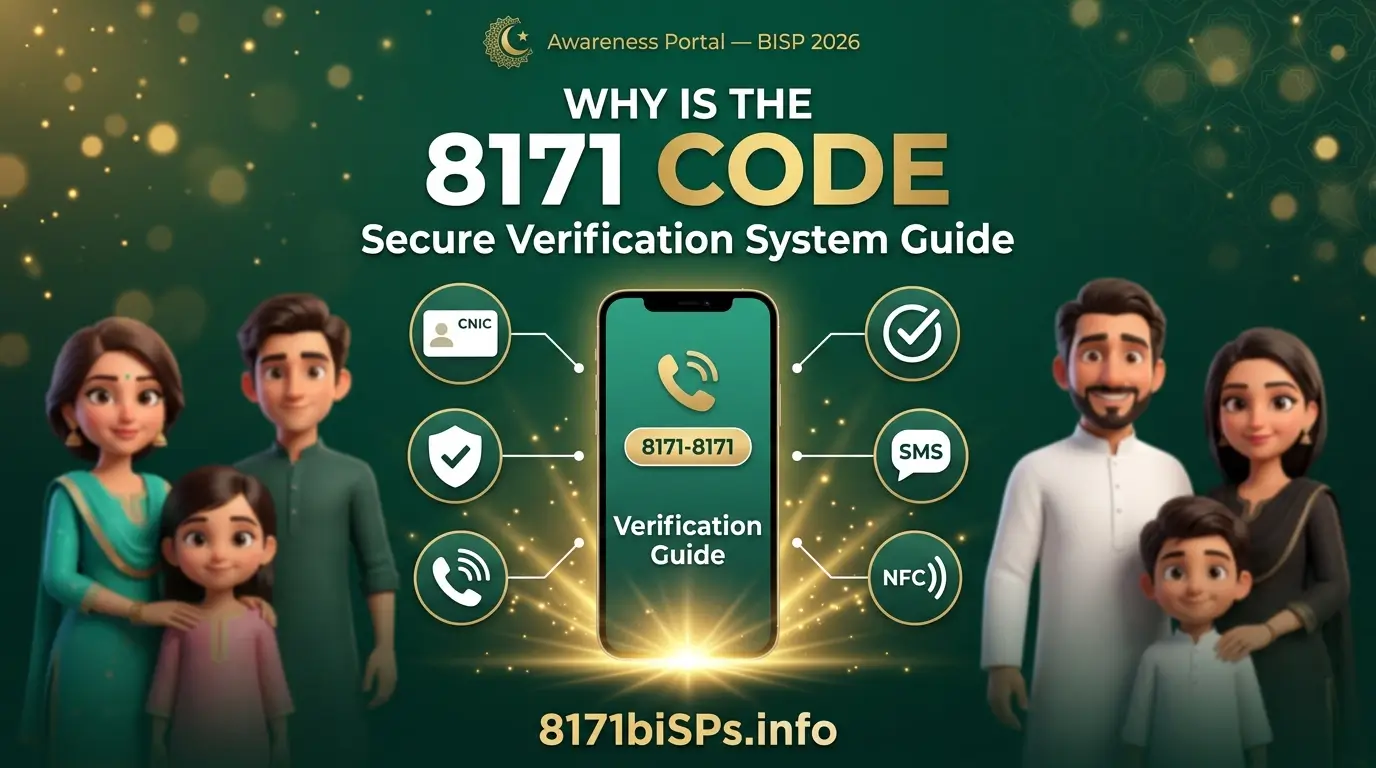
All official BISP communication comes from the number 8171 only.
Messages from any other number — including WhatsApp, regular mobile numbers, or numbers that look similar — are not from BISP.
BISP does not offer bonus payments or special prizes.
Any message claiming you have won extra money or a special package is fraudulent.
BISP does not threaten to remove you from the programme via SMS.
Messages that say your payments will be cancelled unless you act immediately are a known fraud tactic.
BISP never asks for your CNIC image, bank PIN, OTP, or mobile wallet password.
through any message or call.
If you receive a suspicious message:
- Do not reply
- Do not share any personal information
- Verify your actual status through 8171 or 8171.bisp.gov.pk
- Report it to the BISP helpline: 0800-26477 (toll-free)
Real Scenarios
Scenario A — Straightforward case
Saeeda’s household was surveyed two years ago. Her PMT score is below 32. She sends her CNIC to 8171, receives an eligible reply, visits an authorised payment point, completes biometric verification, and collects her payment. No complications.
Scenario B — Payment stopped unexpectedly
Zarina was receiving payments for two years. They stopped after her son started a salaried job, which was captured in a data update and raised her household PMT score above the threshold. She visits the BISP Tehsil Office, explains that her son’s income supports his own household, and requests a dynamic survey to clarify the household composition. The process takes three to four weeks. Reinstatement is not guaranteed but is possible.
Scenario C — Never surveyed
Nazia has never received payments despite qualifying financially. When she checks 8171, she gets “No Record Found.” She visits the BISP office and learns her area was not covered in earlier survey waves. She registers for a dynamic survey. Her status changes to “Under Verification” several weeks later, and eventually to eligible.
Scenario D — Fraud
Rukhsana receives a WhatsApp message offering a Rs. 25,000 bonus. She shares her CNIC and bank details. Her legitimate BISP payment is redirected. The message did not come from 8171, promised money without any verification process, and asked for personal details — three signs of fraud that, once understood, are easy to recognise.
Quick Reference Summary
| Situation | What to Do |
|---|---|
| No reply from 8171 | Wait, retry; check CNIC format; try portal |
| No Record Found | Visit BISP office for dynamic survey registration |
| Under Verification | Wait 2–3 weeks and recheck |
| Not Eligible | Visit BISP office; request dynamic survey update |
| Eligible but no payment | Check district schedule; verify CNIC is not expired |
| Biometric failure | Warm hands, try other fingers; update NADRA if needed |
| Payment stopped | Visit BISP office; check for PMT score changes |
| Suspicious message | Do not engage; report to 0800-26477 |
Frequently Asked Questions
Can I check someone else’s status using their CNIC?
You can send another person’s CNIC to 8171 with their knowledge and permission. Use a SIM registered to your own CNIC and be aware results may not display correctly.
Why did my neighbour get approved but I didn’t?
PMT scores are calculated individually based on each household’s survey data. Differences in housing type, appliances, utility bills, or family composition can produce different scores even for households that appear similar.
My survey was completed but nothing has changed. Why?
Allow two to four weeks after a survey update before rechecking. If the status has not changed after that period, follow up at the BISP Tehsil Office.
Can a son’s or daughter’s income affect my eligibility?
Yes, if they are counted as part of your household in the NSER data. If they run a separate household, this can be clarified through a dynamic survey update.
Is there a charge for any of these services?
No. BISP registration, dynamic surveys, status checks, and payment collection are all free. Any person or agent charging a fee is not authorised to do so.
What if my CNIC has expired?
Renew it at NADRA. Payments are blocked while a CNIC is expired and typically resume after the renewed CNIC is updated in the BISP system, which can take one to two weeks.
I received two payments at once. Is that correct?
A combined payment usually means a previous quarter’s transfer was delayed and is being released together with the current one. It is not a bonus.
Key Contacts
BISP Helpline: 0800-26477 (toll-free) Official portal: 8171.bisp.gov.pk Status check SMS: Send 13-digit CNIC to 8171 FIA Cybercrime (fraud reporting): 9911
About This Guide
This guide is based on publicly available BISP official communications, government announcements, NSER programme documentation, and documented fraud alerts from BISP and Pakistan’s Ministry of IT.
It is not affiliated with BISP, the Government of Pakistan, or NADRA. Programme rules, payment amounts, and eligibility thresholds can change. For the most current and authoritative information, use bisp.gov.pk or call 0800-26477.
Research completed: May 2026
About the Author
This guide was researched and written by an independent content researcher focused on Pakistani government schemes, personal finance topics, and practical consumer guides. The goal is to turn complex official information into simple, accurate, and useful advice for everyday families.
Content is reviewed regularly to reflect policy updates, eligibility changes, and new application processes whenever reliable information becomes available.