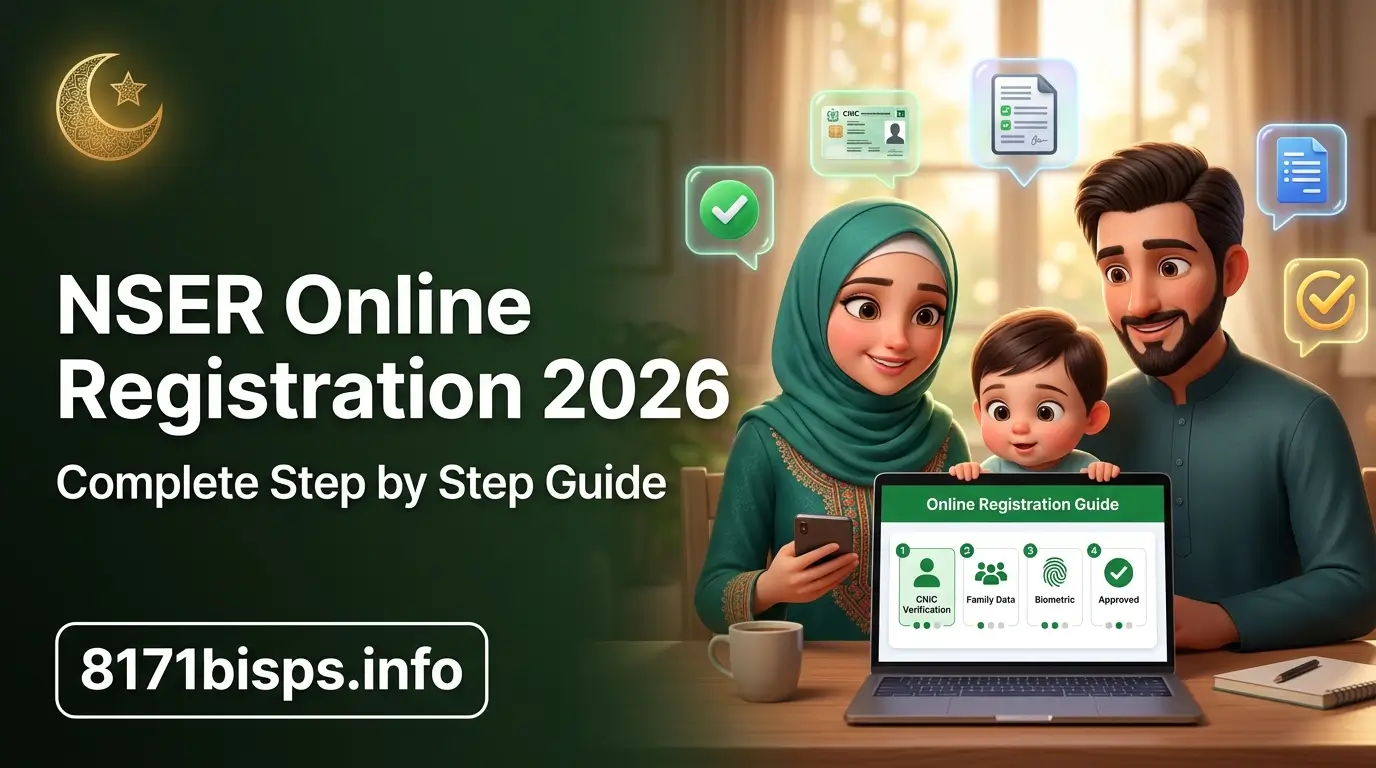
NSER Online Registration 2026 – Complete Step-by-Step Guide
Why Most Families Get Confused — And What This Guide Fixes
You heard about BISP money. Someone said “go get NSER done.” You Googled “NSER registration Pakistan” and found websites that either repeated the same vague steps or looked official but explained nothing clearly.
Here is the core problem: NSER registration is not the same as receiving money. It is not an application. It is not a form you submit and wait for approval. It is a household data survey — and most guides skip right past explaining that, leaving families confused about what they actually need to do.
This guide explains what NSER is, how the eligibility score actually works, what documents you truly need, what the realistic timeline looks like (not the official one), and the hidden issues that stop families from completing registration successfully.
Quick answer if you are in a hurry: Send your 13-digit CNIC number as an SMS to 8171 right now. That tells you whether you are already registered and what your current status is — for free, in under a minute.
What Is NSER Registration? (The Explanation Most Sites Skip)
NSER stands for National Socio-Economic Registry. It is a government database — not a benefits program itself. Think of it as a national list of household financial conditions. Every major welfare program in Pakistan — Ehsaas Kafalat, Taleemi Wazaif, Rashan Riayat, disaster relief funds — uses this same list to decide who gets help.
If your family is not in NSER, or your information is old, you are invisible to every one of those programs. That is why NSER registration Pakistan matters so much.
How the score works: When you register, you answer questions about your income, housing, family size, assets, and employment. The system calculates a Poverty Score Card (PSC) — a number between 0 and 100, where a lower score means greater poverty. Your eligibility for BISP and Ehsaas programs depends on this number, not on an officer’s personal judgment.
Why this design matters: The score-based system exists because Pakistan’s welfare programs historically suffered from targeting corruption — connected people received benefits while genuinely poor families were left out. Automation was meant to remove that bias. It largely works, but it also means the system cannot see your actual circumstances — only your answers to specific questions.
Who Qualifies for NSER Registration 2026?
The program targets families who are genuinely low-income and vulnerable. Key qualifying groups include:
- Households with monthly income below approximately Rs. 25,000–30,000 (this threshold can shift with policy updates — verify via 8171)
- Widows with no other household income source
- Persons with disabilities
- Families with no male earner
- Households in rural and backward areas
- Families affected by unemployment or recent natural disasters
Three common misunderstandings — and the truth:
“If I’m poor, I automatically qualify.” Not exactly. Eligibility is calculated, not assumed. A family that struggles financially but has a concrete house or a land record in the family name may score higher than the threshold — and be told they don’t qualify — even if they genuinely need help.
“Once rejected, it’s permanent.” No. If your situation has changed — a spouse passed away, income dropped, a family member became disabled — you can return and update your data. The system allows re-evaluation.
“Only women can register.” Anyone in the household can go for registration. However, BISP payments are disbursed to the woman of the household — so her valid CNIC is essential, regardless of who submits the form.
How to Do NSER Registration Pakistan — Step by Step (With the Why)
Step 1: Check Your Current Status First (Do This Before Anything Else)
Many families do not realise they were already registered during the original 2010 door-todoor survey. Going for a “new registration” when you are already in the system can create duplicate records and cause long delays.
How to check NSER status online / via SMS:
- SMS your 13-digit CNIC number (no dashes) to 8171 — free, instant result
- Visit bisp.gov.pk — enter your CNIC number
- Visit nadra.gov.pk — for NSER-specific status
If you are already registered with old data, you need an update, not a new application. This distinction saves weeks of confusion.
Step 2: Find Your Nearest BISP Tehsil Office
Since 2021–2022, the government replaced door-to-door surveys with Dynamic
Registration Centers — one in every tehsil. This shift means you now have to travel to the office yourself, rather than waiting for a team to visit.
To locate your nearest center:
- Call BISP helpline: 0800-26477 (toll-free, no charge)
- Visit gov.pk and use the office locator
- Ask at your Union Council or local TMA (Tehsil Municipal Administration) office
Practical tip: Call before you go. Hours vary by office, and some centers have designated days for different groups. Many offices reserve Saturdays specifically for persons with disabilities and special needs.
Step 3: Prepare Your Documents (Originals + Photocopies)
Bring all of the following:
- Valid CNIC of the applicant — must not be expired. This is the single most common reason registrations fail at the counter.
- Valid CNIC of the female head of household — essential for BISP payment eligibility
- B-Form or Child Registration Certificate for all children under 18
- Proof of address — a utility bill, rent agreement, or a letter from your local numberdar or patwari
- Disability documentation if applicable (NADRA disability B-form)
Why each document is checked carefully: The NSER system cross-references your answers with NADRA’s database in real time. A mismatch between your stated address and your CNIC address raises a flag and can pause your application for manual review — adding weeks to the process.
The CNIC problem nobody mentions: In many rural areas, women have never obtained their own CNIC. Without it, she cannot be listed as the BISP payment recipient — which effectively blocks the family from receiving any cash benefit even if they qualify. If this applies to your family, getting her CNIC from NADRA first is a prerequisite, and that alone typically takes two to six weeks.
Step 4: The Registration Interview — What Actually Happens Inside
At the BISP tehsil office, a data entry officer interviews you using a computer or tablet. This system is called CAPI (Computer-Assisted Personal Interviewing) — it replaced paper forms and directly feeds into the central NSER database.
The officer will ask about:
- Total family members and their ages
- Number of earners and approximate monthly income
- Housing type — rented or owned, kutcha or pakka, number of rooms
- Whether anyone in the household is a government employee
- Children’s school enrollment
- Ownership of land, livestock, or a vehicle
- Any disabilities in the household
The most important advice most guides miss: Be thorough about things that reflect genuine hardship — a disabled family member, widow status, no stable employment. Many people are reluctant to mention these out of hesitation or cultural modesty. But these factors directly improve your poverty score in your favour. Leaving them out can be the difference between qualifying and not qualifying.
Do not exaggerate or provide false information. The system cross-checks with NADRA, land records, and other databases. Inaccuracies that are caught can result in disqualification and, in serious cases, legal consequences.
Step 5: After You Submit — What Happens Next
After the interview, collect your tracking slip or receipt. Keep it. This is your only proof that you registered, and you will need it if there are any follow-up questions.
The realistic timeline:
- Official government estimate: 2–4 weeks
- Actual experience reported by families: 4–8 weeks, sometimes longer if there is a NADRA data mismatch requiring manual review
You will receive an SMS update to the phone number you provided. Once approved for BISP, you will be notified to collect your payment through a designated bank agent or payment point using your CNIC and biometric verification.
Check your status every two weeks by SMSing your CNIC to 8171. No news does not always mean rejection — it often means verification is still in progress.
8171 Check Online — How to Use the Portal
The 8171 web portal (8171.bisp.gov.pk) is the government’s official tool to check NSER and BISP eligibility using your CNIC. Here is exactly how to use it:
- Open 8171.bisp.gov.pk in your browser
- Enter your 13-digit CNIC number (no dashes or spaces)
- Enter the four-digit image verification code shown on screen
- Click the check button
- The result will show your registration status and, if enrolled, your payment eligibility
SMS method (faster): Text your 13-digit CNIC to 8171. You will receive an automated reply within minutes.
What the messages mean:
- “Your information is under verification” — your registration is in process; wait two weeks and check again
- “You are not eligible” — your poverty score is above the threshold, or your data is flagged for a mismatch
- “Wait for the survey team” — you are not yet registered; visit your nearest BISP tehsil office
- “You are eligible” — you qualify; follow the instructions in the SMS for payment collection
What Other Guides Don’t Mention — Hidden Challenges
The outdated data trap. Millions of families were registered during the 2010 survey when their circumstances were different. If the old record shows a government-employed family member or higher income than today, that record actively works against you — even if everything has changed. You must formally update your record through the same BISP office process, not start a fresh application.
Punjab has a separate system. Punjab launched its own registry called PSER (Punjab Socio-Economic Registry) at pser.punjab.gov.pk — partly because the provincial government identified that NSER data for Punjab was incomplete and outdated. Punjab residents may need to register with PSER separately to access Punjab-specific programs such as the Negahban scheme. This is genuinely confusing and rarely explained clearly in any guide.
Balochistan and remote areas face the hardest barriers. According to the World Bank’s November 2025 “Mind the Gap” report — the first independent analysis of NSER coverage conducted across roughly 59,000 households — the likelihood of being excluded from NSER is significantly higher for families in Balochistan compared to families in KPK. Distance to registration centers and low awareness of the process are the two biggest factors.
Awareness itself is the largest gap. The same report found that close to half of unregistered households across Pakistan were simply unaware of how to register. And fewer than three in ten knew how to contact BISP. This is not a failure of families — it is a failure of government outreach, particularly in low-literacy areas.
Registration is free. Full stop. If anyone approaches you offering to complete your NSER registration for a fee, or promises to “speed up” your approval for payment, they are misleading you. The entire process — survey, data entry, verification — costs nothing.
Three Real Scenarios: Normal, Difficult, and Rejected
Scenario 1 — Straightforward case (Ruqaiya, rural Sindh):
Ruqaiya is a widow with three children. Her husband passed away two years ago. The old NSER record listed him as a daily wage earner. She visited her BISP tehsil office with her CNIC, the children’s B-forms, and a letter from her patwari confirming she rents a small room. The officer updated her record to reflect her widow status. About six weeks later, she received an SMS confirming her approval for Ehsaas Kafalat. Payment is collected quarterly at a nearby bank agent using her CNIC and fingerprint.
Scenario 2 — Long process (Ahmad, remote Balochistan):
Ahmad’s family was never registered because survey teams never reached their village, and the nearest BISP office is 40 kilometers away. He made the journey after learning about NSER from a local welfare worker. The problem: his wife had no CNIC of her own. The officer explained she needed one to be registered as BISP recipient. Ahmad then had to make a separate trip to NADRA, wait several weeks for her CNIC to be issued, and return to the BISP office. Total time from his first visit to completed registration: close to three months. He did not give up — but most people in that situation would.
Scenario 3 — Rejection and what it misses (Tariq, semi-urban Punjab):
Tariq’s family genuinely struggles month to month. But his CNIC address shows property registered under his father’s name in a small Punjab town. The land record exists — even though the house is shared among three families and is in poor condition. His poverty score came back above the threshold. He was told he didn’t qualify. He was not informed that explaining the actual state of the property to the officer, or getting a patwari letter clarifying shared occupancy, might have changed the assessment. He left without knowing he had any options. This gap — where the system does not explain what you can clarify or contest — is a real and unresolved problem.
Surprising Insights: Why the System Behaves the Way It Does
The shift from door-to-door surveys to registration centers was designed to create a “dynamic” system — one where households can update their information at any time, rather than waiting for a survey sweep that might only happen every decade. That is a genuine improvement in theory.
In practice, it quietly transferred the responsibility. Before 2021, the government came to you. Now, you have to go to the government. For families with transport costs, childcare responsibilities, health issues, or simply no awareness of where to go, that one change locked them out.
The automated poverty scoring exists for a good reason — to make the system fair and corruption-resistant. But it also means the system cannot exercise judgment. It sees your answers, not your reality. Two families with identical scores might be in very different real situations. The scoring model does its best with the information it has, but it is not perfect — and currently there is no straightforward way for families to formally challenge a score they believe is inaccurate.
What NSER Registration Does NOT Solve — Honest Limitations
It does not guarantee payment.
Registration puts you in the database. Whether you receive money depends on your poverty score and the program’s current budget and criteria.
It does not fix documentation problems for you.
Expired CNIC, missing B-forms, or address mismatches must be resolved separately — often through NADRA — before registration can be completed.
It does not mean fast processing.
Data mismatches send applications for manual review, and that can add months to the timeline.
It does not cover all provinces equally.
Punjab’s PSER system operates alongside NSER. Punjab residents may need separate action for some provincial programs.
It does not stay current on its own.
If your circumstances improve significantly — you or a family member gets a government job, for example — you are required by law to update your record. Continuing to receive benefits after becoming ineligible is considered fraud.
Frequently Asked Questions About NSER Registration
Q: Can I do NSER registration online from home?
No. As of 2025–2026, NSER registration requires an in-person visit to your BISP tehsil office, or a visit from a survey team if your area is included in a field survey drive. The 8171 portal and SMS service are for checking status only, not for registering.
Q: How do I check my NSER registration status by CNIC?
Send your 13-digit CNIC number (no dashes) as an SMS to 8171. Or visit 8171.bisp.gov.pk and enter your CNIC. Results appear within minutes.
Q: I was rejected before. Can I apply again for NSER 2026?
Yes. If your financial situation has genuinely changed — loss of income, death of a spouse, a new disability in the household — you can return to your BISP tehsil office, explain the changes, and request a data update. Your record will be re-evaluated.
Q: What documents are needed for NSER registration?
Valid CNIC of the registrant, valid CNIC of the female head of household, B-forms for all children under 18, and proof of current address (utility bill, rent agreement, or patwari letter).
Q: How long does NSER registration take to process?
Officially, 2–4 weeks. In practice, many families report 4–8 weeks, and longer if there is a NADRA data mismatch that requires manual review.
Q: Is NSER registration free?
Yes, completely free. There are no fees at any stage. Anyone charging money for NSER registration or promising faster approval for payment is not authorized to do so.
Q: I live in Punjab. Do I register with NSER or PSER?
Both, ideally. NSER covers national welfare programs. PSER is Punjab’s own registry for provincial programs like Negahban. Registering with both gives you access to the widest range of assistance.
Q: What is the BISP 8171 helpline number?
The toll-free helpline is 0800-26477. You can call this to find your nearest BISP office, ask about your registration status, or get guidance on the process.
Q: My wife does not have a CNIC. Can we still register?
You can start the process, but your wife will need her own CNIC to be listed as the BISP payment recipient. Without it, even an approved household cannot receive payment. Getting her CNIC from NADRA first is a necessary step — plan for 2–6 weeks for that process.
Q: What is a poverty score and how is it calculated?
The Poverty Score Card (PSC) is a number from 0 to 100. It is calculated from your answers during the NSER interview — covering income, housing type and condition, household size, employment status, assets (land, vehicle, livestock), and presence of disabled or vulnerable members. A lower score means greater poverty. Your eligibility for BISP and Ehsaas programs depends on this score falling below a certain threshold.
Practical Pre-Visit Checklist
Before you travel to the BISP tehsil office, confirm each of the following:
- Checked CNIC expiry date — valid and not expired
- Sent CNIC to 8171 to check existing registration status
- Female head of household has her own valid CNIC
- B-forms collected for all children under 18
- Address proof ready (utility bill / rent paper / patwari letter)
- Called 0800-26477 to confirm office hours before traveling
- If in Punjab — also checked pser.punjab.gov.pk separately
- Ready to mention all vulnerabilities honestly: disabilities, widow status, no income
- Photocopies made of all original documents
- Tracking slip collected before leaving the office
What to Do Right Now
If you have not checked your status yet:
Send your CNIC number to 8171 by SMS. It takes 30 seconds and costs nothing.
If the reply says you are not registered:
Call 0800-26477 and ask for your nearest BISP tehsil office location. Plan your visit, prepare your documents using the checklist above, and go.
If the reply says your information is under verification:
Wait two weeks, then check again via 8171. No action needed in the meantime.
If you know someone who needs this help and cannot navigate it themselves:
an elderly parent, a neighbour who does not read well, someone living far from the city — helping them check 8171 and make one visit to the BISP office is a genuinely significant act. The people most likely to be unregistered are the same people least likely to know they need to register.
About This Guide
This article was written by researching across official government sources (bisp.gov.pk, pass.gov.pk, nser.nadra.gov.pk), the World Bank’s November 2025 “Mind the Gap” report on NSER coverage — an independent study based on field interviews with approximately 59,000 households across Pakistan — and multiple welfare information platforms updated between late 2024 and early 2026.
All statistics cited in this guide (coverage figures, exclusion probabilities, awareness percentages) are sourced from the World Bank report or official BISP data, and are described as estimates or findings rather than precise current figures, as these change as the program evolves.
The goal of this guide is clarity, not authority. If anything here is outdated or inaccurate, the BISP helpline at 0800-26477 is always the most reliable source for current information.
About the Author
This guide was researched and written by an independent content researcher focused on Pakistani government schemes, personal finance topics, and practical consumer guides. The goal is to turn complex official information into simple, accurate, and useful advice for everyday families.
Content is reviewed regularly to reflect policy updates, eligibility changes, and new application processes whenever reliable information becomes available.