
Benazir Kafaalat 8171: A Complete Guide for Pakistani Women
Benazir Kafaalat & 8171: A Complete Guide for Pakistani Women
What the program is, who qualifies, how the PMT score works, and what to do if something goes wrong — in plain language. May 2026 All Provinces Source: BISP official portal & government budget docs
Quick answer
Benazir Kafaalat is the cash transfer component of BISP (Benazir Income Support Programme). Eligible women receive Rs. 14,500 per quarter (4 times yearly). To check your status, send your 13-digit CNIC to 8171 via SMS — free, instant reply. Qualification is based on a PMT score of 32 or below (37 for households with a disabled member), calculated from income, assets, and household data. Government employees or pension recipients do not qualify.
What Benazir Kafaalat Is
“Kafaalat” (کفالت) means support or guarantee in Urdu. The Benazir Kafaalat Programme is the core cash transfer component of BISP — the Benazir Income Support Programme launched in 2008. It is not a separate application or a different program; it is the main BISP cash grant.
| Term you see | What it means |
| BISP | The umbrella organisation managing all programs |
| Benazir Kafaalat | The quarterly cash transfer — the largest BISP component |
| 8171 | The SMS number to check your eligibility status (free) |
| NSER | National Socio-Economic Registry — the database your household data lives in |
As of 2026, around 9 million families receive quarterly cash through Benazir Kafaalat — roughly 25% of Pakistan’s population. Payments go to women in the household, not men. BISP’s own data and independent research consistently show that women-directed cash transfers reach food, education, and health needs more reliably than those directed to men.
One terminology note
Saying Benazir Kafaalat “is BISP” is a simplification. BISP also runs education stipends (Taleemi Wazaif), nutrition (Nashonuma), and emergency cash programs. Kafaalat is the cash transfer arm specifically — the part most people mean when they say “BISP money.”
Who Qualifies: PMT Score Explained
Eligibility is determined by a single number: your household’s PMT score (Proxy Means Test). This is calculated algorithmically from survey data — it is not a subjective judgment.
How the PMT score is calculated
| Factor | Effect on Score |
|---|---|
| Monthly household income | Higher income → higher score |
| Number of dependents | More dependents → lower score |
| Education levels of members | Higher education → higher score |
| House type (mud vs. brick, utilities) | Better housing → higher score |
| Asset ownership (vehicle, fridge, TV) | More assets → higher score |
| Land ownership (3+ acres = disqualifying) | Land raises score significantly |
| Disability in household | Raises PMT cutoff threshold to 37 |
The cutoff of 32 was set by the BISP Board in its 52nd meeting on 23 September 2021, based on available fiscal space. It can change in future board meetings if budget increases.
Who is eligible
Priority beneficiaries: widowed, divorced, or separated women; single mothers; women who are the primary household manager even if married. All beneficiaries must be ever-married women with a valid CNIC.
Who is not eligible
Any household where a member is a government employee, receives a government pension, owns more than 3 acres of land, or has a PMT score above the cutoff. CNIC must be valid and unexpired.
The Application Process
Check your current status
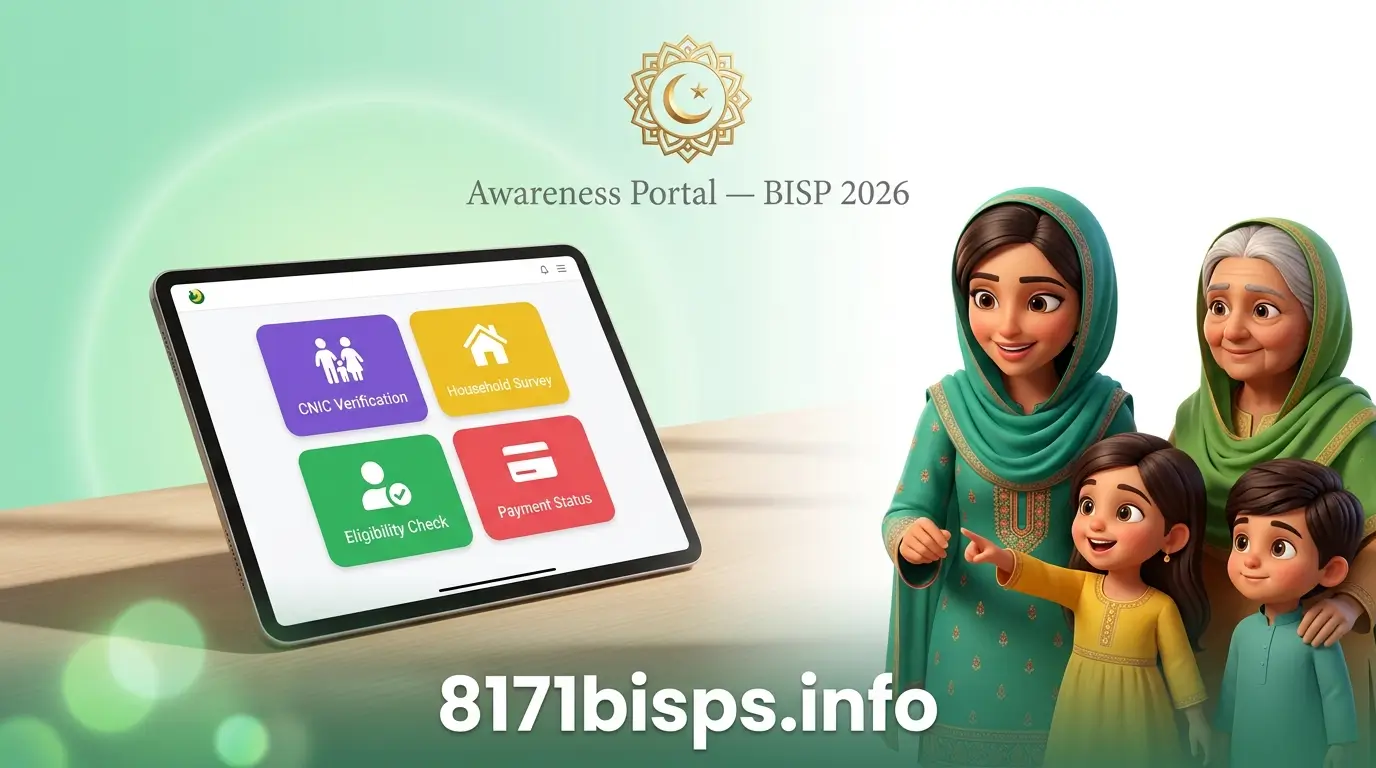
Send your 13-digit CNIC (no spaces or dashes) to 8171 via SMS. Or visit 8171.bisp.gov.pk. You will receive one of four replies: Eligible, Not Eligible, Under Verification, or Payment Available.
Time: 2–3 minutes
If not in the system — request an NSER Dynamic Survey
Visit your nearest BISP Tehsil Office with your original CNIC. A surveyor will record your household income, assets, property, education levels, and any disabilities. This is what generates your PMT score.
Survey duration: 30–45 minutes · Processing: 4–12 weeks
Eligibility decision
BISP cross-checks your survey data against NADRA, NSER, and other government registries. If your PMT score falls at or below the cutoff, you are declared eligible. The registered woman in the household becomes the named beneficiary.
Biometric verification
You must verify your identity at a BISP office, HBL Konnect agent, or official payment camp before collecting any payment. Your fingerprints are matched against NADRA’s database. If this fails, see the issues section below — it is fixable.
Usually same-day once approved
First payment collection
You receive an SMS from 8171. Visit the designated BISP payment camp in your Tehsil with your original CNIC. Payments are only disbursed at official camps — not bank ATMs or general retailers. Total time from survey to first payment: typically 8–16 weeks. Official target is 60–90 days.
- Save these contacts before you apply
- 8171SMS eligibility check
- 0800-26477BISP helpline (free)
Common Problems and Fixes
Most delays and rejections come from a small set of fixable issues. These are rarely explained clearly in official communications.
Biometric verification fails
This happens frequently — worn fingerprints from labor work, old scars, or scanner calibration. Your application is not rejected; verification has simply not yet cleared. Visit a NADRA office to update your biometric records (small fee applies), then return to the next payment camp.
CNIC expired
Payments stop automatically when your CNIC expires. You will receive no warning. Renewal at NADRA costs Rs. 500–1,500 and takes 1–2 weeks. Once renewed, re-check your status via 8171 and resume collection at the next payment camp. This is one of the most common reasons beneficiaries stop receiving payments and mistakenly assume they have been removed from the program.
Check this now
Your CNIC expiry date is printed on the back of the card. If it has passed or expires within 3 months, go to NADRA before your next payment camp date.
Old survey data (situation has worsened)
If you were surveyed several years ago and were ineligible then, that result may still be on file. If your household circumstances have significantly worsened since — job loss, death of earner, increased dependents — you can request a new NSER Dynamic Survey at any BISP Tehsil Office. Do not reapply using 8171 alone; you need to request a fresh survey in person.
Re-verification periods
Every few years BISP updates beneficiary data across the country. During this period some families temporarily stop receiving payments while their data is being re-verified. This is not permanent disqualification. If you stop receiving payments without explanation, call 0800-26477 to confirm whether re-verification is the cause.
Payment collection — important change
As of recent BISP policy, payments are collected only at designated camp sites set up by BISP — not from bank ATMs or general retailers. BISP notifies beneficiaries of camp dates in their Tehsil. If you miss a camp, contact 0800-26477 for the next scheduled date in your area.
Three Realistic Scenarios
✓ Straightforward approval
Zainab, 48 — rural Sindh, widow
Household income: ~Rs. 6,000/month from a son’s shop work. PMT score estimated around 20 — well below the cutoff.
- BISP surveyor visited in 2020, NSER survey completed
- After 8 weeks: SMS notification — Eligible
- Biometric verification passed first attempt
- Now collects Rs. 14,500 quarterly at her local camp
What worked: low, verifiable income; widow status; multiple dependents; no complications in NADRA records.
Delayed — eventually approved
Fatima, 52 — Lahore, divorced, unemployed since 2022
Surveyed in 2015 when employed. Old data showed PMT score of 35 — ineligible at that time.
- Sent CNIC to 8171 in 2024: still showing ineligible (from old data)
- Visited BISP office: requested new NSER Dynamic Survey
- New survey completed December 2024; 6 weeks later: Eligible
- Biometric failed at camp — scarred hands from washing work
- Visited NADRA, updated fingerprints (Rs. 800, one full day)
- Returned to next camp, cleared successfully
Total time: approximately 10 months from first 8171 check to first payment. Two separate office visits required — BISP and NADRA. Process worked but required persistence.
Rejected — no path forward currently
Amina, 35 — Punjab, married
Husband earns ~Rs. 15,000/month as a contractor. Family owns a small house.
- Completed NSER survey in 2024
- PMT score: 38 — above the cutoff of 32
- Reasons: employment income, owned property, relatively smaller family size
- Appealed at BISP office; explained clearly why the score was what it was
- No current path forward unless household income drops significantly or cutoff score changes
The PMT scoring is algorithmic, not negotiable. Amina’s household income, while genuinely modest, placed her above the eligibility threshold.
Honest Limitations
Rs. 14,500 per quarter works out to approximately Rs. 4,833 per month for a family. In any Pakistani city in 2026, this does not cover basic monthly expenses. Benazir Kafaalat is a safety net — it reduces acute hardship, not poverty itself.
What this program does not cover
It does not provide monthly payments — quarterly only. It does not cover healthcare, housing, or emergencies. Eligibility is not permanent — re-surveys can change your score. Only the registered woman can collect; no proxy collection is permitted. CNIC expiry immediately suspends payments with no warning.
Payments have increased over time — from Rs. 3,000 in 2008 to Rs. 14,500 in early 2026 — partly tracking inflation. But the program’s scope is constrained by Pakistan’s federal budget. The quarterly payment structure (rather than monthly) exists because it reduces transaction costs across 9 million households, freeing budget for higher per-payment amounts.
Checklist Before You Apply
Before anything else
- Check CNIC expiry date (on the back) — renew at NADRA if expired or expiring within 3 months
- Send 13-digit CNIC to 8171 — note the reply exactly
- Confirm no household member is a government employee or pension recipient
When visiting BISP office
- Bring original CNIC (not photocopy)
- Know all household members’ names, ages, education, income sources
- Know all assets: land owned, vehicles, house type, utilities available
- Complete NSER survey accurately — small discrepancies delay processing
- Get a receipt or reference number before leaving
After applying
- Check 8171 every 4–6 weeks — “Under Verification” means wait, do not reapply
- On “Eligible” SMS: find next payment camp in your Tehsil (call 0800-26477)
- If biometric fails at camp: go to NADRA, update fingerprints, return next cycle
Frequently Asked Questions
Is Benazir Kafaalat different from BISP?
Benazir Kafaalat is the cash transfer component within BISP. BISP is the wider programme that also includes education and nutrition schemes. For most applicants, “BISP” and “Kafaalat” refer to the same quarterly payment process.
How much is the quarterly payment in 2026?
Rs. 14,500 per quarter as announced by BISP in February 2026. This is paid four times per year. Amounts can change with government budget revisions.
How long does the first payment take?
BISP’s stated target is 60–90 days from completed survey. In practice, 8–16 weeks is more common. If biometric complications or CNIC issues arise, add 2–4 more weeks.
Can a married woman apply?
Yes. Being married is not a disqualifier. The payment goes to the woman in the household regardless. What matters is the household’s PMT score — income, assets, family size.
My CNIC has expired. Can I still collect?
No. Payments stop automatically on CNIC expiry. Renew at NADRA (Rs. 500–1,500), then recheck via 8171. Collection resumes at the next payment camp once your CNIC is updated in the system.
My biometric verification failed. What now?
Visit a NADRA office and request a biometric update. This involves a small fee and typically takes a few hours. Return to the next BISP payment camp afterward. You have not been removed from the program.
I was declared ineligible before. Can I reapply?
Yes, if your household circumstances have changed — job loss, death of an earning member, more dependents. Visit your BISP Tehsil Office and request a new NSER Dynamic Survey. If nothing material has changed, ineligibility will likely stand unless the PMT cutoff score is raised by the BISP Board.
What is the PMT score, and can I find out mine?
PMT (Proxy Means Test) is a number from 0–100 calculated from your survey data. Scores of 32 or below qualify (37 for disabled households). BISP does not routinely share individual PMT scores with applicants. To contest your score, visit the BISP Tehsil Office and request a review or new survey.
Action Plan
Start here — takes 5 minutes
Step 1: Check your CNIC expiry date. If expired, go to NADRA first — everything else waits.
Step 2: Send your 13-digit CNIC to 8171 and save the reply.
If reply is “Eligible” or “Payment Available”: Call 0800-26477 to find your nearest payment camp date. Attend with original CNIC.
If reply is “Under Verification”: Wait 4–6 weeks and check again. Do not reapply.
If reply is “Not Eligible”: Visit your nearest BISP Tehsil Office. Ask whether your survey data is current. If your situation has worsened since your last survey, request a new NSER Dynamic Survey.
No reply to SMS: Ensure your phone has balance, resend without spaces. Or visit BISP office directly.
Sources and verification This guide draws on: BISP official website (bisp.gov.pk) and 8171 portal; BISP Board meeting records including the 52nd meeting (September 2021) where the PMT cutoff of 32 was set; BISP press releases on payment increases (January 2025 and February 2026); government budget documents 2024–2026; NSER survey documentation. Payment amounts and eligibility thresholds are subject to BISP Board decisions and government budget cycles. Always verify current figures via 8171.bisp.gov.pk or helpline 0800-26477 before acting. Last verified: May 2026.