BISP Kafaalat 18000 — Rs 18,000 from January 2027: Easy Guide to the Rise, Eligibility & 8171 Check
This is not an official Government of Pakistan website. This guide is independent, general information about the BISP Kafaalat 18000 rise. For official information, always check BISP at bisp.gov.pk or send your CNIC by SMS to 8171 before you act. Only replies from 8171 are genuine — never trust a message from any other number.
What Is the BISP Kafaalat 18000 Rise?
The BISP Kafaalat 18000 rise is the planned increase in the Benazir Kafaalat quarterly payment from Rs 14,500 to Rs 18,000, starting from January 2027. It is the biggest single rise in the programme’s history, and it matters to every family that receives Kafaalat — but the most important thing to understand first is the date. Nothing at the higher rate is due before January 2027. The October–December 2026 quarter is still Rs 14,500, and any message telling you to collect Rs 18,000 now is false.
The BISP Kafaalat 18000 plan comes from the government’s own policy letter to the International Monetary Fund, published in May 2026 as part of IMF Country Report 26/101, and it was confirmed at the BISP briefing on 22 June 2026 by First Lady Asifa Bhutto Zardari and BISP Chairperson Rubina Khalid. The federal budget for 2026-27 proposed Rs 844 billion for BISP, the largest allocation the programme has ever had. The rise is planned, announced and budgeted — but it is still a plan for January 2027, not a payment you can collect today.
The BISP Kafaalat 18000 question is really two questions, and this guide keeps them separate. The first is what you get now: Rs 14,500 per quarter, paid to one woman in each eligible household, checked through the NSER survey and the PMT score. The second is what changes in January 2027: the same payment, the same eligibility rules, but Rs 18,000 per quarter instead of Rs 14,500. The rise does not change who qualifies, and it does not need a new application. If you are eligible now, the higher amount should reach you automatically when the new rate starts.
Example — the woman who heard Rs 18,000 on WhatsApp: A woman in Multan received a WhatsApp message in November 2026 saying her Kafaalat payment had risen to Rs 18,000 and she should visit an agent to “activate” it. She sent her CNIC to 8171 instead. The reply said she was eligible and her current payment was Rs 14,500. The agent’s message was a scam — the rise starts in January 2027, and no agent can activate it.
Example — the family budgeting for January: A family in Faisalabad receives Rs 14,500 every quarter. They read that the payment rises to Rs 18,000 from January 2027. They now plan their January spending around Rs 18,000, but they know the October–December payment is still Rs 14,500, and they will check 8171 in January before spending money they have not yet received.
BISP Kafaalat 18000 — The Two Amounts, Kept Separate
The table below gives the two amounts of the BISP Kafaalat 18000 story. Read it once, and the confusion ends.
| Payment | Amount | When |
|---|---|---|
| Current quarterly payment | Rs 14,500 | October–December 2026 quarter, and every quarter before it |
| Planned quarterly payment | Rs 18,000 | From January 2027 |
| Increase per quarter | Rs 3,500 | About 24% more than Rs 14,500 |
| Extra money per year | Rs 14,000 | Four quarters at Rs 3,500 more each |
The current amount is Rs 14,500 per quarter. It has been the Kafaalat payment since March 2026, and it is the amount for the October–December 2026 cycle. The planned amount is Rs 18,000 per quarter from January 2027. The increase is Rs 3,500 per quarter — about 24% more — which adds up to Rs 14,000 extra over a full year. That is real money for a poor household: roughly the cost of a month of flour, or several weeks of cooking gas.
The BISP Kafaalat 18000 rise does not change how the payment is made. It is still paid quarterly to the woman of the household, through the same payment points — bank agents, retailers and campsites — and it is still checked the same way, by SMS to 8171 or on the 8171 web portal. The only thing that changes is the amount on the payment slip. If anyone tells you the rise needs a new survey, a new form, a fee, or a visit to an agent, that person is lying to you. The rise is automatic for eligible families.
One warning matters more than any other in this guide. A higher figure than Rs 18,000 is circulating online, in videos and WhatsApp forwards, claiming to be the new Kafaalat amount. That figure does NOT appear in the IMF policy letter, the Budget in Brief, or any BISP release. Treat it as unsupported. The confirmed figures are Rs 14,500 now and Rs 18,000 planned from January 2027. Do not plan your household budget around a higher figure you saw in a video, and do not pay anyone who promises to get you that amount.
Who Qualifies for the BISP Kafaalat 18000 Payment?
The BISP Kafaalat 18000 payment goes to the same families who qualify now, because the rise changes the amount, not the eligibility. Eligibility comes from the National Socio-Economic Registry (NSER) survey, which scores each household on a Proxy Means Test (PMT) from 0 to 100, based on income, family size, housing, assets and similar details. A lower score means a poorer household. The cut-off is set by the BISP Board, and it has been the same for several years.
Your household must have a PMT score of 32 or below to qualify for Kafaalat. If a member of your household has a registered disability, the cut-off is relaxed to 37. That is the rule as of November 2026: the BISP Board set the standard cut-off at 32 on 23 September 2021, and BISP’s own website still shows that figure. For transgender persons with a valid transgender CNIC, there is no PMT cut-off — they can be enrolled after the NSER survey and NADRA verification.
The BISP Kafaalat 18000 rise does not change any of this. A household at or below the cut-off qualifies for Rs 14,500 now and Rs 18,000 from January 2027. A household above the cut-off does not qualify for either amount. The rise is not a new programme, and it is not a new registration drive. If your household is not in the NSER survey, you are invisible to the programme — register at a BISP Tehsil Office, where the survey is done in person. No website, agent or form can register you online.
You cannot see your own PMT score. The 8171 portal and the 8171 SMS service show your eligibility status only — Eligible, Under verification, Not eligible, or Survey required — never the number itself. The number is held by BISP and is given to you only at a BISP Tehsil Office. Any website that claims to show your exact PMT score is guessing. Do not enter your CNIC on such a site.
If your circumstances have changed since your last survey — a child born, a member died, an income risen or fallen — your score may have changed too. The NSER survey is not a one-time event. If your household is now poorer, or if you were surveyed years ago, visit your Tehsil Office and ask whether a re-survey is due. A record that no longer describes your family can block a payment you should be receiving.
How to Check Your BISP Kafaalat 18000 Status on 8171
Checking your status takes one minute, and it is the only check you need. The BISP Kafaalat 18000 status check uses the same two methods as every Kafaalat check before it, and both are free.
Step 1: Send Your CNIC by SMS to 8171
Send your 13-digit CNIC number, without dashes, by SMS to 8171. You will get a reply about your eligibility. The reply comes from 8171 only. If a message arrives from any other number claiming to be BISP, it is fake — delete it and do not reply. The SMS costs the normal SMS charge from your mobile operator; BISP itself charges nothing for the reply.
Step 2: Check on the 8171 Web Portal
Open 8171.bisp.gov.pk in your phone or computer browser. Enter your CNIC number, your mobile number and the code shown in the picture, then submit. The portal shows whether your household is eligible and what to do next. The portal shows your status only, never your PMT score number. Type the address yourself — do not follow a link from a message, because fake portals copy the real one’s look.
Step 3: Read the Result Correctly
If the result says Eligible, your payment is due and you can collect it at your payment point. If it says Under verification, your survey is being checked — wait, and check again in a few days. If it says Not eligible, your PMT score is above the cut-off, and you can visit a Tehsil Office to ask why. If it says Survey required, your household has no NSER record — visit a Tehsil Office to register. None of these results mentions Rs 18,000 yet, because the rise starts in January 2027. The portal will show the new amount only when the new rate takes effect.
Step 4: Collect the Payment the Right Way
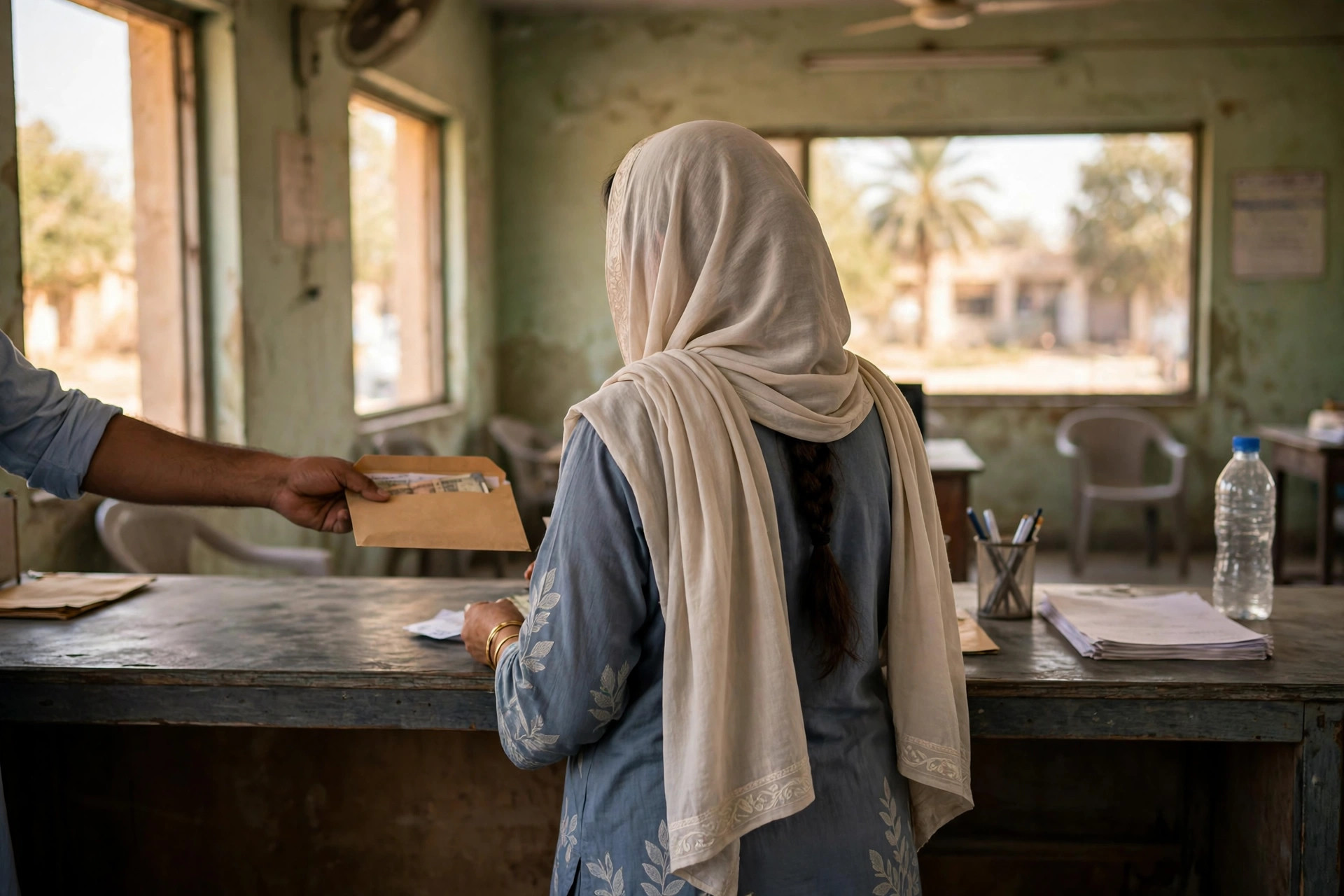
Collect your payment only at an official payment point — a bank agent, a retailer or a campsite — with your original CNIC and, where asked, a biometric check. The payment point must give you the full amount and a receipt. Nobody may deduct a fee from your payment. If an agent asks for a cut, refuse and report it to the BISP helpline or your Tehsil Office. Keep the receipt: it is your proof of payment, and without it a complaint is hard to prove.
What the BISP Kafaalat 18000 Rise Means for Your Household
The BISP Kafaalat 18000 rise means Rs 3,500 more per quarter, or Rs 14,000 more per year, for every eligible household. For a family living on very little, that is not a small change. It is roughly a month’s flour, or the school costs of one child for a term, or several weeks of cooking gas. The rise is meant to protect poor families against rising prices, and it is the largest single increase the programme has made.
Plan around the date, not the announcement. The October–December 2026 payment is Rs 14,500. The January–March 2027 payment should be Rs 18,000. Do not spend Rs 18,000 before January, and do not borrow against it. If a shopkeeper or lender offers you goods “on the new amount” before January, say no — the money does not exist yet, and you would be paying interest on a promise.
The BISP Kafaalat 18000 rise also means your household’s other BISP benefits do not change. If your children receive Benazir Taleemi Wazaif, that stipend continues on its own rules. If you are in the Nashonuma programme, that support continues too. The Kafaalat rise is separate from those programmes, and none of them needs a new application because of it. One survey, one eligibility decision, one payment — the amount is simply higher from January.
Keep your record up to date before January. If your mobile number has changed, update it at your Tehsil Office, because payment messages go to the number on your record. If your CNIC has expired, renew it at NADRA before the January payment cycle. A payment cannot be collected on an expired CNIC, and fixing it in January will cost you days. Check both now, while there is still time.
Common Problems — and What to Do
Your 8171 Reply Says “Not Eligible”
If the reply says Not eligible, your PMT score is above the cut-off. Visit your BISP Tehsil Office with your CNIC and ask for the reason. If your circumstances have worsened since the survey — a job lost, an illness, a death in the family — ask whether a re-survey is possible. Do not pay anyone who promises to make you eligible. Eligibility is decided by the survey score, not by an agent.
Your Payment Has Not Arrived
If your payment has not arrived, first check your status on 8171. If it says Eligible but the money is not at the payment point, visit your Tehsil Office with your CNIC and payment receipt from the last quarter. The office can trace the payment. Do not visit a second agent or pay a fee to “release” the payment. The payment is released by BISP, not by an agent.
Someone Offered to “Activate” the Rs 18,000 for a Fee
This is a scam. The BISP Kafaalat 18000 rise needs no activation, no fee and no agent. It starts in January 2027 for families who are already eligible. Anyone asking for money to activate it is stealing from you. Report the person to your Tehsil Office, and warn your neighbours — scammers target whole streets at once.
Your CNIC Is Expired
An expired CNIC blocks payment collection. Renew it at NADRA before the January cycle. The renewal takes a few days, so do it now, not in January. While you wait, keep your old CNIC safe — the NADRA receipt is your proof that a renewal is in progress, but the payment point needs the new card.
You Received a Message from a Number Other Than 8171
Delete it. BISP communicates only through 8171. Messages from other numbers — even ones that look official, with the BISP logo — are fake. Never send your CNIC, bank details or a code to a number that messaged you first. BISP never asks for your bank details by SMS.
BISP Kafaalat 18000 — Mistakes That Cost You Money
The first mistake is believing the Rs 18,000 is available now. It is not. The October–December 2026 payment is Rs 14,500. Anyone who tells you to collect Rs 18,000 in November or December is either mistaken or lying, and anyone who charges you to collect it is stealing from you.
The second mistake is trusting a higher figure you saw in a video. It appears in videos and forwards, but it does not appear in the IMF policy letter, the Budget in Brief, or any BISP release. Plan your budget on Rs 18,000 from January, and Rs 14,500 until then. A budget built on a higher figure will fall short every quarter.
The third mistake is paying an agent. No agent can register you, raise your PMT score, activate the rise, or release a payment. Every one of those things is done by BISP or NADRA, free of charge. Money paid to an agent is money lost, and the agent has no power to do what they promised.
The fourth mistake is letting your CNIC or mobile number go out of date. The payment goes to the woman of the household, on the CNIC on record, with messages to the mobile number on record. An expired CNIC or a dead number can delay a payment by weeks. Check both before January.
The fifth mistake is entering your CNIC on a fake portal. Only 8171.bisp.gov.pk is official. Type it yourself. A link from a message, a social media post or a search result that looks slightly different — an extra letter, a different ending — is a fake that will steal your details. If in doubt, use the SMS method instead: send your CNIC to 8171 and wait for the reply.
Your BISP Kafaalat 18000 Checklist
- I know the current payment is Rs 14,500 per quarter, and the October–December 2026 payment is still Rs 14,500.
- I know the BISP Kafaalat 18000 rise starts in January 2027, and nothing at the higher rate is due before then.
- I know the rise is Rs 3,500 per quarter — Rs 14,000 more per year — and it needs no new application.
- I know any higher figure quoted online is unsupported and I will not plan my budget on it.
- I have checked my status by SMS to 8171 or on 8171.bisp.gov.pk, and I know what my result means.
- My CNIC is valid and my mobile number on the BISP record is current.
- I will never pay an agent to register me, activate the rise, or release a payment.
- I will only trust messages from 8171 and the official portal 8171.bisp.gov.pk.
Common Questions
What is the BISP Kafaalat 18000 rise? The BISP Kafaalat 18000 rise is the planned increase in the quarterly Kafaalat payment from Rs 14,500 to Rs 18,000, starting from January 2027, per the government’s policy letter in IMF Country Report 26/101 (May 2026) and the BISP briefing of 22 June 2026.
Is Rs 18,000 available now? No. The October–December 2026 quarter is still Rs 14,500. Nothing at the higher rate is due for any quarter before January 2027. Any message saying you can collect Rs 18,000 now is false.
Do I need to apply again for the higher amount? No. If you are already eligible for Kafaalat, the higher amount should reach you automatically when the new rate starts in January 2027. No new survey, form or fee is needed.
What is the PMT score needed for Kafaalat? Your household needs a PMT score of 32 or below in the NSER survey. If a household member has a registered disability, the cut-off is 37. The BISP Board set the cut-off at 32 on 23 September 2021.
Is there a higher Kafaalat figure than Rs 18,000? Some videos and forwards quote a higher figure. It does not appear in the IMF policy letter, the Budget in Brief or any BISP release. The confirmed figures are Rs 14,500 now and Rs 18,000 planned from January 2027.
How do I check my Kafaalat status? Send your 13-digit CNIC number, without dashes, by SMS to 8171, or check on the official portal 8171.bisp.gov.pk. Both show your eligibility status only, never your PMT score number.
Who receives the Kafaalat payment? The payment goes to one woman in each eligible household, paid quarterly through official payment points — bank agents, retailers and campsites — with your original CNIC and a biometric check where asked.
What should I do if someone asks me to pay for the Rs 18,000? Refuse and report them to your BISP Tehsil Office. The rise needs no activation, no fee and no agent. Anyone asking for money to activate it is running a scam.
Conclusion
The BISP Kafaalat 18000 rise is real, planned and budgeted: Rs 14,500 now, Rs 18,000 from January 2027, an extra Rs 3,500 every quarter for every eligible household. It needs no new application, no fee and no agent. The only things you need to do are check your status on 8171, keep your CNIC and mobile number current, and wait for January. Do not believe a higher figure from a video, do not pay anyone to activate the rise, and do not trust any message that does not come from 8171. The rise is coming — the date is January 2027, and the amount is Rs 18,000.
If your payment has increased before, our guide to the BISP payment increase explains the earlier rises, and if you have never checked your status, our guide to the 8171 SMS check explains what each reply means — and if your household has never been surveyed, our guide to the BISP dynamic survey explains how the NSER survey works.