
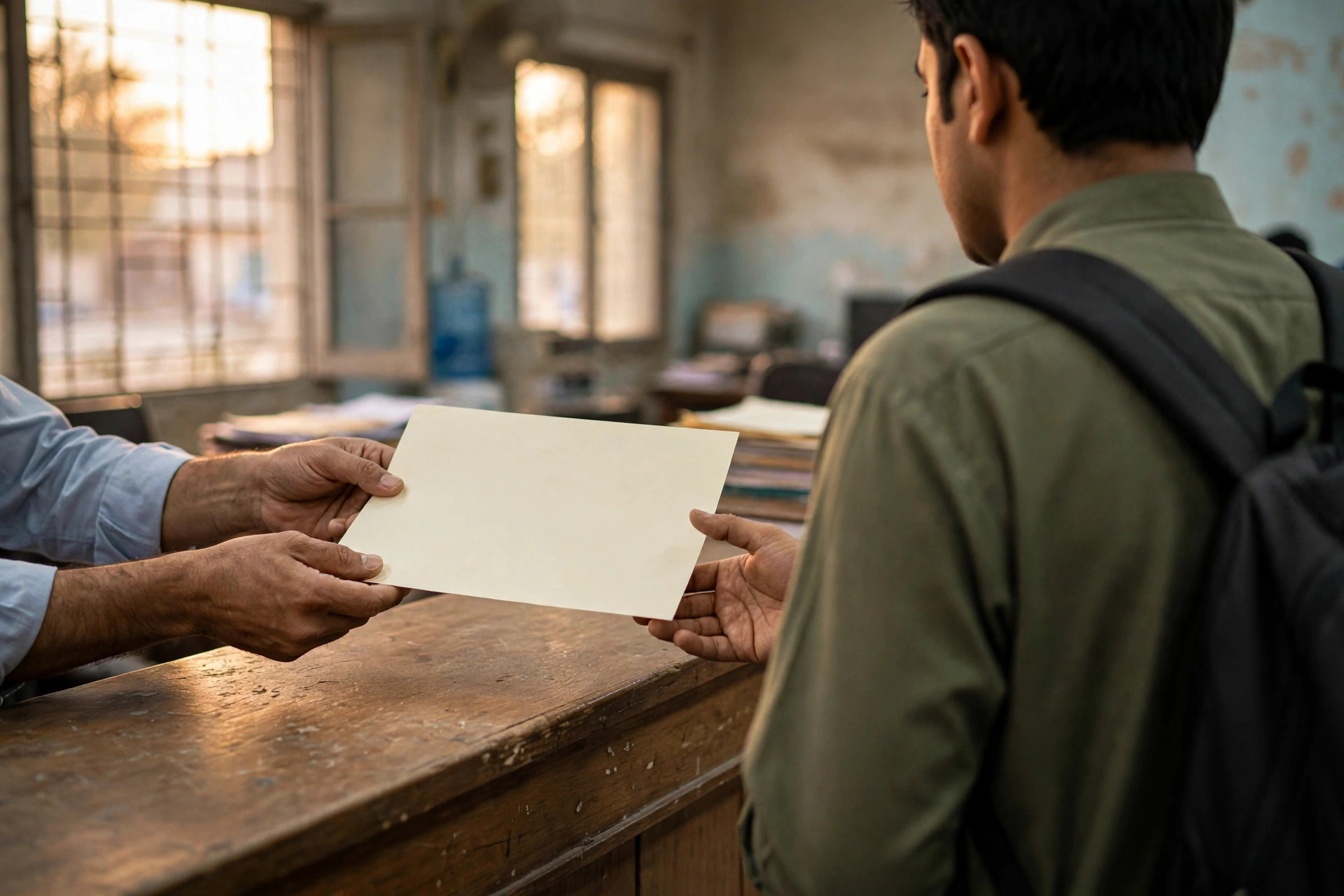
Punjab Domicile Certificate 2026 — Easy Step-by-Step Guide to Fee, Documents & Online Apply
This is not an official Punjab government website. This guide is independent, general information about the Punjab domicile certificate. For official information, always check the Punjab Domicile Management System at domicile.punjab.gov.pk or your district e-Khidmat Markaz before you apply or pay anything.
What Is a Punjab Domicile Certificate?
A Punjab domicile certificate is an official document that proves you are a permanent resident of a particular district in Punjab. It is the paper that answers the question every government office, university and employer asks sooner or later: which district do you belong to? It does not prove your nationality — your CNIC does that — it proves your home district, and it is the document that unlocks district quotas in government jobs, admissions in public colleges and universities, and many provincial schemes that are reserved for residents of a particular area.
A Punjab domicile certificate is issued by the Deputy Commissioner or Assistant Commissioner of your district under the Pakistan Citizenship Act 1951. That is the first fact to get right, because it is also the most common source of confusion. NADRA does not issue domicile certificates.
NADRA verifies your CNIC record, and your CNIC address is one of the proofs the district office looks at, but the certificate itself comes from the district administration — the Assistant Commissioner or Deputy Commissioner — through the e-Khidmat Markaz or the Punjab Information Technology Board’s Domicile Management System. Anyone who tells you to apply for a domicile at a NADRA centre, or offers to get you one from NADRA for a fee, is misleading you.
A domicile certificate has lifetime validity once it is issued, unless your permanent residence changes. You apply once, not every year. That is why it is worth getting it right the first time: a wrong district, a wrong spelling of your father’s name, or an old address on the certificate will follow you into every job application and admission form you ever fill in, and correcting it later means another round at the same office.
Example — the job applicant: A young man from Multan applies for a government job that reserves seats by district quota. The application form asks for his domicile district, and the department wants a copy of the certificate with the form. He has a CNIC with a Multan address, but no Punjab domicile certificate, so his application is incomplete. He applies at the e-Khidmat Markaz, and sixteen working days later he has the certificate — but he has missed the job deadline. The Punjab domicile certificate is the document you get before you need it, not after.
Example — the university admission: A girl from Bahawalpur wins a seat in a public medical college under the district quota. The college asks for her Punjab domicile certificate at admission time to prove she belongs to the Bahawalpur district. Her father had applied for the certificate when she was in Class 9, so it is ready in the file at home. Her seat is confirmed the same day, while another student without the certificate is told to come back with it — and loses the seat to the next candidate on the merit list.
Who Needs a Punjab Domicile Certificate?
Almost every family in Punjab needs a Punjab domicile certificate sooner or later, and the list of uses is long. You need it for government jobs, because provincial jobs are distributed by district quota. You need it for admission to public colleges, universities and professional institutions, because seats are reserved by district.
You need it for the Punjab Daanish Schools, for the Honhaar Scholarship, and for several provincial schemes that ask for proof of Punjab residence. You need it when you apply for a passport in some cases, and when you register a vehicle or apply for certain licences. In short, the domicile certificate is one of the two identity documents — along with the CNIC — that every adult in Punjab should hold.
A domicile certificate is issued for one district only, and that district must be the district where you permanently live. If your family moved from Lahore to Faisalabad ten years ago and you now live in Faisalabad, your domicile should say Faisalabad. If you hold a domicile of another district and have moved permanently, you need a no-objection certificate or cancellation of the old domicile before the new district will issue one. You cannot hold two domiciles at the same time, and applying for a second one without cancelling the first is one of the most common reasons applications are rejected.
Children also need a Punjab domicile certificate, and parents should apply for it early. A child under 18 applies with a B-Form instead of a CNIC, and the father’s or guardian’s CNIC and domicile are attached. Getting the certificate when the child is in school saves a last-minute rush when admissions open. Our guide to the NADRA B-Form 2026 documents and fee explains how to get the birth registration certificate your child needs first.
Punjab Domicile Certificate Fee 2026 — What You Pay
The fee for a Punjab domicile certificate changed in 2026, and the new figure is the one to budget for. In April 2026 the Punjab cabinet approved a revised fee, and the total announced in August 2026 is Rs 550 per application. The Rs 550 is made up of three parts: a Rs 200 domicile fee, a Rs 300 e-affidavit charge, and a Rs 50 PITB service charge.
Of the total, Rs 500 goes to the government treasury and Rs 50 stays with PITB, which runs the system. You pay the whole Rs 550 together, in one payment, through e-Pay Punjab. Cash is not accepted for the online route, and you should not hand cash to anyone who offers to pay it for you.
The table below sets out the fee as reported in 2026, and what changed from the old figure.
| Item | Old figure (before 2026) | 2026 figure (reported) |
|---|---|---|
| Domicile fee | Rs 200 | Rs 200 |
| E-affidavit / stamp paper | About Rs 100 | Rs 300 |
| PITB service charge | None | Rs 50 |
| Total per application | About Rs 300 | Rs 550 |
| Payment method | Challan at the bank | e-Pay Punjab only (online route) |
| Processing time | About 16 working days | About 16 working days at e-Khidmat; about 2–3 days announced for the online route |
The processing time needs a careful note, because the sources disagree. The e-Khidmat Markaz route is consistently reported at about 16 working days from submission to issuance. The online route through the PITB Domicile Management System was announced with a much shorter time — about 2 to 3 days — when the Rs 550 fee was announced in August 2026. Treat the 16 working days as the safe planning figure and the 2–3 days as the announced target for the online route, and confirm the current timeline on the official portal before you count on it. Fees and timelines are set by the government and can change, so always confirm the amount shown on the payment screen before you pay.
A domicile certificate is charged per person, per application. A family of four applying together pays Rs 550 four times — once for each certificate. There is no family discount, and there is no fee for checking the status of an application you have already submitted.
Documents You Need for a Punjab Domicile Certificate
The document list for a domicile certificate is short, but every item on it matters, and a missing document is the most common reason an application is sent back. Keep the originals and the copies ready before you go to the e-Khidmat Markaz or open the app.
- Your CNIC (original and copy). If you are under 18, your B-Form instead.
- Your father’s CNIC copy — or your husband’s CNIC copy if you are a married woman.
- Proof of residence in the district: a property document (fard, registry or allotment letter), a utility bill in your name or your father’s name, a rent agreement, or your voter-list entry or education certificate showing the district address.
- Two recent passport-size photographs.
- An affidavit (e-affidavit in Punjab, or stamp paper where the office asks for it) declaring your residence.
- Form P, the domicile application form, and the Assistant Commissioner verification form where the office asks for it.
- Your father’s or family’s old domicile, if one exists.
- A no-objection certificate or cancellation of your old domicile if you are moving your domicile from another district.
- A birth certificate or school certificate where the office asks for it, particularly for applicants under 18.
If your CNIC has expired, renew it first — our guide to NADRA CNIC renewal 2026 fee and documents explains that process — because the district office will not accept an expired card as proof of identity. If you do not know your CNIC number, our guide to NADRA online CNIC number verification explains how to find it.
How to Apply for a Punjab Domicile Certificate Online — Step by Step
There are three ways to apply for a domicile certificate in 2026: online through the PITB Domicile Management System, in person at your district e-Khidmat Markaz, or through the Dastak doorstep service. The online route is the fastest on paper, and the steps below follow it.
Step 1: Download the Domicile Management System App
The Punjab Information Technology Board runs the Domicile Management System, and you apply through its mobile app (available on the Google Play Store and the Apple App Store) or the portal at domicile.punjab.gov.pk. Download only the official app — the programme runs only on official Punjab government platforms. Never enter your CNIC number on any other website or app that claims to issue domiciles.
Step 2: Create Your Account and Fill in Form P
Create an account with your CNIC number and your mobile number, and fill in Form P, the domicile application form. Enter your name, your father’s name, your date of birth and your permanent address exactly as they appear on your CNIC. A spelling that differs from your CNIC is the most common reason a file is held up, so check every field against the card before you submit.
Step 3: Upload Your Documents
Upload clear photographs or scans of your CNIC, your father’s CNIC, your proof of residence and your photographs. Blurry uploads are rejected, so check each image after uploading. The app will also ask for the e-affidavit — in Punjab this is generated as part of the process, and its Rs 300 charge is included in the Rs 550 total.
Step 4: Pay Rs 550 Through e-Pay Punjab
Pay the fee through e-Pay Punjab from inside the app. Select the domicile fee option, and pay by JazzCash, Easypaisa, debit card or bank transfer, whichever the app offers. Keep the payment receipt and the tracking number. The fee is Rs 550 in total — Rs 200 domicile fee, Rs 300 e-affidavit and Rs 50 PITB charge — and it is paid only through e-Pay Punjab on the online route.
Step 5: Track Your Application and Collect the Certificate
Track your application on the portal or the app with your tracking number. The file is examined at the Domicile Branch of the tehsil Assistant Commissioner office, entered in the register, printed and signed. When it is ready, you are told to collect it — or, on the online route, it is delivered by courier to your home address, as announced. Do not pay anyone who promises to speed up the file: there is no official fast track, and the only people who can move it are the officers in the chain.
How to Apply at an e-Khidmat Markaz — Step by Step
If you prefer to apply in person, or if the app does not work for you, visit your district’s e-Khidmat Markaz. In Lahore the centre is at Jinnah Hall, Lower Mall, Anarkali; in other districts it is at the Deputy Commissioner office complex or the district facilitation centre. Take your original documents and their copies, and your photographs.
At the counter, the staff enter your data into the system and give you a slip with a date. The file goes to the tehsil office for verification and signature by the Assistant Commissioner, and you collect the printed certificate from the same centre on the date on your slip. Processing on this route is reported at about 16 working days. Keep the slip safe — it is your proof of application and your collection receipt.
A third route exists for people who cannot travel: the Dastak doorstep service. You request it through the Dastak app or the helpline 1202, and a trained facilitator comes to your home and handles the application. Domicile is on the Dastak service list, according to reports. This route suits elderly applicants and people with disabilities, but the same documents and the same fee apply.
How to Verify a Punjab Domicile Certificate Online
A domicile certificate can be verified online, and employers and universities do this routinely. The verification portal is domicile.punjab.gov.pk, which has run since January 2015 and pulls directly from the PITB database. Enter your CNIC number or your domicile number, and the portal shows whether the certificate is genuine and which district it belongs to.
Verification matters because fake domiciles are a real problem. A certificate bought from an agent, printed on a fake letterhead, or issued for a district you do not live in will fail verification — and if you used it for a job or an admission, the job or the seat can be cancelled years later. Always verify your own certificate after you receive it, and never pay an agent for a domicile. The official fee is Rs 550, and no agent can issue a genuine certificate faster than the official process.
Common Problems — and What to Do
Your Application Is Rejected for a Wrong District
The most common rejection is a district mismatch: your CNIC address says one district and you applied in another. The domicile must match the district where you permanently live, and the proof of residence must support it. If you have genuinely moved, cancel the old domicile first and apply with proof of your new address — a utility bill, a rent agreement or a property document in the new district.
Your Father’s Name Is Spelled Differently on Two Documents
A spelling difference between your CNIC and your father’s CNIC, or between your CNIC and your school certificate, will hold up the file. Get the spelling corrected first — our guide to NADRA CNIC correction 2026 explains the correction process — and then apply for the Punjab domicile certificate with matching documents.
Someone Offers You a Domicile for a Fee
No agent, no tout outside the DC office and no website other than the official PITB system can issue a Punjab domicile certificate. Anyone who asks for Rs 2,000 or Rs 5,000 for a “quick domicile” is selling you a fake or bribing someone on your behalf, and the certificate will not survive verification. Apply yourself, pay Rs 550 through e-Pay Punjab, and keep your receipt.
You Need the Certificate Urgently for an Admission or a Job
There is no official urgent track for a Punjab domicile certificate. If a deadline is close, apply at the e-Khidmat Markaz in person rather than online, because the staff can tell you the realistic date, and take the slip to the admitting office or the employer as proof that you have applied. Some institutions accept the application slip with an undertaking that the certificate will follow — ask them, do not assume it.
Your Punjab Domicile Certificate Checklist
- I know the Punjab domicile certificate is issued by the Assistant Commissioner / Deputy Commissioner, NOT by NADRA.
- I have my CNIC (or my child’s B-Form) and my father’s CNIC copy ready.
- I have proof of residence in the district — property paper, utility bill, rent agreement or voter-list entry.
- I have two passport-size photographs and the affidavit ready.
- I have filled in Form P with spellings exactly as on my CNIC.
- I have paid Rs 550 through e-Pay Punjab and kept the receipt and tracking number.
- I have applied only on the official PITB app/portal or at the e-Khidmat Markaz — no agent, no extra fee.
- I will verify my certificate on domicile.punjab.gov.pk after I receive it.
Common Questions
What is a Punjab domicile certificate?
A Punjab domicile certificate is an official document proving you are a permanent resident of a particular district in Punjab. It is issued by the Deputy Commissioner or Assistant Commissioner of your district under the Pakistan Citizenship Act 1951, and it is used for government jobs, admissions and provincial schemes that work on district quotas.
Does NADRA issue the domicile certificate?
No. NADRA does not issue domicile certificates. The certificate is issued by the district administration — the Assistant Commissioner or Deputy Commissioner — through the e-Khidmat Markaz or the PITB Domicile Management System. NADRA only verifies the CNIC record behind the application.
What is the fee for a Punjab domicile certificate in 2026?
The reported total is Rs 550: Rs 200 domicile fee, Rs 300 e-affidavit and Rs 50 PITB service charge, paid together through e-Pay Punjab. The figure was announced in August 2026 after a Punjab cabinet decision in April 2026. Confirm the amount on the payment screen before you pay, because fees can change.
How long does a Punjab domicile certificate take?
About 16 working days on the e-Khidmat Markaz route, according to reports. The online route was announced with a target of about 2 to 3 days, but that is an announced target, not a guarantee — plan on 16 working days and confirm the current timeline on the official portal.
What documents do I need for a Punjab domicile certificate?
Your CNIC (or B-Form if under 18), your father’s CNIC copy, proof of residence in the district, two passport-size photographs, an affidavit, and Form P. If you are moving your domicile from another district, you also need a no-objection certificate or cancellation of the old domicile.
Can I apply for a Punjab domicile certificate online?
Yes. Apply through the PITB Domicile Management System app or the portal at domicile.punjab.gov.pk, pay Rs 550 through e-Pay Punjab, and track the application online. You can also apply in person at your district e-Khidmat Markaz, or through the Dastak doorstep service (helpline 1202), according to reports.
How do I verify a Punjab domicile certificate?
Enter your CNIC number or domicile number on domicile.punjab.gov.pk, which checks the PITB database directly. Employers and universities use the same portal, so always verify your own certificate after you receive it.
Is a Punjab domicile certificate valid for life?
Yes, once issued it has lifetime validity, unless your permanent residence changes. If you move permanently to another district, you must cancel the old domicile and apply for a new one in the new district.
Conclusion
A domicile certificate is a small document with a large job: it proves which district you belong to, and in Punjab that one fact decides your quota in government jobs, your seat in a public college, and your eligibility for provincial schemes. The process in 2026 is simpler than it used to be — apply online through the PITB system or at your e-Khidmat Markaz, pay Rs 550 through e-Pay Punjab, and wait for the Assistant Commissioner’s office to verify and sign it.
The two things to remember are the ones that cause most of the trouble. First, NADRA does not issue domiciles — the district administration does, and anyone who says otherwise is either confused or selling you something. Second, apply before you need the certificate, because sixteen working days is a long time when a job or admission deadline is a week away.
Get the domicile certificate now, verify it on domicile.punjab.gov.pk, and keep it in the file with your CNIC — it is the document that turns your address into an official fact. Students planning ahead should also read our guide to the Punjab Honhaar Scholarship 2026, which asks for a Punjab domicile as part of its eligibility, and our guide to the Punjab e-bike scheme 2026 for students, which also works on Punjab residence.