
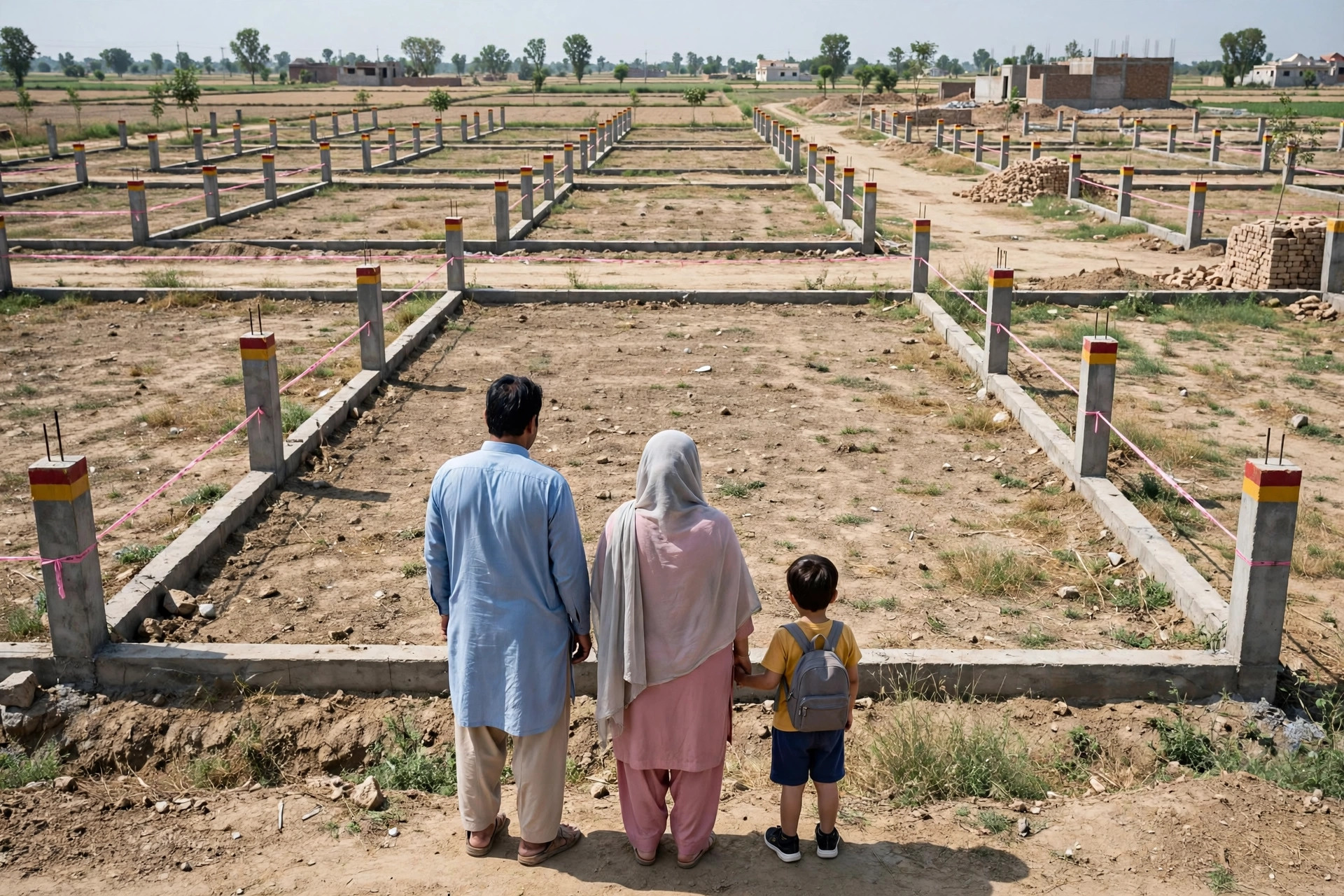
Apni Zameen Apna Ghar Punjab 2026 — Easy Guide to Free 3-Marla Plot, Eligibility & Apply
This is not an official Government of Punjab website. This guide is independent, general information about Apni Zameen Apna Ghar. For official information, always check the portal at azag.punjab.gov.pk before you apply or pay anything. Registration for Apni Zameen Apna Ghar is 100% free — never pay an agent.
What Is Apni Zameen Apna Ghar?
Apni Zameen Apna Ghar is the Punjab government’s scheme that gives a free 3-marla residential plot to homeless, low-income families. It is run by PHATA — the Punjab Housing and Town Planning Agency — under the Housing, Urban Development and Public Health Engineering Department, and it was launched under Chief Minister Maryam Nawaz. The idea is simple: a family that owns no house and no plot anywhere in Pakistan gets a free piece of land to build a home on.
Phase 1 of Apni Zameen Apna Ghar offers 1,892 plots in 23 schemes across 19 districts. The districts are Attock, Bahawalnagar, Bahawalpur, Bhakkar, Chiniot, Faisalabad, Gujrat, Jhang, Jhelum, Kasur, Khushab, Layyah, Lodhran, Mandi Bahauddin, Okara, Rajanpur, Sahiwal, Sargodha and Vehari. If you live in one of those districts and you own nothing, this scheme is for you. If you live in a district that is not on the list, you cannot apply in phase 1 — but later phases may add more districts, so check the portal for updates.
The plot is 3 marla, which is a small residential plot — enough for a modest house, not a mansion. The point is ownership: a family that has always rented, or lived with relatives, or lived in a katchi abadi, gets a piece of land in its own name, with government-verified ownership documents. That document — the proof that the land is yours — is worth more than the land itself, because it is the first step to a house, a loan, and a permanent address.
Example — the landless family in phase 1: A family in Bahawalpur has lived in a rented room for twenty years, moving every time the rent goes up. The father earns Rs 35,000 a month as a labourer, and the family owns no house and no plot anywhere in Pakistan. They apply for Apni Zameen Apna Ghar on the portal, are selected by computerised balloting, and receive a free 3-marla plot in their own district. For the first time, they have land in their own name.
Example — the widow with children and no home: A widow in Faisalabad lives with her brother’s family, with no home of her own and no income beyond a small pension. Her household income is below Rs 50,000 a month, and she owns nothing. She applies for Apni Zameen Apna Ghar in her district, and if she is selected by balloting, the plot gives her children a place that is theirs.
Apni Zameen Apna Ghar vs Apni Chhat Apna Ghar — Do Not Mix Them
This is the most important section in this guide, because readers constantly confuse two programmes with similar names. They are different schemes, for different people, and the table below separates them.
| Feature | Apni Zameen Apna Ghar | Apni Chhat Apna Ghar |
|---|---|---|
| What you get | A FREE 3-marla plot | An interest-free housing LOAN |
| Who it is for | People who own NOTHING — no house, no plot anywhere in Pakistan | People who already OWN a plot (up to 5 marla urban / 10 marla rural) |
| What it costs | Free — registration is 100% free | A loan, to be repaid, for building on your own plot |
| Portal | azag.punjab.gov.pk | acag.punjab.gov.pk |
| Run by | PHATA | Punjab government housing programme |
Apni Zameen Apna Ghar gives you land. Apni Chhat Apna Ghar gives you a loan to build on land you already own. If you own nothing, you want Zameen. If you own a plot but cannot afford to build, you want Chhat. Applying to the wrong one wastes your time — and if you own a plot, your Zameen application will be refused, because the Zameen rule is that you own nothing. Our Apni Chhat Apna Ghar post explains the loan programme in detail — see our Apni Chhat Apna Ghar guide.
Apni Zameen Apna Ghar — Who Can Apply
The eligibility rules for Apni Zameen Apna Ghar are fixed, and they are checked against records. The table below gives them.
| Condition | Requirement |
|---|---|
| Residence | Permanent Punjab resident, with CNIC |
| District | Apply ONLY in your own district |
| Ownership | Neither the applicant, the spouse nor dependent children own any house or plot anywhere in Pakistan |
| Income | Household income below Rs 50,000 per month |
| Record | Clean criminal record |
| Bank | Not a bank defaulter (reported) |
| Preference | NSER-registered with a PMT score of 60 or below (reported) |
The ownership rule is the heart of the scheme: neither you, your spouse, nor your dependent children may own any house or plot anywhere in Pakistan. The department checks this. A family that owns a small plot in a village — even an old one, even an inherited one — does not qualify. The scheme is for families who own nothing at all.
The income rule is also strict: the household income must be below Rs 50,000 a month. A family earning Rs 55,000 is outside the scheme. The preference rule is a hedge: NSER-registered families with a PMT score of 60 or below are reported to get preference, but the department has not confirmed that preference on its own page, so this guide presents it as reported, not as a guarantee.
The district rule matters too. You apply only in your own district, and only if your district is in phase 1. A family from a district that is not on the phase 1 list cannot apply in this phase, whatever their need.
Apni Zameen Apna Ghar — How to Apply
The application for Apni Zameen Apna Ghar is online, on the official portal, with offline help available. The steps below follow the official route.
Step 1: Check That Your District Is in Phase 1
Check the list of 19 districts above. If your district is on it, you can apply. If it is not, you cannot apply in phase 1 — check the portal later for new phases. Do not apply in another district: applications are only for your own district, and an application in the wrong district will be rejected.
Step 2: Open the Official Portal
Go to azag.punjab.gov.pk, the official Apni Zameen Apna Ghar portal. Type the address yourself — do not follow a link from a message. Fake portals collect CNIC numbers and bank details. The real portal is a .gov.pk address.
Step 3: Register and Fill in the Form
Register on the portal, fill in the form, and upload your documents: your CNIC, proof of residence, proof of income, and a declaration that you, your spouse and your dependent children own no house or plot anywhere in Pakistan. Be honest — the department verifies the ownership claim, and a false declaration ends the application.
Step 4: Get Help Offline If You Need It
If you cannot apply online, go to the Assistant Commissioner office or the District Housing Authority desk in your district. The staff there can help you with the form. The application is free either way — online or offline, no one can charge you for it.
Step 5: Wait for the Computerised Balloting
Selection is by computerised balloting. There is no interview, no test, and no merit list — the computer draws the names. If you are selected, you will be told through the portal and by SMS. If you are not selected, your application does not carry to the next phase automatically — check the portal for the next round.
Apni Zameen Apna Ghar — The Plot Conditions
The plot comes with conditions, and you should know them before you apply. The table below gives them.
| Condition | Rule |
|---|---|
| Use | Residential use only |
| Sale or transfer | No sale or transfer for 5 years (reported) |
| Ownership | Government-verified ownership documents |
| Construction loan | Rs 15 lakh interest-free construction loan reported as an add-on — hedge it, do not promise it |
The no-sale rule is reported: the plot cannot be sold or transferred for five years. That rule exists to stop people from taking a free plot and selling it the next week. The plot is for building a home, not for trading. The construction loan is also reported, not confirmed: a Rs 15 lakh interest-free construction loan is reported as an add-on to the plot award. This guide hedges it — it is reported, not promised. Do not plan your house around a loan that is not confirmed on the official portal.
Common Problems — and What to Do
Your District Is Not in Phase 1
If your district is not among the 19 in phase 1, you cannot apply now. Check the portal for later phases. Do not apply in another district — the application will be rejected, and you will have wasted the effort. The programme may add districts in later phases, and the portal is the place to watch.
You Own a Small Plot and Did Not Know It Disqualified You
The ownership rule covers any house or plot anywhere in Pakistan, however small, however old, however inherited. If your family owns a plot in a village, you do not qualify for Apni Zameen Apna Ghar — but you may qualify for Apni Chhat Apna Ghar, the loan programme for people who already own a plot. See our Apni Chhat Apna Ghar guide.
The Portal Rejects Your Application
If the portal rejects your application, check the reason. The most common reasons are: the district is wrong, the CNIC number is wrong, or the income figure is over Rs 50,000. Fix the error and apply again. If the reason is ownership — the department found a plot in your family’s name — the rejection is final for this phase.
Someone Asks You to Pay for a Plot
Registration for Apni Zameen Apna Ghar is 100% free. Anyone who asks for money for a plot, a form, or a “guaranteed” selection is running a scam. The helpline is 0800-09100 (reported). Report the person and do not pay.
Apni Zameen Apna Ghar — Mistakes That Cost You the Plot
The first mistake is applying in the wrong district. Apply only in your own district, and only if it is in phase 1. The second mistake is hiding ownership. The department verifies the ownership claim, and a false declaration ends the application. The third mistake is confusing Zameen with Chhat — land versus loan. If you own a plot, you want Chhat, not Zameen. The fourth mistake is paying an agent. Registration is free. The fifth mistake is planning around the reported Rs 15 lakh construction loan. It is reported, not confirmed — do not build your budget on it until the portal confirms it.
What Happens After Balloting — From Selection to Ownership
Balloting is not the end of the process — it is the middle. A family selected by the computerised draw is told through the portal and by SMS, and then the verification begins. The department checks the ownership claim again, checks the income, and checks the district. A family that passes the checks is allotted a plot, and the allotment is recorded in the department’s books.
The allotment comes with documents: the government-verified ownership papers that prove the land is yours. Keep those papers safe — they are the proof of ownership, and they are the first thing a bank, a court, or a future buyer will ask for. The papers are worth more than the plot itself in one sense: without them, the plot is just a piece of ground, and with them, it is an asset in your name.
The plot is allotted for residential use, and the family is expected to build on it. The five-year no-sale rule is reported, not confirmed — but the intention is clear: the plot is for a home, not for trading. A family that builds a house on its plot has turned a free piece of land into a permanent home, and that is the whole purpose of the scheme.
Building on Your Plot — The Next Steps
A plot is not a house, and the hard work starts after the allotment. The first step is to plan: a 3-marla plot is small, and a modest house — two rooms, a kitchen, and a bathroom — is what fits on it. A family that plans for a big house on a small plot will be disappointed; a family that plans for a modest house will have a home.
The second step is money. The reported Rs 15 lakh interest-free construction loan is not confirmed, so do not plan your house around it. Build in stages if you must: a boundary wall first, then a room, then the rest. A house built in stages is still a house, and a family that builds slowly is still building.
The third step is the paperwork: the building plan, the water connection, and the electricity connection. Each one needs the ownership papers, so keep them safe and keep copies. A family with its papers in order gets its connections faster than a family that has lost them.
Who Builds First — What the First Families Did
The first families to receive a plot faced the same question every selected family faces: what do you build first? The answer, from the families who built first, is always the same — a boundary wall. A wall marks the plot as yours, it keeps the land safe, and it is the cheapest first step. A family that builds a wall first has a plot that is protected while the house is planned.
The second step is a single room with a roof, a door, and a window — a place to sleep, a place to store your things, and a place to call home. A room with a roof is a home, even if it is only one room. The kitchen and the bathroom come next, and the second room comes after that. A house built in stages is still a house, and a family that builds slowly is still building.
The lesson is patience. A 3-marla plot is small, and a house on it is built over months, not days. The families who succeeded were the ones who built one thing at a time, paid for it as they went, and did not borrow money they could not repay. The plot is free — the house is earned, one wall at a time.
And when the house is finished, the family owns something no one can take away: a home, in their own name, on land that is theirs. That is the promise of the scheme, and it is kept one brick at a time. A family that owns its home is a family that can plan for the future, because no landlord can ask them to leave — and no rent increase can force them out. The house may be small, but it is yours, and that is what matters most of all.
Your Apni Zameen Apna Ghar Checklist
- I live in one of the 19 phase 1 districts, and I will apply only in my own district.
- Neither I, my spouse nor my dependent children own any house or plot anywhere in Pakistan.
- My household income is below Rs 50,000 a month.
- I have a clean criminal record and I am not a bank defaulter.
- I will apply ONLY on azag.punjab.gov.pk — no agent, no payment.
- I know selection is by computerised balloting — there is no interview and no test.
- I know the plot is for residential use only, with no sale or transfer for 5 years (reported).
- I know the Rs 15 lakh construction loan is reported, not confirmed, and I will not plan around it.
Common Questions
What is Apni Zameen Apna Ghar? Apni Zameen Apna Ghar is the Punjab government’s scheme that gives a free 3-marla residential plot to homeless, low-income families. It is run by PHATA, and phase 1 offers 1,892 plots in 23 schemes across 19 districts.
Who can apply for Apni Zameen Apna Ghar? A permanent Punjab resident with a CNIC, applying in their own district, whose household income is below Rs 50,000 a month, and where neither the applicant, the spouse nor dependent children own any house or plot anywhere in Pakistan.
How do I apply for Apni Zameen Apna Ghar? Apply on the official portal azag.punjab.gov.pk — register, fill in the form, and upload your documents. Offline help is available at the Assistant Commissioner office or the District Housing Authority desk. Registration is free.
Is Apni Zameen Apna Ghar really free? Yes. Registration is 100% free, and the plot is free. Never pay an agent for a plot or a form. The helpline is 0800-09100 (reported).
What is the difference between Apni Zameen Apna Ghar and Apni Chhat Apna Ghar? Apni Zameen Apna Ghar gives a FREE plot to people who own nothing. Apni Chhat Apna Ghar gives an interest-free housing LOAN to people who already own a plot. They are different programmes — see our Apni Chhat Apna Ghar guide for the loan.
How are plots selected in Apni Zameen Apna Ghar? By computerised balloting. There is no interview and no test. Selected applicants are told through the portal and by SMS.
Can I sell the plot I get from Apni Zameen Apna Ghar? No sale or transfer is allowed for 5 years, as reported. The plot is for residential use only, for building a home.
Which districts are in phase 1 of Apni Zameen Apna Ghar? Attock, Bahawalnagar, Bahawalpur, Bhakkar, Chiniot, Faisalabad, Gujrat, Jhang, Jhelum, Kasur, Khushab, Layyah, Lodhran, Mandi Bahauddin, Okara, Rajanpur, Sahiwal, Sargodha and Vehari — 19 districts, 23 schemes, 1,892 plots.
Conclusion
Apni Zameen Apna Ghar is land for the landless: a free 3-marla plot, in your own district, for a family that owns nothing and earns less than Rs 50,000 a month. Phase 1 covers 19 districts and 1,892 plots, and selection is by computerised balloting — no interview, no test, no fee. Apply on azag.punjab.gov.pk, in your own district, and be honest about ownership and income.
Do not confuse it with Apni Chhat Apna Ghar, the loan for people who already own a plot. If you own a plot and need money to build, the loan is your route — see our Apni Chhat Apna Ghar guide, and our PM loan scheme for house Pakistan post for the federal housing loan. If you need proof of residence for your application, our guide to the Punjab domicile certificate 2026 explains it, and our Punjab land record fard online 2026 guide explains how to check a land record.





One Comment