Apna Gaon Programme Punjab — Easy Guide to 485 Villages, Cooperative Societies & the 44-Day Launch
This is not an official Government of Punjab website. This guide is independent, general information about the Apna Gaon Programme Punjab. The programme was approved on 17 November 2026, and no list of villages has been released yet. For official information, always check the Punjab government portal at punjab.gov.pk before you act. Never pay anyone for registration or inclusion.
What Is the Apna Gaon Programme Punjab?
The Apna Gaon Programme Punjab is a village development programme approved on 17 November 2026 by Chief Minister Maryam Nawaz. It is also called the Khushhal Dehat Programme in a Dunya News report — the same initiative, under a second name. The programme works through cooperative societies: residents of a village form a cooperative society, and the society decides the village’s development priorities. The government then funds the works the society chooses. It is a different way of developing villages — the village decides, instead of an office far away deciding for it.
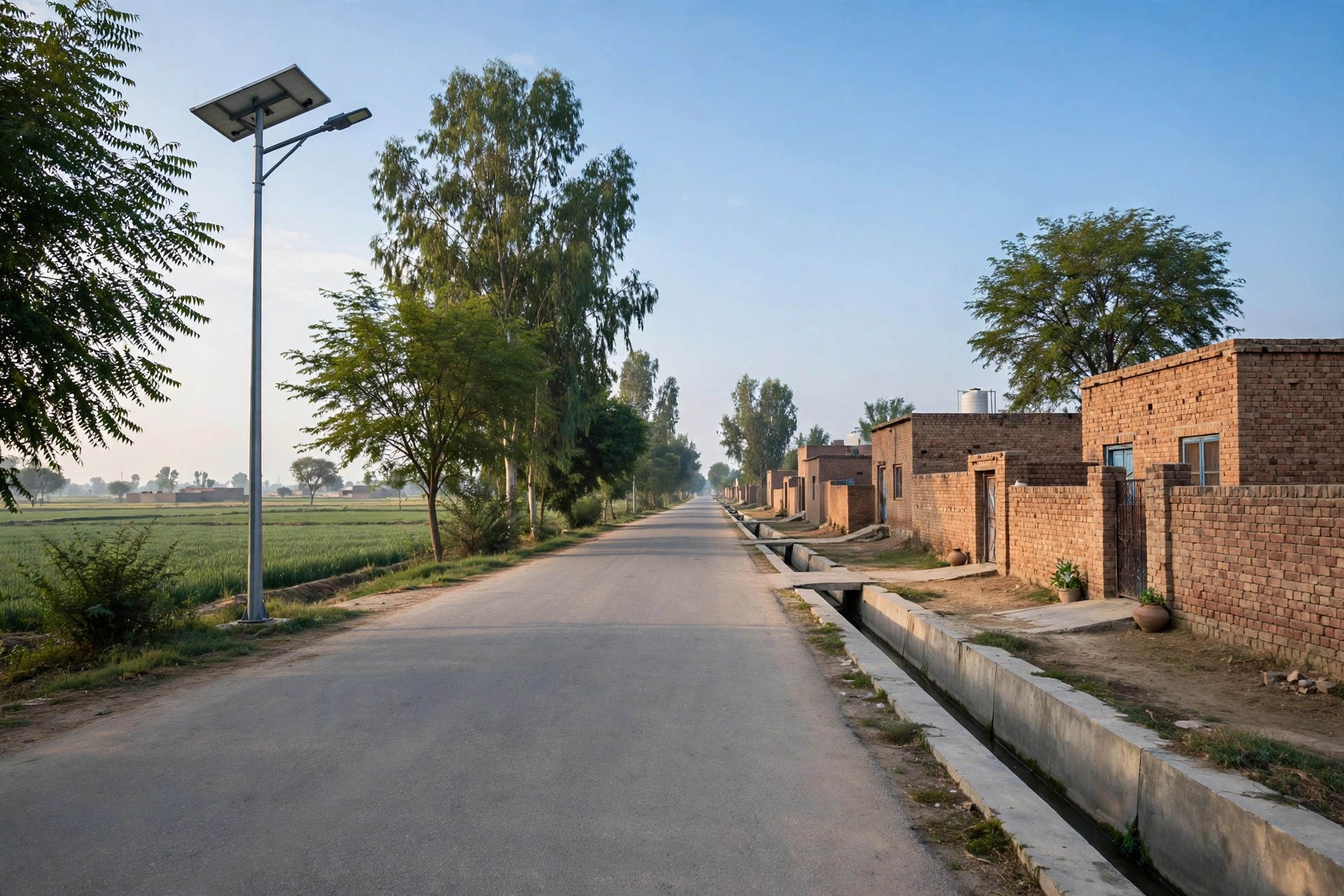
The Apna Gaon Programme Punjab starts with 485 villages in Phase 1, organised through cooperative societies, and then a further 1,500 villages in Phase 2 — a total planned coverage of 1,985 villages. The Chief Minister set a 44-day deadline to launch, which runs to about the end of December 2026. The works named in the announcement are the basics every village needs: paved streets, modern drainage systems, wastewater disposal ponds, and solar streetlights. For the launch, the government partially lifted a 29-year ban on cooperative societies — a ban that had stood since the late 1990s — so that the societies could be formed for this model.
The Apna Gaon Programme Punjab matters because village development in Punjab has usually been decided from above: a scheme announced in Lahore, a list made in an office, works chosen by officials who have never visited the village. The cooperative model reverses that. The residents decide — which street is paved first, where the drainage goes, where the pond is built. Whether it works in practice depends on whether the societies are genuinely run by residents, and whether the money follows their decisions. That is the question to watch as the programme launches.
Example — the village that needs a drain first: A village in Gujranwala has one street that floods every monsoon, because there is no drain. Under the Apna Gaon Programme Punjab, the village’s cooperative society could choose the drain as its first work, ahead of a streetlight or a paved lane. The residents know which problem hurts most — the programme’s idea is that they should choose.
Example — the village that was promised a list: A village in Bahawalpur heard about the Apna Gaon Programme Punjab and asked whether it was among the first 485 villages. Nobody could say — no list of the 485 villages has been released. The village’s residents decided to form their cooperative society anyway, so that they are ready when the list comes. That is the right response: prepare, do not pay anyone who claims to know the list.
Apna Gaon Programme Punjab vs Apni Zameen Apna Ghar — Do Not Confuse Them
The two programmes sound alike — both have “Apna” in the name, both were announced by the same Chief Minister — but they do different things. The box below keeps them apart.
| Apna Gaon Programme Punjab | Apni Zameen Apna Ghar | |
|---|---|---|
| What it gives | Village infrastructure | Housing plots |
| Who it is for | Whole villages, through cooperative societies | Individual families who need a plot |
| Works | Paved streets, drainage, wastewater ponds, solar streetlights | A free plot of land for a house |
| First phase | 485 villages | Plots allocated by balloting |
| Status | Approved 17 Nov 2026, launching by end Dec 2026 | Announced, plots being allocated |
The Apna Gaon Programme Punjab builds things a whole village shares: streets, drains, ponds, lights. Apni Zameen Apna Ghar gives a plot to one family, for that family to build a house on. A village can be in the Apna Gaon programme and its families can also hold Apni Zameen plots — the two do not exclude each other. But they are separate programmes, with separate lists, separate budgets and separate offices. Our guide to Apni Zameen Apna Ghar explains the plots scheme. This guide is only about the villages programme.
How the Apna Gaon Programme Punjab Works
The Apna Gaon Programme Punjab works through cooperative societies, and the society is the centre of the whole model.
Step 1: The Village Forms a Cooperative Society
Residents of a village form a cooperative society — a registered group that represents the village. This is the step the 29-year ban had blocked: cooperative societies were banned for 29 years, and the ban was partially lifted for this programme so that societies could be formed. The society is the village’s voice: it meets, it discusses, and it decides the village’s priorities.
Step 2: The Society Decides the Priorities
The society decides what the village needs first. The works named in the announcement are paved streets, modern drainage systems, wastewater disposal ponds and solar streetlights — but the choice of which work comes first, and where it goes, is the society’s. A village with a flooding street chooses the drain. A village with no light at night chooses the streetlights. The residents know their village; the programme’s idea is that they should decide.
Step 3: The Government Funds the Works
The government funds the works the society chooses, through the programme. The details of how the money flows — how much per village, who holds it, how it is audited — have not been published yet. That is a gap this guide states plainly: the announcement names the works and the model, but not the money. Watch for the funding details when the programme launches.
Step 4: The Works Are Built
The works are built in the village: streets paved, drains laid, ponds dug, lights installed. The society watches the work, because it is the society’s village and the society chose the work. Whether the quality holds depends on that watching — a society that checks the work gets better work than a society that does not.
What Is NOT Confirmed About the Apna Gaon Programme Punjab?
This is the part of the guide that matters most, because it is where false promises live. The following are not confirmed as of 25 November 2026:
- No budget figure was published. The announcement does not say how much money the programme has. Any figure you hear — in billions, per village, per phase — is invented until an official source publishes it.
- No list of the 485 first-phase villages was released. A reader cannot yet check whether their village is included. Any person who claims to know the list is guessing or lying.
- No registration step exists. There is no form to fill in, no office to visit, and no fee to pay to join the programme. A village does not “register” for Apna Gaon — the programme comes to villages through the cooperative societies, and the selection of the first 485 has not been published.
- No funding details. How much money goes to each village, who holds it, and how it is audited have not been published. Do not believe a figure until it appears on punjab.gov.pk or in a Chief Minister’s statement reported by a major newspaper.
If a piece of news, a video or a person fills in any of these gaps, ask for the source. The source should be the Punjab government portal or a statement by the Chief Minister reported by Dawn, The News or Dunya News. A YouTube video, a WhatsApp forward or an agent’s word is not a source. Until an official source fills a gap, the gap stays empty.
The 44-Day Launch Deadline — What It Means
The Chief Minister set a 44-day deadline to launch the Apna Gaon Programme Punjab. The programme was approved on 17 November 2026, so 44 days runs to about the end of December 2026. That is the deadline for the launch — the programme’s start — not for the works to be finished. Paving 485 villages’ streets and laying their drains will take far longer than 44 days. The deadline means the programme should be running by the end of December: societies formed, first villages named, first works started.
A deadline is a promise to watch, not a guarantee. Governments set launch deadlines and miss them. If the end of December passes with no list of villages and no works started, the deadline was missed, and the programme is late. That does not mean it is cancelled — it means it is late, and the delay should be asked about. Watch for three things by the end of December: the list of the 485 villages, the funding figure, and the first works starting. If none of the three appears, the programme has not launched on time.
The 44-day deadline also matters for your village’s preparation. If your village is not among the first 485, it may be in the 1,500 of Phase 2 — but Phase 2 has no date either. The useful preparation is the same either way: form the cooperative society, discuss your priorities, and keep your village’s records straight. A village that is organised when its turn comes will move faster than a village that starts organising then.
How Your Village Can Prepare
Your village cannot register for the Apna Gaon Programme Punjab, because there is no registration. But it can prepare, and preparation is free.
First, talk to your neighbours about forming a cooperative society. The society is the programme’s unit — the village’s voice. A society needs residents who will meet, discuss and decide. It needs a record of who its members are. It needs someone to keep the minutes. None of this costs money, and all of it can be done now.
Second, list your village’s priorities. Walk the village. Which street floods? Where does the wastewater go? Which lane has no light? Write the list down, in order, with the residents’ agreement. When the programme reaches your village, the society will be asked what it wants first — a village with a ready list answers at once, and a village without one argues for weeks.
Third, keep your village’s records straight. Land records, the Fard, the mutation record — the programme’s works touch land, and clean records make everything faster. Our guide to Maryam Ki Dastak explains the doorstep service that can bring government services to your village while you wait.
Fourth, do not pay anyone. No one can put your village on the list of 485, because the list has not been published. No one can register your village, because there is no registration. Anyone asking for money to do either is running a scam. Report them to your district office, and warn the neighbouring villages.
Common Problems — and What to Do
Someone Offered to Put Your Village on the List
Refuse. The list of the 485 villages has not been released, and no one outside the government can put a village on it. Anyone asking for money to do so is stealing from you. Report the person to your district office.
Your Village Formed a Society but Hears Nothing
If your village formed a cooperative society and hears nothing, that is normal for now — the programme was approved on 17 November 2026 and the launch deadline runs to the end of December. Wait for the launch. Keep the society meeting, keep the priorities list current, and check punjab.gov.pk once a month. If the end of December passes with no list, ask your district office what the status is.
Two Groups in the Village Both Claim to Be the Society
If two groups both claim to be the cooperative society, the village must settle it — one society, one voice. A programme cannot work with two societies claiming the same village. Hold a village meeting, agree on one society with a written record of members, and register it properly when the procedure is published. Do not let the dispute delay the village’s preparation.
You Heard a Budget Figure from a Video
A budget figure from a video, a forward or a social media post is not a budget figure. No budget figure was published with the announcement. Until one appears on punjab.gov.pk or in a Chief Minister’s statement, there is no budget figure — and no village should plan spending around one.
The Programme Misses Its December Deadline
If the end of December passes with no list and no works, the programme is late. That is a fact to note, not a reason to pay someone who promises to “fix” it. Ask your district office for the status, and watch for the official announcement. A late programme can still launch — but only the government can launch it.
Apna Gaon Programme Punjab — Mistakes That Cost Your Village
The first mistake is paying to get on the list. There is no list yet, and no one can add a village to it for money. Money paid to get on the list is money lost.
The second mistake is believing a village list from an unofficial source. A list on a video or a forward is invented. The real list, when it comes, will be on punjab.gov.pk or in a major newspaper. Until then, no list exists.
The third mistake is not forming the society. The cooperative society is the programme’s unit. A village without a society has no voice in the programme, and will wait while organised villages move first. Form the society now, while there is time.
The fourth mistake is letting the village argue about priorities after the programme arrives. Decide now, in the village, which work comes first. A village that argues for weeks after its turn comes will watch its turn pass to a village that decided earlier.
The fifth mistake is confusing this programme with the plots scheme. Apni Zameen Apna Ghar gives plots to families. The Apna Gaon Programme Punjab builds streets, drains, ponds and lights for whole villages. A family can benefit from both, but they are separate programmes with separate lists. Do not apply for one when you mean the other.
Your Apna Gaon Programme Punjab Checklist
- I know the Apna Gaon Programme Punjab was approved on 17 November 2026, and it is also called the Khushhal Dehat Programme.
- I know Phase 1 covers 485 villages through cooperative societies, and Phase 2 covers a further 1,500 villages — 1,985 in total.
- I know the works are paved streets, modern drainage, wastewater disposal ponds and solar streetlights.
- I know the Chief Minister set a 44-day deadline to launch, running to about the end of December 2026.
- I know NO budget figure was published and NO list of the 485 villages was released.
- I know there is no registration step and no fee — a village cannot register for this programme.
- I know my village should form its cooperative society now and list its priorities, so it is ready when its turn comes.
- I will never pay anyone to put my village on the list, and I will check punjab.gov.pk once a month for the real list.
Common Questions
What is the Apna Gaon Programme Punjab? The Apna Gaon Programme Punjab is a village development programme approved on 17 November 2026. It works through cooperative societies: residents decide their village’s priorities, and the government funds the works — paved streets, modern drainage, wastewater disposal ponds and solar streetlights.
How many villages are in the Apna Gaon Programme? Phase 1 covers 485 villages through cooperative societies, and Phase 2 covers a further 1,500 villages — a total planned coverage of 1,985 villages.
Is my village in the first 485? Nobody can say yet. No list of the 485 first-phase villages has been released as of 25 November 2026. Any person who claims to know the list is guessing or lying. Watch punjab.gov.pk for the real list.
How much money does the Apna Gaon Programme have? No budget figure was published with the announcement. Any figure you hear is invented until an official source publishes it.
How does a village join the Apna Gaon Programme? There is no registration step. A village forms a cooperative society, which is the programme’s unit, and the programme comes to villages through those societies. Prepare by forming the society and listing your priorities.
What is the 44-day deadline? The Chief Minister set a 44-day deadline to launch the programme, running from the 17 November 2026 approval to about the end of December 2026. It is the deadline for the launch, not for the works to be finished.
Is Apna Gaon the same as Apni Zameen Apna Ghar? No. Apni Zameen Apna Ghar gives housing plots to individual families. The Apna Gaon Programme Punjab builds infrastructure — streets, drainage, ponds, lights — for whole villages. They are separate programmes with separate lists.
What should I do if someone asks my village to pay for inclusion? Refuse and report them to your district office. There is no fee, no registration and no list yet. Anyone asking for money is running a scam.
Conclusion
The Apna Gaon Programme Punjab is a real approval with a real idea — villages deciding their own development through cooperative societies, starting with 485 villages and aiming for 1,985, with a 44-day launch deadline running to the end of December 2026. What is missing is just as real: no budget figure, no list of villages, no funding details, no registration. The honest position for a village today is to prepare and to wait: form the society, list the priorities, keep the records straight, and pay nobody. When the list comes, an organised village will be ready. Until then, the programme is a promise — and a promise is judged when it is kept, not when it is made.
If your family also needs a plot, our guide to Apni Zameen Apna Ghar explains the plots scheme — and if you need a government service at your doorstep while you wait, our guide to Maryam Ki Dastak explains the doorstep service.