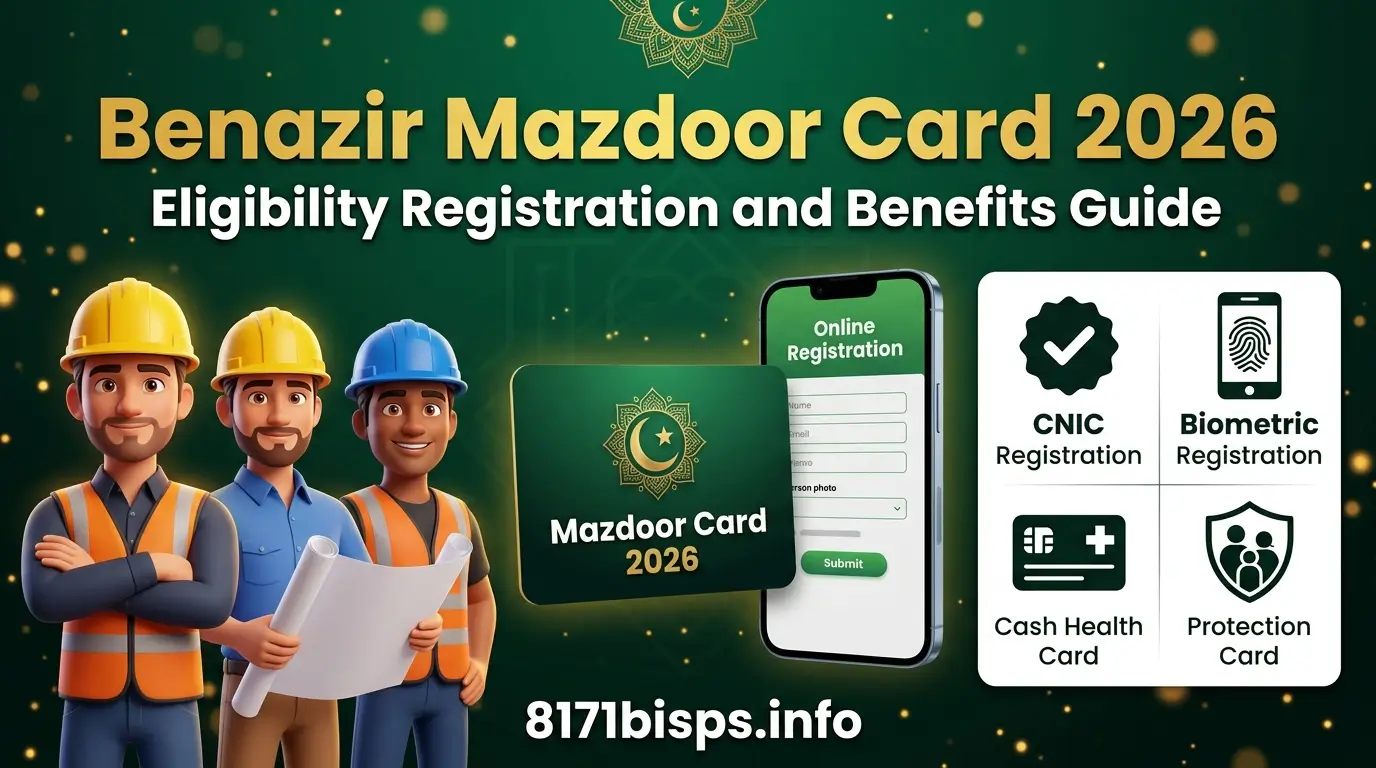
Benazir Mazdoor Card 2026 – Eligibility, Registration & Benefits
Guide for Pakistani Workers
What nobody tells you before you apply — real process, real timelines, real challenges
Quick Answer
What is the Benazir Mazdoor Card? It is a government-issued smart card providing Pakistani laborers with free healthcare, annual cash assistance, children’s education stipends, and accident/disability support. It was launched in Sindh in 2021 and expanded to Punjab in 2024–2025.
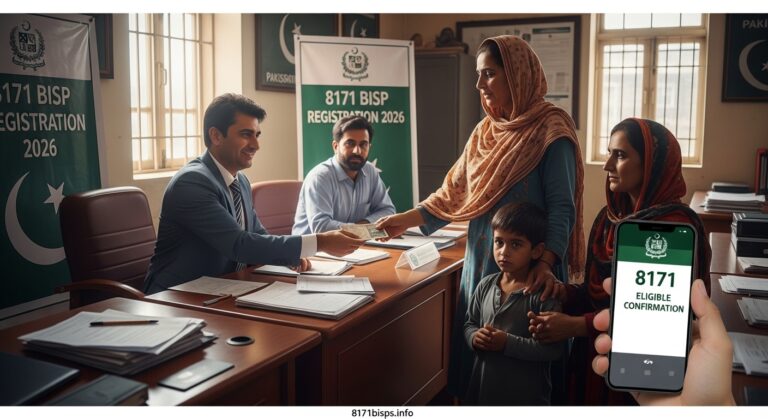
How to apply: Visit your nearest SESSI office (Sindh) or Labour Department / PESSI office (Punjab) with your CNIC, verified mobile number, and employment proof. SMS your CNIC to 8171 first to check your BISP status.
The Frustration Nobody Writes About
You searched for “Benazir Mazdoor Card” and found ten articles all saying the same thing: “Submit your CNIC. Visit the office. Get benefits.”
What they don’t tell you:
- Which province is this actually running in right now?
- What if you’re an informal worker with no employer letter?
- How long does it really take — two weeks or two months?
- Why do some people get rejected even when they qualify on paper?
This guide answers those questions honestly. I cross-referenced official government sources, NADRA documentation, Dawn news reporting from the program’s launch, and BISP records. Where things are still unclear, I’ll say so — because honesty is more useful than false confidence.
Background: Why This Program Exists
The Origin
The Benazir Mazdoor Card was launched on Labour Day, May 1, 2021 by the Sindh government under PPP Chairman Bilawal Bhutto Zardari. Punjab followed with its own expanded version under CM Maryam Nawaz in 2024–2025.
The Key Fact Most People Miss
Under Pakistan’s 18th Amendment, labour is a provincial subject. This means there is no single national Benazir Mazdoor Card. Each province runs its own version — different agencies, different benefit amounts, different eligibility rules.
Who Runs It Where
| Province | Implementing Body | Current Status |
| Sindh | SESSI + NADRA | Active |
| Punjab | PESSI + Labour Dept. | Expanding |
| KPK | BISP coordination | Partial |
| Balochistan | BISP coordination | Limited |
Why the Process Feels Slow
Three institutions — SESSI/PESSI, NADRA, and BISP — each verify your data independently through separate databases. When those databases don’t match (a common problem), it triggers manual resolution. That’s the real reason behind delays, not bureaucratic laziness.
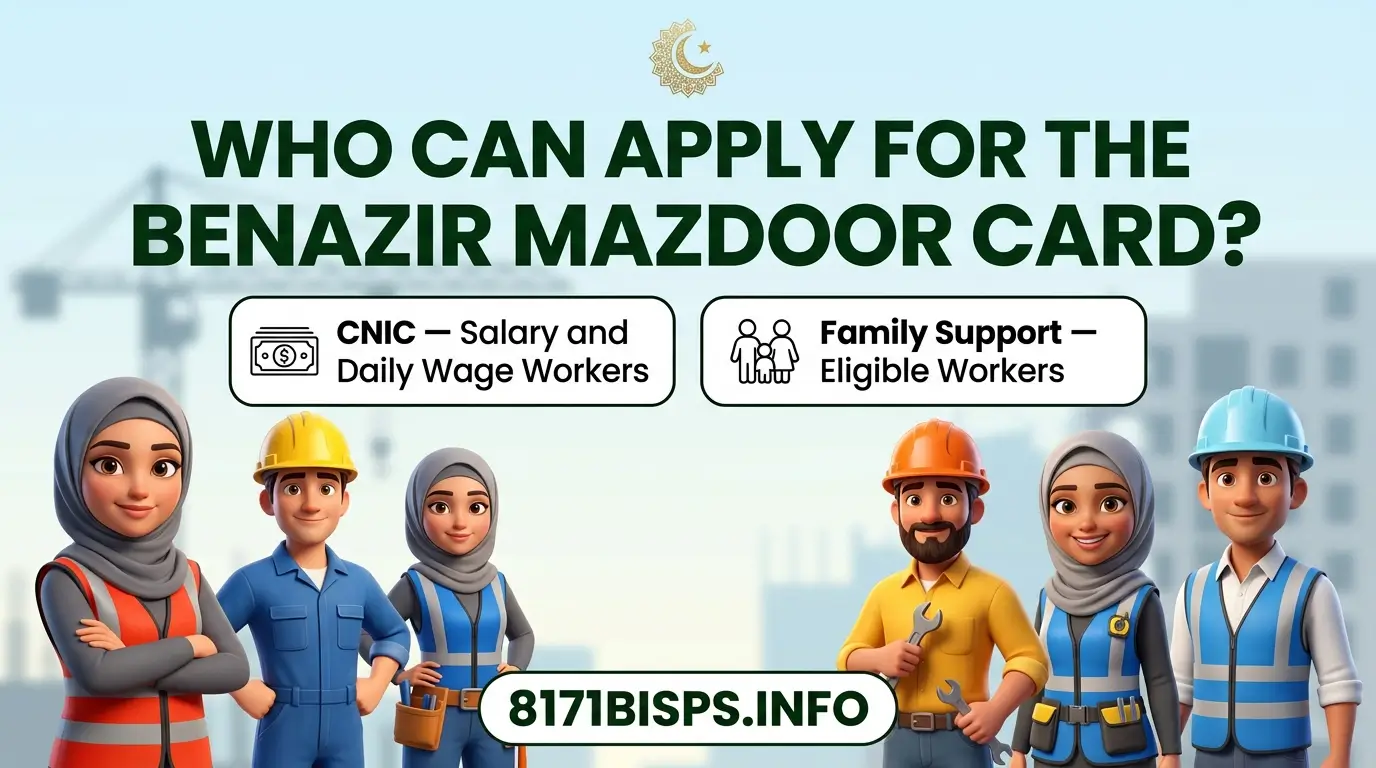
Who Qualifies for the Benazir Mazdoor Card
Basic Eligibility (Confirmed Across Provinces)
You likely qualify if you meet all of the following:
- Pakistani citizen with a valid, active CNIC
- Age 18–60 years
- Work as a laborer: construction worker, factory worker, domestic helper, driver, electrician, plumber, mason, rickshaw driver, or similar daily-wage occupation
- Monthly household income under 25,000–30,000 (threshold varies by province)
- Not a government employee
- Not a registered taxpayer
The Hidden Complexity: Formal vs. Informal Workers
This is the biggest gap in most guides — and it explains why some workers qualify easily while others struggle.
Formal workers
Registered with SESSI or PESSI, whose employer pays 6% social security contributions) are already in the system. Their application is fast and usually straightforward.
Informal workers
Domestic helpers, daily construction laborers, street vendors working for no fixed employer — face a harder path. They have to first enter a registration system that was never originally designed for them.
Important:
You may need a minimum of six months of registered employment with the Labour Department before you can apply. If you’ve never registered anywhere as a worker, that step comes first.
Who Is NOT Eligible
- Government employees at any level
- Registered taxpayers
- Self-employed contractors or small business owners (even with modest income — see Scenario C below)
- Anyone already receiving a conflicting major government welfare benefit (check with BISP before assuming)
Benefits: What You Actually Get
The Benazir Mazdoor Card (بینظیر مزدور کارڈ) provides:
- Healthcare — Free or subsidized treatment at SESSI/PESSI-affiliated hospitals for you and your family
- Cash Assistance — Annual financial support (reported at Rs. 12,000–13,500 depending on province and phase)
- Education Stipends — Children’s scholarships via the Taleemi Wazaif program (requires separate enrollment)
- Accident & Disability Aid — Emergency financial support for work injuries or disability
- Pension Support — Retirement benefits for workers who have been making SESSI/PESSI contributions
- Subsidized Rations — Access to Utility Store subsidized food items
Honest note: Benefit amounts vary by province and program phase. Do not make major financial decisions based on the highest figure you’ve seen online. Confirm exact amounts at your local office for your specific situation.
Documents You Need — And Why Each Matters
Don’t arrive unprepared. Here is what to bring, and why each document is actually required:
| Document | Why It’s Needed |
|---|---|
| Original CNIC | NADRA identity verification — photocopies alone are often rejected |
| CNIC-verified mobile SIM | All SMS notifications come through 8171 — unverified SIMs miss everything |
| Employment proof | Formal workers: SESSI number or employer letter. Informal workers: Union Council letter, affidavit of occupation, or union certificate |
| B-Form / Family Registration | Required to enroll children in scholarship benefits |
| Proof of address | Utility bill, tenancy agreement, or UC letter — program is province-residency based |
The Real Application Process — Step by Step
Step 1 Check Your BISP Status First
SMS your CNIC to 8171. If you’re not in the BISP database at all, you may need a household survey before proceeding.
Step 2 Fix Any Name Mismatches Now
If your name is spelled differently across your CNIC, union card, and utility bill — even “Muhammad” vs “Mohammad” — it will flag during NADRA verification and delay or reject your application. Resolve this before you go.
Step 3 Call the Office Before Visiting
Ask: “Kya aap ke yahaan Benazir Mazdoor Card registration ho rahi hai?” Not every district office has started registration simultaneously. One phone call saves a wasted day.
Step 4 Go to the Right Office
- Sindh workers: Nearest SESSI office or Sindh Labour Department district office
- Punjab workers: Tehsil-level Labour Department office or nearest PESSI center
- Unsure: Any BISP office can redirect you correctly
Step 5 Register and Submit Biometrics
Fill the form, provide your thumbprint for biometric verification. This confirms your CNIC identity and must be done in person.
Step 6 Photograph Your Acknowledgment Slip
This slip is your only proof of application. It contains your tracking reference. Photograph it on your phone the moment you receive it.
Step 7 Track and Collect
Check 8171 every two weeks. The government states 10 working days for processing. In practice, expect 3–8 weeks — faster for formally registered workers, slower for informal workers requiring manual data entry. Cards may be collected from the office or, in some cases, linked to JazzCash for withdrawals.
Three Real Scenarios
Scenario A The Easy Case
Khalid, 38, factory worker in Karachi, SESSI-registered for 4 years.
His employer had been paying SESSI contributions throughout his employment. He visited the SESSI district office with his CNIC and phone number. His biometric matched instantly against existing records. SMS confirmation arrived in 3 weeks. His children were enrolled in the scholarship program the following quarter.
Why it was easy: The system was built for workers like Khalid.
Scenario B The Harder Path
Zainab, 29, domestic helper in Lahore, no fixed employer.
No SESSI registration, no employer letter. The office required a Union Council letter confirming her occupation. She returned with it. Her name was spelled differently on the UC letter versus her CNIC — a two-week delay while a correction letter was processed. Total wait: six weeks. She received her card.
What this shows: The process works for informal workers, but demands patience and perfect paperwork.
Scenario C The Rejection
Imran, 44, construction contractor in Hyderabad.
Imran hires other laborers — he is not a wage earner himself. His contractor status disqualified him. An old business registration also put him above the income eligibility threshold.
The lesson: The program is for employed wage-earners, not self-employed contractors, even with modest incomes.
What Others Don’t Mention
The Stacking Question
Can you receive Benazir Mazdoor Card benefits alongside BISP Kafaalat? Official guidance is vague. The systems cross-check each other. Ask your BISP office directly before assuming the two can be combined.
The Online Portal Myth
Sources from 2024 and 2025 mention an “upcoming online registration portal.” As of mid2026, this remains in development for most provinces. Do not wait for it. Apply in person now.
The Political Reality
Dawn’s reporting at launch included public skepticism about equitable distribution. The NADRA biometric verification layer exists to add objectivity. Your best protection: arrive with documentation that is perfect and complete.
Healthcare Has Limits
Benefits only apply at empaneled hospitals — not every government hospital. Confirm which facilities in your city accept the Mazdoor Card before assuming full coverage.
Why the System Works This Way
Pakistan has roughly 70–80% of its workforce in the informal sector — no payslips, no employer registration, no social security number. The social protection system was built for the formal 20–30%. Extending it to everyone else means building new database infrastructure, worker by worker.
The Benazir Mazdoor Card is a genuine attempt to bridge SESSI/PESSI (old social security institutions), NADRA (identity infrastructure), and BISP (poverty targeting) into one smart card. The ambition is real. The execution is still maturing.
Workers who succeed fastest: those who arrive with consistent documentation, a verified SIM, and pre-confirmed employment status. They make it easy for the system to say yes.
What This Program Does NOT Solve
Be clear-eyed about limitations:
- Not income replacement — cash support is supplementary, not a living wage
- Not job protection — the card does not prevent termination or compensate lost wages
- Not universal healthcare — only works at designated empaneled facilities
- Scholarships aren’t automatic — require separate Taleemi Wazaif enrollment
- Limited outside Sindh/Punjab — KPK and Balochistan coverage remains sparse; verify in your district before traveling
Your Pre-Application Checklist
Before leaving home, confirm every item:
- SMS CNIC to 8171 — confirm BISP database status
- CNIC is active and current with NADRA
- Mobile SIM is registered to your own CNIC
- Name spelling is identical across all documents
- Employment proof obtained (SESSI number / employer letter / UC certificate / affidavit)
- B-Form or family registration documents for dependents
- Photocopies of every document made
- Called the office to confirm registration is active there
- Planning to go early — queues start long
- Phone ready to photograph the acknowledgment slip
Frequently Asked Questions
Q: What is the Benazir Mazdoor Card?
A: It is a government smart card providing Pakistani daily-wage workers with healthcare, cash assistance, education stipends, and accident support. It was first launched in Sindh in 2021 and is now expanding across provinces.
Q: How do I apply for the Benazir Mazdoor Card in 2025–2026?
A: Visit your nearest SESSI office (Sindh) or PESSI/Labour Department office (Punjab) with your CNIC, verified mobile number, and employment proof. There is currently no working online portal for most provinces — apply in person.
Q: Who is eligible for the Benazir Mazdoor Card?
A: Pakistani citizens aged 18–60, working as daily-wage laborers with household income under Rs. 25,000–30,000, who are not government employees or taxpayers.
Q: Is the Benazir Mazdoor Card registration free?
A: Yes. Registration is completely free. Do not pay anyone who claims to process your application for a fee.
Q: How long does it take to receive the card?
A: The government states 10 working days. Realistic expectation is 3–8 weeks, depending on whether you are formally registered with SESSI/PESSI or require manual verification as an informal worker.
Q: Can informal workers apply?
A: Yes, especially in Punjab’s expanded program. Informal workers typically need a Union Council letter or affidavit confirming their occupation. Registration may be slower as it requires manual verification.
Q: Can I receive both Benazir Mazdoor Card and BISP Kafaalat?
A: Not clearly defined in official guidance. Ask your BISP office directly — the two systems cross-check each other, and the answer may depend on your specific registration status.
Q: What documents are required for the Benazir Mazdoor Card?
A: Original CNIC, CNIC-verified mobile number, employment proof (SESSI number, employer letter, or UC certificate), B-Form for dependents, and proof of address.
Q: How do I check my Benazir Mazdoor Card status?
A: SMS your CNIC to 8171 or visit your nearest BISP facilitation center.
Q: What if my application is rejected?
A: Ask the office for the specific rejection reason in writing. Common causes are income threshold exceedance, contractor/self-employed status, government employment in the family, or documentation mismatches. Correct the issue and reapply.
Take Action Now
If you’re in Sindh: Call your nearest SESSI office today. Ask if you’re already in their database — you may qualify faster than you think.
If you’re in Punjab: Visit your tehsil Labour Department office. Dedicated Mazdoor Card counters are active in most districts.
If you’re in KPK or Balochistan: Call your nearest BISP office first — 0800-26477 (toll-free) — and ask specifically about Mazdoor Card availability in your district before traveling.
Key contacts:
- BISP Helpline: 0800-26477 (toll-free)
- Status check: SMS CNIC to 8171
- SESSI (Sindh): sessi.gov.pk
- PESSI (Punjab): pessi.gop.pk
- NADRA: 051-111-786-100
If someone you know qualifies, share this guide with them. The workers who miss out on this program aren’t undeserving — they’re simply uninformed. That’s a solvable problem.
About This Research
This guide draws from: government official statements, Dawn.com reporting from the 2021
Sindh launch, NADRA’s published documentation on the SESSI smart card agreement, BISP program records, and provincial Labour Department sources. I am not a government representative. Where details are uncertain, I’ve said so. The right source for your specific situation is always your local Labour Department or BISP office — not any website, including this one.
Benazir Mazdoor Card Guide · Information only · Verify at bisp.gov.pk · Updated May 2026
About the Author
This guide was researched and written by an independent content researcher focused on Pakistani government schemes, personal finance topics, and practical consumer guides. The goal is to turn complex official information into simple, accurate, and useful advice for everyday families.
Content is reviewed regularly to reflect policy updates, eligibility changes, and new application processes whenever reliable information becomes available.