
BISP Dynamic Survey (NSER) 2026 — Easy Step-by-Step Guide to Complete Your Re-Survey Before Disqualification
This is an independent informational website, not BISP’s official website. For official information, use the 8171 portal at 8171.bisp.gov.pk or call the BISP helpline 0800-26477.
What Is the BISP Dynamic Survey?
The BISP dynamic survey is BISP’s updated household survey, run through the National Socio-Economic Registry (NSER). When you first registered for BISP, your household information was recorded.
Over time, that information becomes old — incomes change, children grow up, families move. The BISP dynamic survey collects fresh information so BISP can confirm who still qualifies for support.
The BISP dynamic survey is not a new registration. It is a re-check of households that are already in the system, and it is now a condition for continuing to receive payments.
Think of it this way: your first registration was a photograph of your household at one moment in time. The BISP dynamic survey takes a new photograph. A family that qualified ten years ago may have a very different situation today — a son may now earn a regular wage, a daughter may have married and moved away, or the household may have become poorer after an illness or a job loss.
BISP cannot tell which of those is true from the old record alone, so it asks every household to update its information. The survey does not decide your eligibility by itself — your PMT poverty score does that, with a cut-off of 32 or below for standard households, or 37 or below where a family member has a disability — but the survey supplies the information that score is based on. You can check the current PMT rules in our PMT score check guide.
Example: A widow registered for BISP when her children were small and she had no income. Ten years later, two of her children are working and one has moved to another city. Her old record still shows a household with no earners. The dynamic survey records the new situation honestly, and her record is updated to match reality — which is exactly what the survey is for, whether the result is that she still qualifies or that her situation has changed.
Who Must Complete the BISP Dynamic Survey?
You should complete the dynamic survey if any of the following apply to you:
- You are a current BISP beneficiary and have received a message or notice asking you to complete the survey.
- Your payments have stopped or your status shows “survey required” on the 8171 portal.
- Your household information has changed since your first registration — for example, a change in income, family size, or address.
- You registered many years ago and have never been re-surveyed.
Even if you have not received a message, completing the BISP dynamic survey when your tehsil office asks for it is the safest way to protect your payments.
Do not wait for a message that may never come. Not every beneficiary receives an SMS — a message can go to an old mobile number, or be lost in network congestion on a busy day.
If your payments have stopped, that is itself a signal to check your status on the 8171 portal at 8171.bisp.gov.pk and to visit the tehsil office. If you are unsure whether your district is included in the current round of surveys, ask at your tehsil office or call the BISP helpline on 0800-26477, toll-free, Monday to Friday, 9:00 am to 5:00 pm — the office can tell you whether you need to complete the survey now. If you have moved to a different district since you first registered, tell the office: the survey is linked to your area of residence, and you should complete it at the tehsil office for the district where you now live.
Example: A beneficiary has never received a survey message, but her payment stops. She checks the portal and sees “survey required”.
She visits the tehsil office with her CNIC and her children’s B-Forms, completes the survey the same morning, and her payment is normally restored in the following payment cycle if she remains eligible. If she had kept waiting for a message, she would have missed another cycle for no reason.
Who should go first?
If any of these apply to you, do not delay: your payment has already stopped, the portal says “survey required”, you received a message or notice asking you to complete the survey, or your household has changed significantly since registration — a marriage, a death, a move, a new job, or a child leaving school. Households with no change and no message can still be asked to complete the survey when the tehsil office calls them, but the households above are the ones most at risk of losing a payment cycle while they wait.
What Happens If You Do Not Complete the BISP Dynamic Survey?
BISP has made it clear that beneficiaries who do not complete the BISP dynamic survey risk having their payments stopped. In many cases the payment is paused rather than cancelled — it can be restored after the survey is completed — but every missed payment cycle is money your family does not receive.
There is another risk: households whose updated information shows they no longer meet the eligibility criteria can be removed from the programme. That is the purpose of the survey.
Completing it honestly and on time is the only way to keep your record in good standing.
It is important to understand the difference between a paused payment and a removal. A paused payment is a hold while information is missing: complete the survey, the record is updated, and the payment is normally restored in the following payment cycle if you remain eligible.
A removal happens when the updated information itself shows the household no longer qualifies — for example, because the PMT score is now above the cut-off. Nothing about the survey can change a household’s real situation, but an incomplete survey can cause a payment to be paused even for a household that would still qualify. That is why delay is costly in two ways: it costs you the missed cycle, and it leaves your record in a state where no one can confirm you still qualify.
Example: Two neighbours are both asked to complete the survey. One goes the same week; her payment pauses for one cycle and then resumes.
The other waits six months, hoping the requirement will go away; she misses two payment cycles before she finally completes the survey. Both households still qualified — but the second family lost months of support for no reason other than delay.
How to Complete the BISP Dynamic Survey — Step by Step
Step 1: Visit Your Nearest BISP Tehsil Office
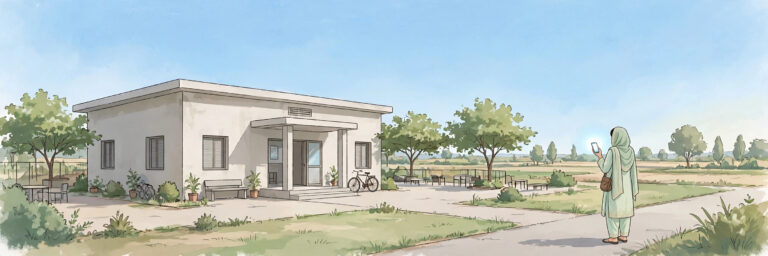
The BISP dynamic survey is completed in person at a BISP tehsil office. There is no online form for the full survey. Go to the office for your own district — the survey is linked to your area of residence.
Go early in the morning if you can, because queues are longest later in the day, and take a family member with you if the journey is long or you need help with the forms. You can find your nearest office through our BISP office near me guide. Do not pay anyone who offers to complete the survey for you, and do not follow anyone who claims the survey can be done online for a fee — the full survey is completed in person at the office, and the service is free.
Step 2: Bring the Right Documents
Take the following with you:
- Your original CNIC.
- The CNICs of other adult family members, if available.
- B-Forms of your children.
- Proof of residence, such as a utility bill, if you have one.
- Any disability certificate, if a family member has a disability.
Original documents are preferred. Photocopies may be accepted for some items, but the office will confirm.
Before you leave home, put the documents in one folder and check each one against the list.
If a child’s B-Form is missing, or an adult family member’s CNIC is not available, take what you have and tell the staff what is missing — do not stay away because one document is not ready. If you have a disability certificate for a family member, take it: the PMT cut-off is 37 or below where a family member has a disability, rather than 32, so that certificate can matter to the result. Keep the originals safe and do not hand them to anyone outside the office.
| Document | Why it is needed | If you do not have it |
|---|---|---|
| Your original CNIC | Proves your identity and links the survey to your record | Get it renewed or unblocked at NADRA first |
| Other adults’ CNICs | Records every adult in the household | Take what is available; tell the staff what is missing |
| Children’s B-Forms | Records your children and links Taleemi Wazaif | Take what you have; ask the office what to do about the rest |
| Proof of residence | Confirms your address, e.g. a utility bill | Take it if you have one; the office will tell you if it is needed |
| Disability certificate | Supports the higher PMT cut-off of 37 where applicable | Take it if a family member has a disability |
Step 3: Give Accurate Household Information
The survey asks about your household: family members, income sources, housing conditions, assets such as a vehicle or land, and children’s schooling. Answer honestly and completely. Giving false information can lead to disqualification and legal trouble, while honest answers simply record your real situation.
The questions may feel personal — income, assets, housing — but they are the information the eligibility score is based on, and an incomplete answer is worse than an honest one.
If you are unsure about a figure, say so and give your best honest estimate rather than guessing a precise number you cannot support. If a family member has moved away, say so; if a child has left school, say so. Leaving a person or an income source out of the survey can cause your record to be flagged later, when the missing information is discovered, and that flag can pause your payment all over again. Take your time, listen to each question, and ask the staff to repeat a question if you do not understand it — there is no penalty for asking.
Example: A household owns a small piece of land that earns almost nothing, and the beneficiary is tempted not to mention it. She mentions it honestly.
The land earns so little that it does not change her eligibility, and her record is now complete and consistent. In a different household, a son’s regular job is left out of the survey; when the omission is discovered later, the record is flagged and the payment is paused while the information is corrected. Honesty is not only the right choice — it is the choice that avoids a second problem later.
Step 4: Confirm Your Record Before Leaving
After the BISP dynamic survey, ask the staff to confirm that your record has been updated in the system. Note the date of your visit. Keep any receipt or slip they give you.
Do not leave without that confirmation. Ask the staff to show you on the screen that the survey has been recorded, and write down the date, the name of the office, and any reference or slip number they give you.
Keep that slip with your CNIC and your payment receipts — if a question about your survey comes up later, the date and the slip are your proof that you completed it. Before you leave, also ask whether anything else is needed from you, and whether your mobile number in the record is correct and in your own name, so future messages reach you.
BISP Dynamic Survey: How Long Does It Take?
The BISP dynamic survey itself usually takes less than an hour, although waiting times at busy tehsil offices can be longer. Go early in the morning to avoid the longest queues. After the survey, your updated record is processed by the system — payments are normally restored in the following payment cycle if you remain eligible.
The exact processing time after the survey is not published as a fixed number of days, so do not rely on a figure you hear from a neighbour or on social media.
What is known is the pattern: the survey is recorded, the system processes the updated record, and if you remain eligible the payment is normally restored in the following payment cycle. If your payment does not return in the next cycle, check your status on the 8171 portal at 8171.bisp.gov.pk first — it will tell you whether your case is still under verification or whether something else is missing — and then visit the tehsil office with your CNIC, the date of your survey, and any slip you were given. You can also confirm the release through our BISP payment check guide before you travel.
BISP Dynamic Survey: Common Mistakes to Avoid
- Waiting for a message that never comes. Not every beneficiary receives an SMS. If your payments have stopped, check your status on the 8171 portal and visit the office.
- Going to the wrong office. The survey must be done at the tehsil office for your district of residence.
- Paying an agent. The BISP dynamic survey is completely free. Anyone who asks for money to complete your survey or to speed it up is committing fraud.
- Giving incomplete information. Missing family members or income sources from the survey can cause your record to be flagged later.
Two more mistakes are worth naming. The first is bringing only photocopies and no originals: photocopies may be accepted for some items, but the office prefers originals, and a visit with no original CNIC at all will not complete the survey.
The second is leaving without confirming the record: a survey that was taken but never confirmed on the screen can leave you unsure whether it was actually recorded, and you will have no date or slip to show if a question arises later. Treat the confirmation step as part of the survey, not an optional extra.
BISP Dynamic Survey and Taleemi Wazaif
If your children receive the Taleemi Wazaif education stipend, the dynamic survey also affects that support, because the stipend is linked to your BISP household record and your children’s school enrolment. Completing the survey keeps both the Kafaalat payment and the education stipend active. Bring your children’s B-Forms and, if asked, proof of school enrolment.
The link is direct: the stipend is paid for children recorded in your BISP household, and it depends on their school enrolment. If the survey is incomplete, the household record is out of date, and the stipend can be affected along with the Kafaalat payment.
If a child has changed school, or a new child has started school since your last registration, the survey is the place to record it — and the B-Form and proof of enrolment are the documents that support it. You can read more in our Benazir Taleemi Wazaif guide.
Example: A mother’s Kafaalat payment stops because her survey is incomplete, and her daughter’s Taleemi Wazaif stipend stops at the same time.
She completes the survey with the children’s B-Forms and proof of school enrolment, her record is updated, and both payments are normally restored in the following payment cycle if the household remains eligible. One visit, with the right documents, protects both payments.
BISP Dynamic Survey Checklist: Before You Go for the Survey
- Check your status on the 8171 portal at 8171.bisp.gov.pk and note the exact message.
- Take your original CNIC and the CNICs of other adult family members, if available.
- Take your children’s B-Forms and, if asked, proof of school enrolment.
- Take proof of residence, such as a utility bill, if you have one.
- Take any disability certificate, if a family member has a disability.
- Go to the tehsil office for your own district, early in the morning if you can.
- Confirm on the screen that your record has been updated, note the date, and keep any slip.
- Do not pay anyone — the survey is free.
Work through the checklist the evening before you go, so a missing document does not cost you a second journey.
BISP Dynamic Survey Frequently Asked Questions
Do I have to complete the BISP dynamic survey even if I never received a message about it? Yes, if your tehsil office asks for it, or if your payment has stopped and the portal says “survey required”. Not every beneficiary receives an SMS, so check the portal at 8171.bisp.gov.pk and visit the office rather than waiting for a message.
Can I complete the BISP dynamic survey online? No. The full survey is completed in person at a BISP tehsil office — there is no online form for it. You can check your status on the 8171 portal, but the survey itself needs a visit. Anyone who offers to do it online for a fee is committing fraud.
How long does the survey take, and when will my payment return? The survey itself usually takes less than an hour, although queues can be longer at busy offices. After the survey, payments are normally restored in the following payment cycle if you remain eligible. The exact processing time is not published as a fixed number of days, so do not rely on a figure from a neighbour or social media.
What happens if my updated information shows I no longer qualify? Your household may be removed from the programme if the updated information shows it no longer meets the eligibility criteria — that is the purpose of the survey. Completing it honestly and on time is the only way to keep your record in good standing, and an honest survey is always better than an incomplete one that pauses your payment anyway.
Does the survey affect my children’s Taleemi Wazaif stipend? Yes. The stipend is linked to your BISP household record and your children’s school enrolment, so completing the survey keeps both the Kafaalat payment and the education stipend active. Bring your children’s B-Forms and, if asked, proof of school enrolment.
What should I do if I have completed the survey but my payment still has not returned? First check your status on the 8171 portal — it will tell you whether your case is still under verification or whether something else is missing. Then visit the tehsil office with your CNIC, the date of your survey, and any slip you were given, and ask the staff to look at your record with you. You can also check your status through our 8171 check online by CNIC guide.
BISP Dynamic Survey: Conclusion
The dynamic survey is now a routine part of staying in the BISP programme. It is free, it takes under an hour, and it protects your payments. If your payments have stopped or you have been asked to complete the survey, do not delay — visit your tehsil office with your CNIC and your children’s B-Forms, give accurate information, and confirm your record before you leave.
The cost of delay is measured in missed payment cycles, and the cost of the survey itself is only a morning at the tehsil office.
Check your status on the 8171 portal at 8171.bisp.gov.pk, take the documents in the checklist above, and complete the survey while your record is still in good standing. Your Kafaalat payment — Rs 14,500 per quarter for the Oct–Dec 2026 cycle, per the government’s June 2026 announcement, rising to Rs 18,000 planned from January 2027, with the exact amount for your cycle to be checked on the 8171 portal — and your children’s Taleemi Wazaif both depend on that record being up to date.