Punjab Zakat Rashan Card 2026 — Easy Guide to Rs 2,000 Guzara Allowance & Apply
This is not an official Government of Punjab website. This guide is independent, general information about the Punjab Zakat Rashan Card. For official information, always check the Punjab Zakat and Ushr Department at zakat.punjab.gov.pk before you apply. The Punjab Zakat Rashan Card is a Zakat-funded support — no one can charge you for an application.
What Is the Punjab Zakat Rashan Card?
The Punjab Zakat Rashan Card is the Punjab Zakat and Ushr Department’s monthly cash support for the poorest Muslim families in Punjab. It runs under the Punjab Zakat and Ushr Act 2018, and it pays Rs 2,000 a month to each person who qualifies — a person the department calls a “mustahiq”, someone entitled to Zakat under Shariah. The money is called the Guzara Allowance, and that name is the old one: the department’s own FAQ still uses both names, but the current programme is the Zakat Rashan Card.
The Punjab Zakat Rashan Card is different from most government schemes in one important way: there is no online application, no portal, and no SMS code. You apply in writing to the Chairman of the Local Zakat and Ushr Committee in your area of residence, and the committee decides whether you qualify — a decision the department calls “istehqaq” — after checking your financial condition. The committee is local, the decision is local, and the money is paid through branchless banking after biometric verification.
The second thing to understand is that this is Zakat money, and Zakat has rules. The person must be a Muslim, must be living below the poverty line, must be entitled to Zakat under Shariah, and must not own wealth above the Nisab. The Nisab for the year 1446–47 AH is Rs 503,529 — a person who owns wealth above that amount is Sahib-e-Nisab and cannot receive Zakat. Those rules are not the department’s invention; they are the Shariah rules for Zakat, and the department applies them.
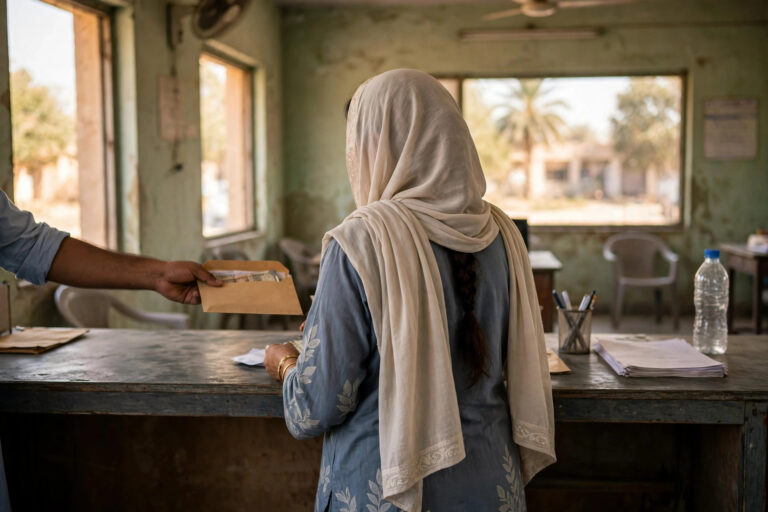
Example — the widow with no income: A widow in a village near Bahawalpur has no income, no property, and two small children. She writes to the Chairman of her Local Zakat Committee, the committee checks her condition, and she is declared a mustahiq. She receives Rs 2,000 a month through branchless banking, after biometric verification. It is not a large amount, but it is a regular amount, and it is hers by right.
Example — the labourer who cannot work: A daily-wage labourer in Lahore is injured and cannot work for months. His family has no savings and no other support. He applies to his Local Zakat Committee, the committee verifies that he is unemployed, not a government servant, and not receiving help from any other public body, and he starts receiving the Rs 2,000 monthly Guzara Allowance.
Punjab Zakat Rashan Card — Who Qualifies and Who Does Not
The Punjab Zakat Rashan Card has clear rules about who qualifies. The table below gives them.
| Condition | Rule |
|---|---|
| Religion | Adult Muslim |
| Poverty | Living below the poverty line |
| Zakat entitlement | Mustahiq — entitled to Zakat under Shariah |
| Employment | Unemployed |
| Government service | NOT a government servant |
| Pension | NOT a pensioner |
| Begging | NOT a habitual beggar |
| Wealth | NOT Sahib-e-Nisab — does not own wealth above Nisab (Rs 503,529 for 1446–47 AH) |
| Other help | NOT already receiving regular help from BISP, Bait-ul-Mal, PSPA or any other public body |
| Household | One person per household |
The last two rows are the ones that catch people out. If you are already receiving regular help from BISP, from Bait-ul-Mal, or from the Punjab Social Protection Authority, you cannot also receive the Punjab Zakat Rashan Card. The department checks this, and a person who is already on another public support list will be refused. The rule is one regular public support per person — not two, not three.
The one-person-per-household rule matters too. A household with two poor adults cannot get two cards. One person per household receives the Rs 2,000 a month, and the household is the unit. If your household is already receiving the card through another member, your application will be refused.
Punjab Zakat Rashan Card — Rs 2,000 a Month, and What Else the Department Offers
The Punjab Zakat Rashan Card pays Rs 2,000 a month per mustahiq, according to the official department FAQ checked in November 2026. The money is paid through branchless banking after biometric verification — which means you verify your identity with your fingerprint or face at the payment point, and the money goes to your account or wallet. There is no cash handed over by a committee member, and no deduction is allowed.
One rate conflict needs a clear note. An older Khyber Pakhtunkhwa Zakat page lists the Guzara Allowance at Rs 1,000. That is a different province’s page, and a different rate. This guide uses the Punjab department’s figure — Rs 2,000 a month — because this is the Punjab programme. Do not mix the two provinces’ figures.
The Zakat department offers other help too, and the table below lists it. These are separate from the Rashan Card, and they have their own rules.
| Help | Amount |
|---|---|
| Marriage Assistance | Rs 50,000 (paid by mobile wallet) |
| Education Stipends (General) | Rs 10,000–20,000 per year (through the head of the institution) |
| Deeni Madaris stipends | Rs 5,000–15,000 per year |
| Guzara Allowance for Blinds | Discontinued for the current financial year — do NOT present it as open |
The last row matters: the Guzara Allowance for Blinds is discontinued for the current financial year, according to the department page. Do not apply for it, and do not tell anyone it is open. It is not.
Punjab Zakat Rashan Card vs CM Punjab Ration Card — Do Not Mix Them
This is the most important section in this guide, because readers constantly confuse two programmes with similar names. They are different programmes, run by different departments, with different amounts, different rules, and different ways to apply. The table below separates them.
| Feature | Punjab Zakat Rashan Card | CM Punjab Ration Card |
|---|---|---|
| Amount | Rs 2,000/month cash grant | Rs 3,000/month |
| Run by | Punjab Zakat and Ushr Department | Punjab government ration programme (PSER-based) |
| How you apply | Written application to the Local Zakat Committee | PSER registration, digital card for grocery purchases |
| What you get | Cash through branchless banking | A digital card for buying groceries |
| Who decides | Local Zakat Committee, after checking istehqaq | PSER registration and verification |
The Punjab Zakat Rashan Card pays Rs 2,000 a month in cash, decided by your Local Zakat Committee. The CM Punjab Ration Card pays Rs 3,000 a month, registered through PSER, and the money is for grocery purchases on a digital card. They are not the same programme, they are not the same amount, and they are not the same application. Our guide to the Punjab ration card 2026 explains the Ration Card in detail.
One viral claim needs a direct correction. The claim that the “Zakat Rashan Card pays Rs 3,000” is unverified, and it is wrong: it mixes the Ration Card’s Rs 3,000 with the Zakat Card’s name. The Punjab Zakat Rashan Card pays Rs 2,000 a month. Do not repeat the Rs 3,000 claim as a fact about the Zakat Card.
How to Apply for the Punjab Zakat Rashan Card — Step by Step
There is no online application for the Punjab Zakat Rashan Card. The steps below follow the official route, which is paper and local.
Step 1: Check That You Qualify
Read the eligibility table above. You must be an adult Muslim, below the poverty line, unemployed, not a government servant, not a pensioner, not Sahib-e-Nisab, and not already receiving regular help from BISP, Bait-ul-Mal, PSPA or any other public body. If any of those conditions fails, do not apply — the committee will refuse you.
Step 2: Write to the Chairman of Your Local Zakat Committee
Write an application to the Chairman of the Local Zakat and Ushr Committee of your area of residence. The application is in writing — there is no online form. Forms are available on zakat.punjab.gov.pk. State your name, your CNIC number, your address, and your financial condition, and ask for the Guzara Allowance under the Punjab Zakat Rashan Card.
Step 3: Let the Committee Check Your Condition
The committee decides istehqaq — your entitlement — after checking your financial condition. The committee may visit your home, ask your neighbours, or check with the local office. Cooperate fully. The check is the point of the system: Zakat must go to people who are genuinely entitled to it.
Step 4: Get Verified and Start Receiving Rs 2,000 a Month
If the committee declares you a mustahiq, you are registered, and the Rs 2,000 a month is paid through branchless banking after biometric verification. One person per household receives it. Keep your CNIC safe, and verify your identity at the payment point each month.
What NOT to Do — The 8123 Warning
Do not send your CNIC to 8123 for the Punjab Zakat Rashan Card. The number 8123 belongs to a different programme, and sending your CNIC there will not get you the Zakat Rashan Card. It will only put your CNIC number in the hands of a system that has nothing to do with your application. The Punjab Zakat Rashan Card has no SMS code, no online form, and no short code. The application is a written letter to your Local Zakat Committee. Anyone who tells you to SMS your CNIC to a number for the Zakat Card is either confused or running a scam.
The same warning applies to agents. No one can charge you for a Zakat Rashan Card application. The form is free, the committee is local, and the decision is the committee’s. A person who asks for money to “get your card approved” is selling something that is not for sale.
Common Problems — and What to Do
The Committee Refused Your Application
If the committee refused you, ask why. The most common reasons are: you are already receiving help from another public body, your household already has a card holder, or the committee found income or wealth you did not declare. If the reason is wrong — if you are not receiving other help, or the household has no card — go back to the committee with proof and ask for a review. If the reason is right, accept it: Zakat has rules, and the rules are the same for everyone.
Your Payment Has Stopped
If your monthly payment stops, check first whether your biometric verification failed — a fingerprint that does not match will block the payment. Go to the payment point and re-verify. If the verification is fine and the payment still does not come, contact your Local Zakat Committee and ask whether your registration is still active. A mustahiq whose condition has changed — a new job, a new income — may be removed from the list.
You Were Told to Apply Online
There is no online application for the Punjab Zakat Rashan Card. If a website, a video, or a person tells you to apply online, they are talking about a different programme — probably the Ration Card, which uses PSER registration. The Zakat Card is paper and local. Do not waste time on a portal that does not exist.
Punjab Zakat Rashan Card — Mistakes That Cost You the Card
The first mistake is confusing the Zakat Card with the Ration Card. The Zakat Card pays Rs 2,000 in cash through the Local Zakat Committee. The Ration Card pays Rs 3,000 for groceries through PSER. Apply to the right programme, or you will be refused by the wrong one. The second mistake is sending your CNIC to 8123 — that number belongs to a different programme. The third mistake is hiding income or other help. The committee checks, and a false application is refused — and a person caught making a false Zakat claim may be barred from future help. The fourth mistake is paying an agent. The application is free. The fifth mistake is applying when your household already has a card holder — one person per household is the rule, and a second application from the same household will be refused.
How the Zakat Card Fits Into Punjab’s Social Protection
The Zakat Card is one piece of a larger system, and understanding where it sits helps a family use it well. At the top of the system is BISP Kafaalat, the federal quarterly payment for the poorest families. Below it are the provincial programmes: the Ration Card for groceries, the Zakat Card for cash, the Himmat Card for persons with disabilities, and the Buzurg programme for the elderly. Each one covers a different need, and each one has its own rules.
A family can receive more than one of these — a family can have a Kafaalat payment and a Zakat Card, for example — as long as each application is honest and each programme’s rules are met. The programmes do not cancel each other out. What they do not do is duplicate each other: the Zakat Card is cash, the Ration Card is groceries, and the two are different programmes for different needs. Apply to the one that fits your need, or to both if you genuinely need both.
The Local Zakat Committee is the heart of the Zakat Card, and it is the part most applicants misunderstand. The committee is local — it knows the village, it knows the families, and it knows who is genuinely needy. That is why the verification is local and not done by a distant office. A family that is known to the committee has an easier time than a family that is not — so the useful step, before you apply, is to make sure the committee knows your situation. Talk to the committee, explain your need, and let them see the truth of it.
What to Do If You Lose Your Zakat Card
A lost card is a problem, but it is a fixable one. The first step is to report the loss to the Local Zakat Committee — the same committee that verified your application. The committee can block the old card and arrange a replacement. Do not wait: a lost card that is not reported can be used by someone else, and the money it carries is yours.
The second step is to keep your CNIC safe, because the card is tied to your CNIC. A replacement card is issued against the same CNIC, and the committee will check that the person asking for the replacement is the person on the CNIC. Keep the card and the CNIC in the same safe place, and do not hand either to an agent or a stranger.
How the Committee Decides — What “Genuinely Needy” Means
The Local Zakat Committee does not use a single number to decide who is needy. It uses what it knows: the family’s income, the family’s size, whether anyone in the family works, whether the family owns land or a house, and whether the family already receives help from another programme. A family with no earner and five children is needy. A family with a working son and a small shop is not.
The committee also checks the family’s story against its neighbours. A claim that does not match what the village knows will be questioned — and a false claim is refused, with the risk of being barred from future help. The committee’s job is not to punish anyone; it is to make sure the money goes to the families who need it most, because the money is limited and the need is not.
The practical advice is simple: tell the truth, in full. Do not hide income, do not hide help, and do not hide a family member who works. An honest application that is refused can be made again. A false application that is caught is a closed door.
Your Punjab Zakat Rashan Card Checklist
- I am an adult Muslim, below the poverty line, unemployed, and entitled to Zakat under Shariah.
- I am not a government servant, not a pensioner, and not Sahib-e-Nisab.
- I am not already receiving regular help from BISP, Bait-ul-Mal, PSPA or any other public body.
- No one else in my household holds a Punjab Zakat Rashan Card.
- I know the amount is Rs 2,000 a month — not Rs 3,000, which is the Ration Card.
- I will apply in writing to the Chairman of my Local Zakat Committee — there is no online form.
- I will NOT send my CNIC to 8123 — that belongs to a different programme.
- I know the payment comes through branchless banking after biometric verification.
Common Questions
What is the Punjab Zakat Rashan Card? The Punjab Zakat Rashan Card is the Punjab Zakat and Ushr Department’s monthly cash support for the poorest Muslim families in Punjab. It pays Rs 2,000 a month — the Guzara Allowance — to a person declared mustahiq by the Local Zakat Committee.
How much does the Punjab Zakat Rashan Card pay? Rs 2,000 a month per mustahiq, paid through branchless banking after biometric verification. One person per household receives it.
How do I apply for the Punjab Zakat Rashan Card? There is no online application. Write to the Chairman of the Local Zakat and Ushr Committee of your area of residence. Forms are on zakat.punjab.gov.pk. The committee decides istehqaq after checking your financial condition.
Is there an online form for the Punjab Zakat Rashan Card? No. There is no online form, no portal, and no SMS code. Do not send your CNIC to 8123 — that belongs to a different programme.
What is the difference between the Punjab Zakat Rashan Card and the CM Punjab Ration Card? The Zakat Rashan Card pays Rs 2,000 a month in cash, decided by the Local Zakat Committee. The CM Punjab Ration Card pays Rs 3,000 a month, registered through PSER, for grocery purchases on a digital card. They are separate programmes — see our Punjab ration card 2026 post for the Ration Card.
Who cannot get the Punjab Zakat Rashan Card? Government servants, pensioners, habitual beggars, Sahib-e-Nisab (wealth above Rs 503,529 for 1446–47 AH), and anyone already receiving regular help from BISP, Bait-ul-Mal, PSPA or any other public body.
What is the Nisab for Zakat in 1446–47 AH? Rs 503,529. A person who owns wealth above that amount is Sahib-e-Nisab and cannot receive Zakat.
Can two people in one household get the Punjab Zakat Rashan Card? No. One person per household receives the Rs 2,000 monthly Guzara Allowance.
Conclusion
The Punjab Zakat Rashan Card is Zakat as it is meant to work: Rs 2,000 a month, decided locally, paid to the person who is genuinely entitled to it. It is not a large amount, but it is regular, and it is for the poorest — the widow with no income, the labourer who cannot work, the family with nothing. Apply in writing to your Local Zakat Committee, tell the truth about your condition, and do not pay anyone for the application.
Do not confuse it with the Ration Card, do not send your CNIC to 8123, and do not believe the viral Rs 3,000 claim. The Zakat Card pays Rs 2,000. If you need a different kind of help — a one-time grant for a medical emergency, for example — our guide to the Pakistan Bait-ul-Mal financial assistance 2026 explains that programme, and the 8171 portal is the route for BISP support — see our 8171 web portal check online guide.