Ehsaas Panahgah 2026 — Easy Step-by-Step Guide to Free Shelter, Meals & How to Stay
This is not an official BISP website. This guide is independent, general information about Ehsaas Panahgah. For official information, check the official Punjab government portal or the Social Welfare Department, and for BISP matters always use the 8171 portal at 8171.bisp.gov.pk or the BISP helpline on 0800-26477.
Quick answer: An Ehsaas Panahgah is a free government shelter: a clean bed, free breakfast and dinner, washrooms, drinking water, and security — no fee, no card, no online application. You simply walk in, register at the shelter, and stay, usually for up to three days. It is for homeless people, daily-wage workers, travellers, and patient attendants. Go in the early evening, before 9:00 pm if you can, and never pay anyone who claims to book a bed for you — an Ehsaas Panahgah bed is always free.
What Is Ehsaas Panahgah?
Ehsaas Panahgah is a government shelter programme that gives homeless people, daily-wage workers, and travellers a free, safe, clean place to sleep at night — and free meals. “Panahgah” means a place of shelter, and that is exactly what it is: a roof, a bed, clean bedding, a washroom, clean drinking water, and food, for people who have nowhere else to go. There is no fee, no card, and no online application. You walk in, you register at the shelter, and you stay.
The programme began under the Ehsaas initiative, launched in November 2019, with the first five shelters in Lahore. It was built for the people a city forgets at night: the labourer who came from another district for work and cannot afford a hotel, the homeless person sleeping on a footpath, the traveller stranded at a bus stand, the patient attendant who has spent everything on treatment and has nowhere to sleep near the hospital. A city can be a hard place after dark, especially in winter. Panahgah exists so that nobody has to sleep on the street because they are poor.
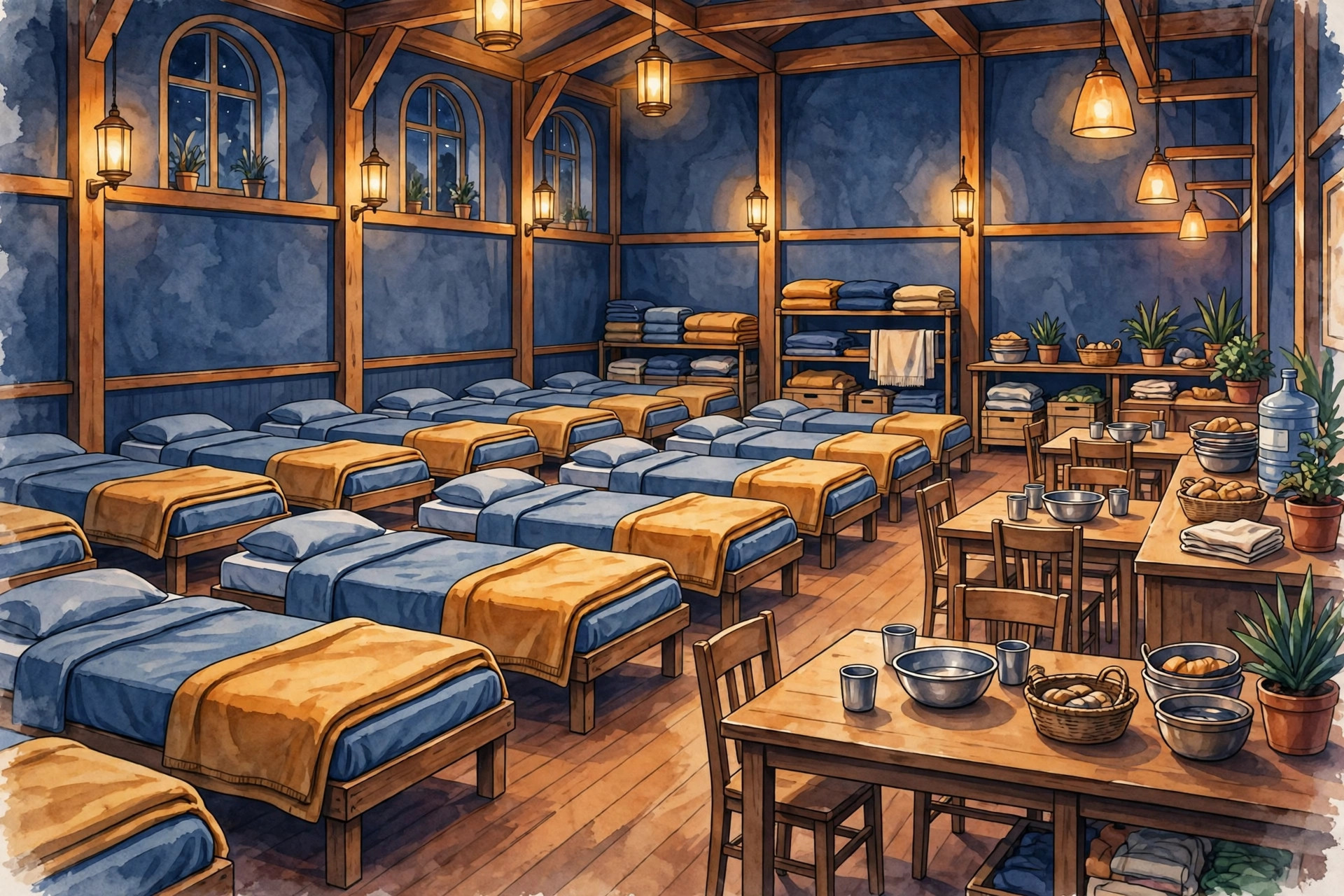
The idea is simple, and its dignity matters as much as its practical help. An Ehsaas Panahgah is not a charity handout given with pity. It is a clean, organised shelter with beds, meals, security, and hygiene standards — described in official material as a one-star-plus bed-and-breakfast standard — where a person is treated as a guest, not a beggar. Staff have received training, including specialised training provided in collaboration with Serena Hotels, according to programme reports. That training shows in the details: clean linen, hot water, a dining hall, a mosque on site, laundry and housekeeping, backup electricity so the lights do not go out, and CCTV and security through the night.
Example — the labourer who cannot afford a hotel: A mason from a village in south Punjab comes to Lahore for a week’s work. He earns a daily wage, and a hotel room would cost more than he earns in a day. He sleeps at a Panahgah near the bus stand: a bed, a blanket, dinner in the evening, and breakfast in the morning. The money he saves on a room is money he can send home to his family. Without the Panahgah, he would sleep on the pavement, or not come to the city for work at all.
Example — the hospital attendant: A woman brings her husband to a big hospital in Lahore for treatment. The treatment is free at the government hospital, but there is nowhere for her to sleep. She cannot afford a hotel, and she cannot leave her husband alone. She stays at a Panahgah near the hospital — the shelters at Kot Khawaja Saeed Hospital and Jinnah Hospital in Lahore were built for exactly this situation. She sleeps safely, eats, and is back at the hospital in the morning.
Example — the stranded traveller: A man arrives at a bus stand late at night. His bus to his village has left, the next one is in the morning, and he has little money. Instead of sleeping on a bench, he goes to the nearest Panahgah, registers, and sleeps in a bed. In the morning he has breakfast and catches his bus. The Panahgah is not only for the homeless — it is for anyone who needs a safe place for the night.
Ehsaas Panahgah is separate from BISP, but the two serve many of the same families. A BISP household’s Kafaalat payment — Rs 14,500 per quarter for the Oct–Dec 2026 cycle, per the government’s June 2026 announcement, rising to Rs 18,000 planned from January 2027 — check the exact amount for your cycle on the 8171 portal — is cash for the household. Panahgah is a bed and a meal for the person who is away from home. Neither replaces the other, and using a Panahgah does not affect your BISP payments or your eligibility. If you need to check your household’s BISP status, use our guide to check your BISP status by CNIC online or read about Benazir Kafaalat and the 8171 programme.
Who Can Stay at an Ehsaas Panahgah?
Anyone who is homeless, a daily-wage labourer, a traveller, or otherwise in need of temporary shelter can stay at an Ehsaas Panahgah free of cost. There is no income test, no BISP registration requirement, and no card to show. The programme is for Pakistani citizens regardless of race or religion, and it is aimed in particular at vulnerable people: homeless people, people with no regular income, daily-wage workers, women, children, older people, and people with disabilities.
You do not need to be from the city where the Panahgah is. In fact, being from another city is one of the main reasons people use Panahgahs: you have come for work, for treatment, or for travel, and you have no home in that city. You also do not need to book in advance. There is no online procedure to get a bed — you go to the shelter, and you register there. That is worth stating plainly, because many websites and social media posts claim you can “apply online” for Panahgah. You cannot. Anyone who asks you to fill in an online form or pay a fee to book a Panahgah bed is committing fraud.
Example — who qualifies, in plain terms: A rickshaw driver who works in the city but sleeps in his rickshaw qualifies. A widow who has come to the city for her child’s hospital appointment qualifies. A student who has missed the last bus home qualifies. A family that lost its home in a flood and is passing through the city qualifies. The test is need, not paperwork: do you have a safe place to sleep tonight? If not, the Panahgah is for you.
Example — a woman travelling alone: A woman travelling alone for a hospital visit worries about where she can sleep safely. Panahgahs are meant to be safe for women too, with security and separate arrangements — but arrangements for women vary by shelter, and a research study of Lahore shelters has recommended dedicated spaces for homeless women with female staff. If you are a woman travelling alone, go early in the evening, ask the manager about the women’s arrangements, and if the shelter cannot accommodate you safely, ask the manager or the Social Welfare Department where the nearest suitable shelter is. Your safety comes first; do not stay somewhere you feel unsafe.
What You Get at an Ehsaas Panahgah
Every Panahgah offers the same basic package, free of charge:
- A bed for the night — a clean bed with clean bedding in a shared hall or room.
- Free meals — breakfast and dinner every day. Meals are also served to people who do not stay overnight, within the shelter’s daily capacity.
- Clean drinking water — safe water available at the shelter.
- Washrooms and hygiene — washrooms with hot water, and a clean, hygienic environment.
- Medical and first-aid facilities — basic medical help for residents who need it, with doctors or nurses available according to the shelter’s arrangements.
- Security — 24-hour security and CCTV surveillance, so residents can sleep without fear.
- A mosque, laundry, and housekeeping — on-site facilities that keep the shelter clean and usable.
The scale of each shelter is large. Programme reports describe model Panahgahs with around 100 beds for overnight stay, and meals served to around 400 to 500 people a day. That means a shelter feeds far more people than it sleeps: many people come for a meal even if they do not stay the night. In Punjab, the Social Welfare Department reports 16 Panahgahs fully operational, with about 700 people staying daily on average, and approximately 3.7 million people facilitated from November 2018 to April 2024 with accommodation, breakfast, and dinner. Those are Punjab’s official figures, and they are the most reliable numbers in this guide. National totals are harder to pin down: different sources report 34, 39, or more than 100 shelters across Pakistan, and those figures come from different years and count different things — some count only model Panahgahs, others count every shelter. This guide does not state a single national total as fact, because the sources disagree. What is certain is that shelters exist in all major cities, including Lahore, Islamabad, Karachi, Peshawar, Multan, and Faisalabad.
Example — a meal, not just a bed: A daily-wage worker earns too little to eat three meals a day. He does not stay at the Panahgah — he has a small room shared with other workers — but he eats dinner there. The meal is hot, free, and served in a dining hall. Over a month, the meals he saves on are money his children can use for school. The Ehsaas Panahgah kitchen matters as much as its beds.
Where Are the Ehsaas Panahgah Shelters? Punjab Locations
In Punjab, the programme is run by the Social Welfare Department. It began in 2017 with five signature Panahgahs in Lahore, and then eight more were established in the city — at LOS Icchra, Gajumata, Kot Khawaja Saeed Hospital, Band Road, Johar Town, Shahdara, Bibi Pak Daman Ali Complex, and Jinnah Hospital in Lahore — and then three more, one each in Multan, Bahawalpur, and Taunsa Sharif. That makes 16 Panahgahs in Punjab, all reported fully operational by the Social Welfare Department.
Beyond Punjab, shelters are reported in Islamabad (including Tarlai, Tarnol, G-9, and Mandi More, where new model Panahgahs were being built), Karachi, Peshawar, Rawalpindi, Gujranwala, Kohat, Bannu, Dera Ismail Khan, Hyderabad, Sukkur, Washuk, Noshki, and Kharan, among others. A research study of Lahore shelters also names Panahgahs at Data Darbar, the Railway Station, Thokar Niaz Baig, Badami Bagh, and Lorri Adda — useful landmarks if you are trying to find one in Lahore. But do not rely on a list in an old article to find a shelter in an emergency. Shelter locations, names, and capacities change. Ask at the nearest Social Welfare office, at a bus stand, at a hospital reception, or at a police post — or call the Social Welfare Department. A local person — a shopkeeper near a bus stand, a hospital guard — will often know the nearest Panahgah, because these shelters are well known in the areas around them.
| City / area | What is reported there | How to confirm |
|---|---|---|
| Lahore | The most shelters: the original five, plus LOS Icchra, Gajumata, Kot Khawaja Saeed Hospital, Band Road, Johar Town, Shahdara, Bibi Pak Daman, Jinnah Hospital; also Data Darbar, Railway Station, Thokar Niaz Baig, Badami Bagh, Lorri Adda | Ask at the Social Welfare Department or any hospital reception in Lahore |
| Multan, Bahawalpur, Taunsa Sharif | One Panahgah each in Punjab’s official count | Social Welfare Department, Punjab |
| Islamabad | Model Panahgahs including Tarlai, Tarnol, G-9, Mandi More (new ones reported as being built) | Check locally — new shelters may have opened since the reports |
| Karachi, Peshawar, other cities | Shelters reported in all major cities | Ask at the nearest Social Welfare office or bus stand |
How to Stay at an Ehsaas Panahgah — Step by Step
Step 1: Go to the Nearest Ehsaas Panahgah Before Night
Go early in the evening. Reports say you should reach the Panahgah before 9:00 pm so you can register and get a bed — after 9:00 pm you will need to contact the manager, who will try to make a place for you. Going early matters for another reason: beds are limited, and a shelter can fill up. If you arrive at midnight, there may be no bed left. Plan your day so you are at the shelter by the early evening, especially in winter, when demand is highest and the nights are coldest.
Step 2: Register at the Shelter
At the shelter, register with the manager or the staff on duty. Registration is free and happens at the shelter itself — there is no online registration and no advance booking. Bring your CNIC if you have one; it helps the staff register you, but do not stay away if you have lost your CNIC or do not have it with you. Tell the staff honestly why you need shelter — you are a labourer from another city, you are a patient attendant, you are stranded, you are homeless. The staff are there to help, not to judge, and honesty helps them place you correctly.
Step 3: Get Your Bed and Settle In
The staff will show you your bed and explain the shelter’s rules: where the washrooms are, when meals are served, when the lights go out, and where to keep your belongings. Keep your money, phone, and CNIC on your person or in a safe place — as in any shared sleeping hall, look after your valuables. Follow the shelter’s rules: they exist so that a hundred strangers can share one hall safely and peacefully.
Step 4: Eat, Rest, and Ask for Help If You Need It
Dinner is served in the evening and breakfast in the morning. Meal timings reported for Panahgahs are: breakfast from 6:00 am to 8:00 am, and dinner from 6:00 pm to 8:00 pm in winter, or 6:30 pm to 8:30 pm in summer — but these timings are from secondary sources and can vary by shelter, so confirm them with the manager when you arrive. If you feel unwell, tell the staff: the shelter has first-aid and medical facilities, and staff can direct you to a hospital if you need more help. If you need to stay longer, or you need help finding work, a hospital, or a government office, ask the manager. They know the area and the services around it.
Step 5: Know the Stay Limit — Usually Three Days
The usual rule reported for Panahgahs is that you can stay for a maximum of three days. That limit exists so that beds keep turning over for new arrivals. If you need to stay longer — because your work runs longer, or a patient’s treatment is not finished — speak to the manager and explain your situation. Reports say the administration can allow extra days on request. Do not assume the extension, and do not simply stay without asking: speak to the manager before your three days end. If you have a longer-term need — you have come to the city for months of work and have no home — an Ehsaas Panahgah is a short-term answer, not a home. Ask the manager or the Social Welfare Department about longer-term options, and if you are a BISP household, make sure your BISP registration and payments are in order so the household has its own support: see our guide to BISP registration check by CNIC and how to find a BISP office near you.
Your First Night at an Ehsaas Panahgah — Checklist
- ☐ I know the location of the nearest Panahgah before dark.
- ☐ I have arrived in the early evening, before 9:00 pm if possible.
- ☐ I have my CNIC with me (or I can explain if I do not have it).
- ☐ I have registered with the manager — free, at the shelter, no online form.
- ☐ I know where my bed is, where the washrooms are, and when meals are served.
- ☐ My money, phone, and documents are safe on my person.
- ☐ I know the stay limit (usually three days) and I will speak to the manager if I need longer.
- ☐ I have not paid anyone anything — shelter, meals, and registration are all free.
Ehsaas Panahgah vs Other Help — What Fits Your Situation?
| Situation | Best option | Why |
|---|---|---|
| You need a bed for tonight in a city away from home | Ehsaas Panahgah | Free, no booking, no card, open to anyone in need |
| You need a free meal but have somewhere to sleep | Ehsaas Panahgah dining hall, or Ehsaas Langar / Koi Bhooka Na Soye | Meals are served to non-residents too, within daily capacity |
| Your household needs regular cash support | BISP Kafaalat | A quarterly cash payment to the household, checked on the 8171 portal |
| You need food support at home in Punjab | Punjab Ehsaas Rashan Riayat or Ehsaas Rashan | Ration support for the household, not a shelter |
| You are in an emergency and need immediate help | Panahgah manager, hospital, or the BISP helpline 0800-26477 | The manager and local services can direct you the same night |
If your need is food at home rather than a bed, read our guides to Ehsaas Koi Bhooka Na Soye (no one sleeps hungry) and Punjab Ehsaas Rashan Riayat. If your need is emergency cash support, read about the Ehsaas Emergency Cash programme — but remember that emergency programmes have their own eligibility rules and timelines, and a Panahgah is the option that helps tonight, without an application.
Ehsaas Panahgah: Common Questions
Is staying at an Ehsaas Panahgah really free? Yes. The bed, the meals, the water, and the washrooms are all free. Registration is free. Anyone asking for a fee in Panahgah’s name is committing fraud — report it to the Social Welfare Department or the BISP helpline on 0800-26477.
Do I need to apply online for an Ehsaas Panahgah? No. There is no online procedure to get a bed. You go to the shelter and register there. Do not fill in any online form or pay anyone who claims to book a Panahgah bed for you.
How long can I stay? The usual rule reported is a maximum of three days for one person. If you need longer, speak to the manager and explain your situation — extra days can be allowed on request. Confirm the rule at your shelter, because it can vary.
What time should I arrive? Go in the early evening, and before 9:00 pm if you can, so you can register and get a bed. After 9:00 pm, contact the manager, who will try to make a place for you — but beds may be full.
What meals are served, and when? Breakfast and dinner are served daily. Reported timings are breakfast 6:00–8:00 am and dinner 6:00–8:00 pm in winter or 6:30–8:30 pm in summer, but confirm the timings with the manager at your shelter, because they can vary.
Can women and children stay? Panahgahs are intended for vulnerable people including women, children, and older people, with security through the night. Arrangements for women vary by shelter, so go early, ask the manager about the women’s arrangements, and do not stay anywhere you feel unsafe.
Do I need a CNIC or BISP registration? No. There is no BISP requirement and no card. Bring your CNIC if you have it, because it helps with registration — but do not stay away if you do not have it.
How many Ehsaas Panahgah shelters are there? In Punjab, the Social Welfare Department reports 16 fully operational Panahgahs. National totals reported by different sources range from 34 to more than 100, depending on the year and what is counted, so this guide does not state a single national figure. Ask locally for the nearest shelter rather than relying on a national count.
Conclusion
Ehsaas Panahgah is one of the simplest and most humane programmes in Pakistan: a bed, a meal, and a safe night, free, for anyone who needs it. There is no form to fill in, no fee to pay, and no card to show. If you are away from home for work, for treatment, or because you have nowhere else to go, find your nearest Panahgah before dark, register with the manager, and sleep safely. And if you know someone sleeping on the street — a labourer at a bus stand, a patient attendant outside a hospital — tell them about the Ehsaas Panahgah. Many people who need it have simply never heard of it. For your household’s longer-term support, check your BISP status on the 8171 portal at 8171.bisp.gov.pk, or read our guide to the Ehsaas programme and 8171 for the wider picture.