BISP Payment Blocked CNIC Expired – How to Fix Fast 2026
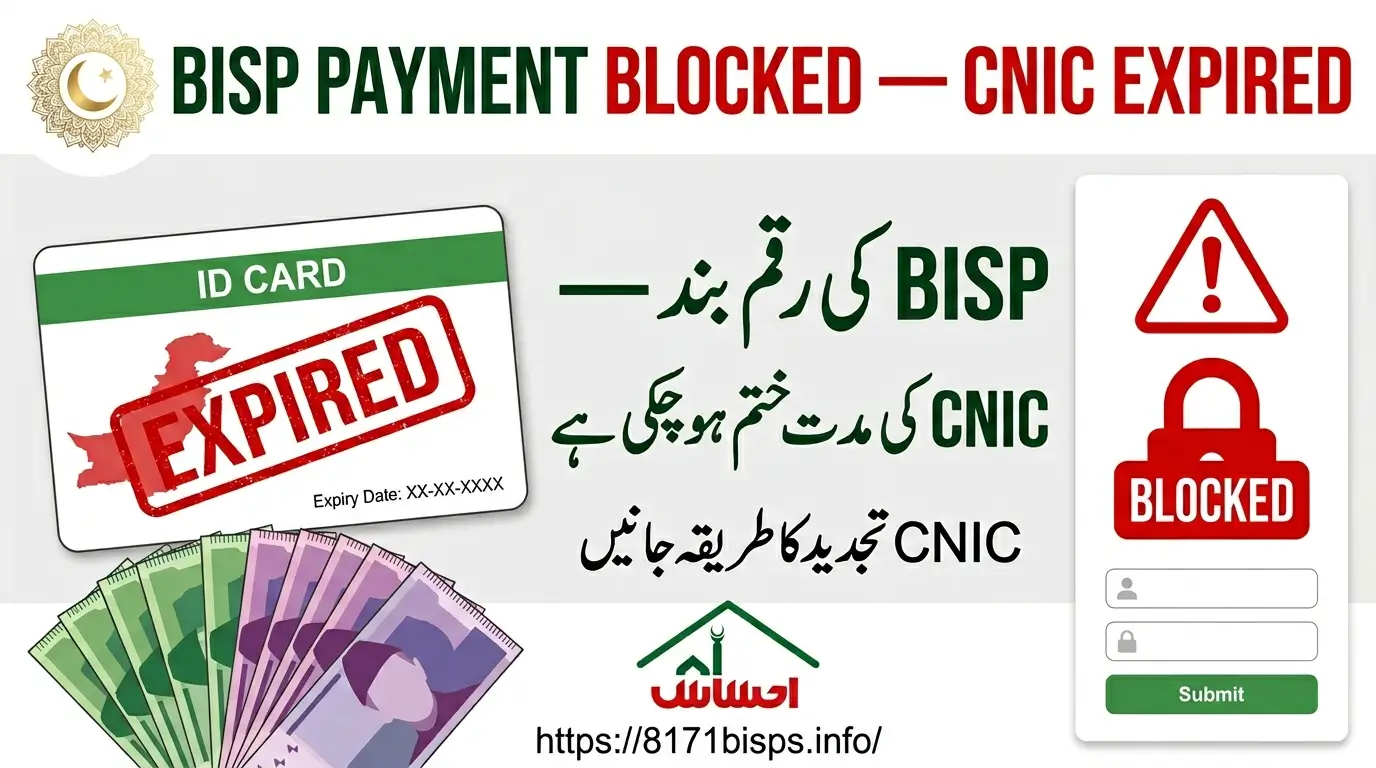
Why Is My BISP Payment Blocked After CNIC Expired?
You sent your CNIC to 8171. The reply said blocked. You went to the payment counter. Nothing. Then someone finally told you — “Aapka CNIC expire ho gaya hai.”
Your identity card, sitting quietly in your bag for years, has just stopped your family’s monthly support.
This is one of the most common problems BISP beneficiaries face across Pakistan. Based on available reports, tens of millions of CNICs may be expired nationwide — and a large portion of those holders are BISP-registered women, widows, and elderly families who had no warning that an expired card would freeze their payments entirely.
This guide explains why the BISP payment blocked CNIC expired problem happens, not just what to do. It covers the real process, realistic timelines, hidden traps most guides skip, real-world scenarios, and direct answers to the questions people search for most.
The most important thing to know before anything else: your money is not lost. Blocked payments stay safely in the system and are released once your CNIC is renewed and verified.
Why BISP and CNIC Are Directly Connected
BISP — the Benazir Income Support Programme — was launched in 2008 to provide direct quarterly cash support to Pakistan’s lowest-income families. What most people don’t realize is that BISP does not store your identity independently. Every payment cycle, the BISP system automatically queries NADRA’s database: “Is this CNIC currently valid?”
If NADRA returns an expired status, BISP’s automated system blocks the payment immediately — with no human review, no warning SMS, no grace period.
This is why payments stop without any notice. The system was built at scale to prevent fraud, including ghost beneficiaries and duplicate registrations. Individual cases get caught in the same automation.
Your eligibility has not changed. Your PMT poverty score is intact. Your household record is intact. You are still a BISP beneficiary. The block is purely a verification pause — and it ends once NADRA confirms your CNIC is active again.
Who Gets Affected Most — And Common Misunderstandings
Certain groups appear consistently in field reports about this problem. Elderly women aged 60 and above who missed CNIC renewal dates. Widows who never renewed after their husband’s death, often due to mobility restrictions or lack of support. Rural families who delayed renewal because travel to a NADRA office costs money they didn’t have.
A few misunderstandings that cause unnecessary delays:
My renewal receipt is enough to unblock my payment It is not. A receipt means your application was received. NADRA must fully process and update their database before BISP sees any change.
I’ll show my old card at the BISP office and it will be fixed A counter visit alone doesn’t unblock anything. The fix happens through a database sync, not a face-to-face conversation.
I need to re-register with BISP You do not. Your enrollment is intact. Re-registering creates additional complications and is unnecessary.
Urgent CNIC renewal is always faster for BISP This is actually not always true, and it is one of the most important things this guide covers. Read the next section carefully.
How to Fix BISP Payment Blocked Due to Expired CNIC — Step by Step
Step 1: Confirm the Block is Actually CNIC-Related
Before spending money on CNIC renewal, confirm that CNIC expiry is the actual reason. BISP payments can also be blocked due to an outdated dynamic survey, a duplicate registration dispute, or a family record mismatch — and these require completely different solutions.
Send your 13-digit CNIC number (no dashes, no spaces) via SMS to 8171. The automated reply will indicate the reason for the block. If it mentions expired CNIC or “record not updated,” proceed with CNIC renewal. If it says something else, visit your nearest BISP Tehsil Office to understand the specific problem first.
Step 2: Go to NADRA for Renewal — Choose Your Category Carefully
Visit your nearest NADRA Registration Centre (NRC) or Mega Centre. Bring your expired CNIC — they need it for verification even though it has expired.
Approximate NADRA Smart NIC renewal fees (2025–2026 estimates — confirm at your office as rates may change):
Estimated:
| Category | Approximate Fee | Timeline |
| Normal | Rs. 750 | ~30 days |
| Urgent | Rs. 1,500 | ~12–15 days |
| Executive | Rs. 2,500 | ~7–9 days |
Here is what most guides miss: Urgently processed CNICs sometimes cause synchronization failures between NADRA and BISP’s systems. The card arrives fast, but BISP’s database may still flag the old CNIC as expired for weeks afterward. If you can wait approximately 30 days, the Normal category is often safer for restoring BISP payments. If you cannot wait and choose Urgent or Executive, be prepared to visit the BISP Tehsil Office afterward to manually trigger a database update.
Keep your receipt and token number. This is your only proof during the processing period.
You can also apply through NADRA’s official Pak-Identity app and pay via JazzCash or Easypaisa — useful if travel to a NADRA office is costly. Online processing typically runs at Urgent/Executive rates.
Step 3: Wait for the NADRA–BISP Database Sync
This is the step most people don’t understand, and it causes the most frustration.
NADRA and BISP are two separate government systems. They do not update each other in real time. After NADRA processes your renewal, there is a gap — sometimes days, sometimes longer — before BISP’s system reflects that your CNIC is now active. During this period, checking 8171 will still show “blocked” even though your card is valid.
Realistic total timeline from CNIC renewal application to first payment release is estimated at 2 to 6 weeks in most cases. Official BISP guidance suggests 7 to 10 working days after NADRA updates their records — real-world reports from beneficiaries suggest it can run longer, especially in rural areas or during busy payment cycles.
Step 4: Re-Check 8171 After 10 to 14 Days
Starting approximately 10 to 14 days after your CNIC renewal application, send your CNIC to 8171 again. If the status has changed from blocked to active or payment confirmed, your next installment should release automatically. If it still shows blocked, move to the next step.
Step 5: Visit BISP Tehsil Office If Still Blocked After 3 Weeks
If approximately 3 weeks have passed with no change, visit your nearest BISP Tehsil Office in person.
Bring: your renewed CNIC (original plus at least one photocopy), your NADRA renewal receipt, and any previous BISP payment documents you have.
Ask the officer to check your status on their terminal and submit a “payment unblock request” or “data update request” to BISP headquarters in Islamabad. This manual request creates a priority update in the central system. Based on documented cases, resolution after this step typically takes an estimated 10 to 15 additional working days.
Go early in the morning. BISP Tehsil Offices are often understaffed and handle many cases daily. Arriving in the first hour means shorter waits and more time with the officer.
Step 6: Escalate via Helpline If Needed
If the Tehsil Office visit does not resolve the issue, call the BISP helpline at 0800-26477 (toll-free). Request a formal complaint registration and ask for a tracking number. This creates an official record that can be followed up and escalated.
Do not pay anyone to fix this. All BISP services at official offices are free. Anyone asking money to unblock your payment or “process your case” is not legitimate.
What Other Guides Don’t Tell You
The sync gap is the root cause of most “still blocked after renewal” cases. The gap between NADRA updating their database and BISP reflecting that update is real, consistent, and poorly communicated to beneficiaries. Knowing it exists helps you stay patient during the first three weeks and know exactly when to push back.
Widows face a more complex situation if the primary BISP beneficiary (typically the registered woman) has passed away and her CNIC expires before the benefit is formally transferred to a surviving guardian. This situation requires both a death certificate from the Union Council and a fresh BISP household verification — CNIC renewal alone is not enough in this case.
Biometrics cannot be skipped or delegated. When renewing at NADRA, the beneficiary must be physically present for fingerprint scanning. No family member can do this step on their behalf, regardless of age or health. For elderly or unwell beneficiaries, plan the trip specifically around this requirement.
The Pak-Identity app (NADRA’s official mobile application) is a genuine option for families far from NADRA centres. Fee payment via JazzCash or Easypaisa makes it accessible without a bank account.
Real Scenarios: What Actually Happens in Practice
The Straightforward Case
Farzana, a 45-year-old beneficiary from rural Punjab, checks 8171 and sees her payment is blocked due to CNIC expiry. She visits the district NADRA office, applies for Normal renewal, pays approximately Rs. 750, and keeps her receipt. About 3 weeks later, NADRA updates their database and BISP syncs automatically within a few additional days. She receives both the current installment and her previously blocked amount in the same cycle. Estimated total time: around 28 days from discovery to payment.
The Difficult Case (Urgent Renewal Backfire)
Hajra, a widow from Karachi, opts for Urgent category renewal expecting faster BISP payment restoration. Her new card arrives in 14 days, but 8171 still shows the payment as blocked. At the BISP Tehsil Office, the officer finds that BISP’s system still flags the old expired status — the rapid processing caused a sync failure. After a manual headquarters update request, an additional estimated 12 working days pass before her payment releases. Estimated total time: approximately 6 weeks — longer than Normal renewal would likely have taken. Choosing speed at NADRA does not guarantee speed at BISP.
The Physically Challenging Case
Naseem, an elderly woman from DG Khan, was unwell when her CNIC expired. Her daughter tried to renew on her behalf but was told Naseem must appear in person for biometric verification — no exceptions. This delayed the process by approximately 3 additional weeks. Once Naseem attended the NADRA office and the renewal was processed, a manual BISP update request was submitted and payments resumed after an estimated total of 7 weeks. Early planning for the biometric step saves significant time.
Why the System Works This Way — Surprising Context
The strict CNIC-BISP linkage was a deliberate policy response to serious fraud in the programme’s earlier years. Before tighter automated verification, payments were reportedly reaching ghost beneficiaries — individuals who had died, or names that didn’t correspond to real people. The automatic blocking system was introduced specifically to close those gaps at scale.
The result is a system that is accurate but impersonal. It doesn’t pause to consider individual circumstances. Understanding this doesn’t make the experience less frustrating — but it explains why the fix requires going through official channels rather than just explaining your situation at a counter.
There is also a genuine information gap in the programme. The most vulnerable beneficiaries — elderly rural women, widows with limited mobility — often have no practical way to know their CNIC expiry date is approaching until payments stop. SMS reminders from BISP about upcoming CNIC expiry are not consistently sent. This is a gap worth acknowledging, especially if you are helping a family member navigate this situation.
What This Guide Cannot Solve
This guide addresses BISP payment blocked specifically due to expired CNIC and nothing else.
It does not cover situations where your CNIC details (name spelling, date of birth) don’t match NADRA records — those require a separate NADRA correction process. It does not cover duplicate registration disputes, which require an FRC (Family Registration Certificate) and BISP headquarters review. It does not apply to cases where payments were suspended due to failing a Dynamic Survey reassessment, which requires a separate re-evaluation. And it does not cover complex widow succession cases where both legal and BISP verification processes must be completed together.
If you renew your CNIC, wait more than 4 weeks, visit the Tehsil Office, register a complaint, and payments remain blocked — the underlying issue is likely more complex and may require advocacy or legal support to resolve.
Practical Checklist — BISP Payment Blocked CNIC Expired
- Send CNIC to 8171 via SMS — confirm blocked status and specific reason before doing anything else
- Visit NADRA office with expired CNIC — apply for renewal; choose Normal category if you can wait ~30 days
- Pay the fee and keep your receipt — do not lose this document
- Wait 10 to 14 days — then re-check 8171 for status update
- If still blocked after 3 weeks — visit BISP Tehsil Office, bring renewed CNIC copy + NADRA receipt, request manual unblock
- If Tehsil Office doesn’t resolve it — call 0800-26477, register a complaint, get tracking number
- Do not re-register with BISP — enrollment is intact
- Do not pay any third-party agent — all official services are free of charge
Take Action Now
If you haven’t started yet: Visit NADRA this week. Every week of delay is another week before your payment releases. Your money is safe in the system — but it won’t move until you begin the renewal process.
If you already renewed your CNIC: Check 8171 every few days from Day 10 onward. Most cases resolve automatically without needing any office visit.
If you’re helping an elderly family member: Plan the NADRA trip specifically. The beneficiary must be present for biometric scanning — this step cannot be skipped or delegated. Once it’s done, you can handle all follow-up steps on their behalf.
If it’s been more than a month with no resolution: Visit the Tehsil Office and call 080026477. You have every right to follow up formally.
Frequently Asked Questions — BISP Payment Blocked CNIC Expired
Will I lose my BISP payments if my CNIC has been expired for months?
No. Blocked payments remain safely stored in the system. Once your CNIC is renewed and NADRA updates their database, all pending installments are typically released together in the next available cycle.
How do I check if my BISP payment is blocked due to expired CNIC?
Send your 13-digit CNIC number (without dashes) via SMS to 8171. The automated reply will indicate whether the block is due to CNIC expiry or another reason. You can also visit the official BISP portal at 8171.bisp.gov.pk or go to your nearest BISP Tehsil Office counter.
How long does it take for BISP payment to resume after CNIC renewal?
Based on available reports, most cases resolve within an estimated 2 to 4 weeks after NADRA updates their records — though this varies. If payments don’t resume after 3 weeks, a manual request at the BISP Tehsil Office typically speeds up the process.
Should I get Urgent CNIC renewal to unblock my BISP payment faster?
Not necessarily. Field experience suggests that urgent CNIC processing can sometimes cause synchronization failures between NADRA and BISP systems, leading to continued payment blocks even after the new card arrives. If you can wait approximately 30 days, Normal category renewal is often more reliable for BISP purposes.
Do I need to re-register with BISP after renewing my CNIC?
No. Your BISP registration remains fully intact. You only need to renew your CNIC through NADRA. BISP’s system will update automatically once NADRA’s database reflects your renewed status.
Can someone else renew my CNIC for me if I am elderly or unwell?
Unfortunately, no. Biometric fingerprint verification requires the beneficiary’s physical presence at NADRA. No family member or representative can complete this step on someone else’s behalf, regardless of age or health condition.
What if my BISP payment is still blocked 4 weeks after CNIC renewal?
Visit your nearest BISP Tehsil Office with your renewed CNIC and NADRA renewal receipt. Ask the officer to submit a manual “payment unblock request” to headquarters. If that doesn’t resolve it within another 2 weeks, call the BISP helpline at 0800-26477 and register a formal complaint with a tracking number.
Is there any charge to fix a blocked BISP payment at the Tehsil Office?
No. All services at BISP Tehsil Offices are completely free. Anyone asking you for money to fix your payment status or “process your case” is not an official BISP representative.
Can I renew my CNIC online without visiting NADRA?
Yes, through NADRA’s official PakIdentity app or website. You can apply and pay via JazzCash or Easypaisa. Online applications typically run at Urgent or Executive fee rates, but this option saves travel costs for families far from NADRA offices.
What if my CNIC details don’t match NADRA records — will renewal fix the block?
No. If the block is caused by a name, date of birth, or family record mismatch between BISP and NADRA — rather than simple expiry — CNIC renewal alone will not fix it. This situation requires a separate NADRA data correction process. Confirm the exact block reason via 8171 before taking action.
About This Post
This guide was written through independent research — reviewing documented beneficiary cases, NADRA fee structure announcements, publicly available BISP field reports, and official programme communications. It is not affiliated with BISP, NADRA, or any government body. It does not constitute legal or official government advice.
Information was accurate to the best of available research as of early 2026. BISP policies, payment amounts, and NADRA fees do change — always confirm current details at your nearest BISP Tehsil Office or through the official 8171 channel before acting.
BISP Helpline:
0800-26477 (toll-free)
CNIC Status Check:
SMS your CNIC number to 8171
BISP Official Portal:
8171.bisp.gov.pk
NADRA Helpline:
051-111-786-100
About the Author
This guide was researched and written by an independent content researcher focused on Pakistani government schemes, personal finance topics, and practical consumer guides. The goal is to turn complex official information into simple, accurate, and useful advice for everyday families.
Content is reviewed regularly to reflect policy updates, eligibility changes, and new application processes whenever reliable information becomes available.