Punjab Zewar-e-Taleem 2026 — Easy Guide to Rs 1,000 Monthly Stipend for Girls & Eligible Districts
This is not an official Punjab government website. This guide is independent, general information about Punjab Zewar-e-Taleem. For official information, always check the Punjab Social Protection Authority at pspa.punjab.gov.pk or call the PSPA helpline 1221 before you rely on any figure.
What Is Punjab Zewar-e-Taleem?
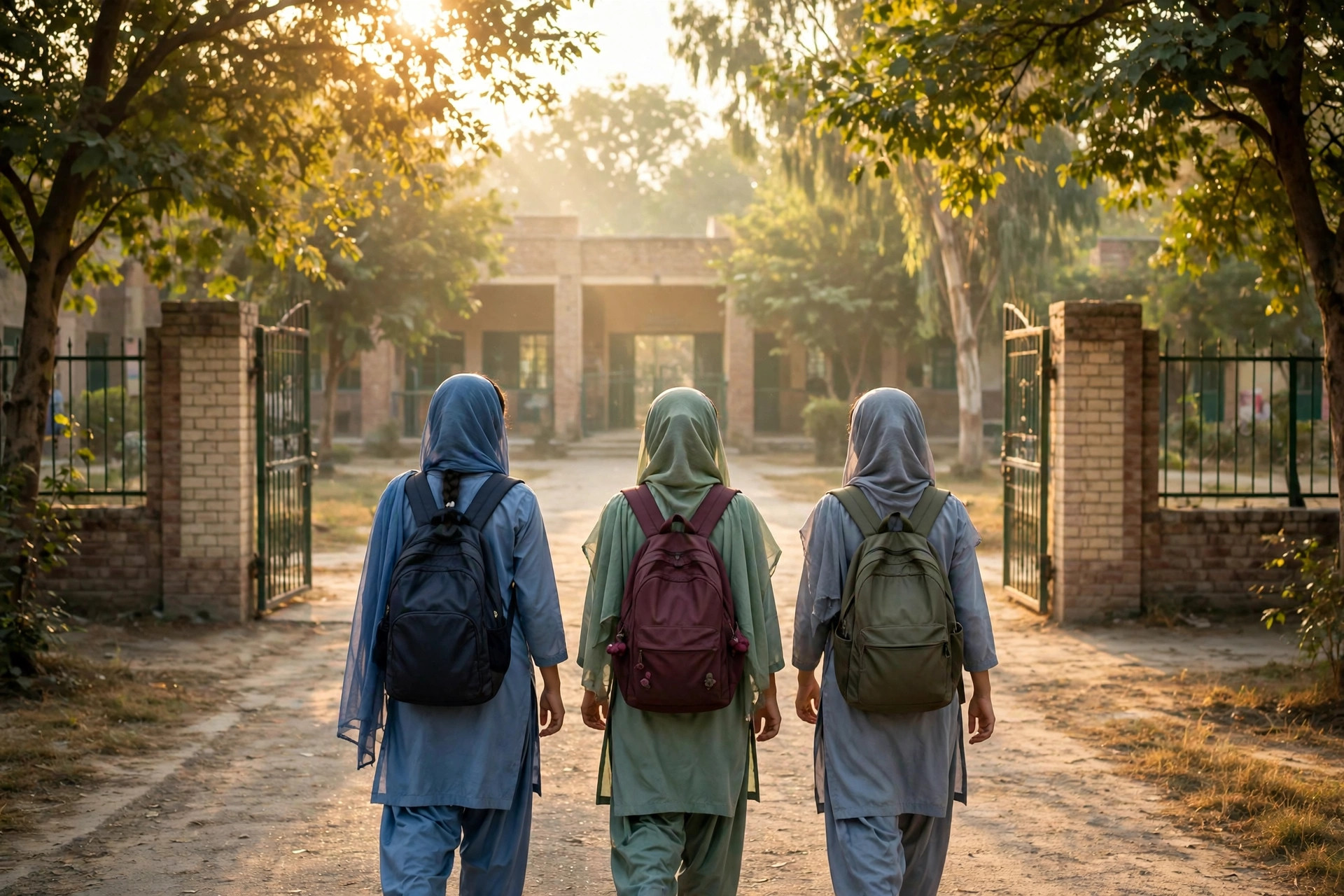
Punjab Zewar-e-Taleem is a conditional cash programme that pays a monthly stipend to girls in government schools, so that poor families can afford to keep their daughters in school instead of taking them out to work or marrying them early. The Punjab Zewar-e-Taleem stipend is Rs 1,000 a month, paid quarterly as Rs 3,000 every three months, to girls in grades 6 to 10 at government schools in the programme’s districts. It is run by the Punjab Social Protection Authority (PSPA), and it is one of the oldest girls’ education programmes in the province — it began in 2003 as the Girls Stipend Programme, and it was revamped and rebranded as Zewar-e-Taleem in 2017.
The idea behind Punjab Zewar-e-Taleem is simple, and it is backed by twenty years of evidence. A girl who stays in school until Class 10 marries later, earns more, and sends her own children to school. A family that loses Rs 1,000 a month of a daughter’s labour needs something in return, and the stipend is that something: it covers books, uniform, transport and the small costs that push poor families to withdraw a girl from school. The programme does not pay for enrolment alone — it pays for attendance, and that condition is what makes it work.
Punjab Zewar-e-Taleem is a conditional cash transfer, which means the money follows the behaviour. The school reports the girl’s attendance every quarter, and the money is released only if she attended at least 80 per cent of school days. A girl who drops out is excluded automatically. A girl who repeats a grade does not get the stipend for the repeating year, though she can qualify again when she is promoted. These rules are strict, and they are the reason the programme is trusted: the money goes to girls who are actually in school.
Example — the girl who stayed in school: A girl in Class 7 at a government school in Muzaffargarh is the eldest of four children. Her father is a daily-wage labourer, and the family had decided she would leave school to look after her younger siblings. The school tells the family about Punjab Zewar-e-Taleem: Rs 1,000 a month, paid quarterly, as long as she attends 80 per cent of school days. The money covers her books and uniform, and the family changes its mind. She stays in school, passes Class 8, and is now aiming for Class 10.
Example — the family that lost the stipend: A girl in Class 9 in Layyah receives the Punjab Zewar-e-Taleem stipend for two quarters, then her attendance falls below 80 per cent because she is kept at home to work in the fields during the harvest. The school reports the attendance, and the next quarterly payment does not come. Her mother goes to the school, the teacher explains the rule, and the girl returns to school the next week. The stipend resumes only when the attendance is back above 80 per cent — the rule is the point of the programme.
Who Can Get the Punjab Zewar-e-Taleem Stipend?
The eligibility rules for Punjab Zewar-e-Taleem are short, and they are all checked by the school and the education department, not by an application form you fill in yourself. A girl qualifies if she is enrolled in grades 6 to 10 at a government school in one of the programme’s districts, if she attends at least 80 per cent of school days, if she is not repeating the grade, and if she has passed biometric verification. There is no separate form to fill in — girls enrolled through the School Education Department’s annual enrolment drive receive the stipend after biometric verification, and the money is released when the department reports 80 per cent attendance.
The programme is for girls only. It is for government schools only — private school students do not qualify. It is for grades 6 to 10 only: a girl in Class 5 does not qualify yet, and a girl who completes Class 10 is removed automatically after the academic session. And it is for the programme’s districts only, which is the part most families get wrong — Lahore, Faisalabad, Rawalpindi and Multan are NOT on the list, because the programme targets districts with low female literacy.
The family’s poverty is part of the design, though the programme does not publish a single income cut-off the way some other schemes do. Eligibility is verified through CNICs, B-Forms, school registration and a parental survey, so that the assistance reaches genuinely deserving families. If your daughter is enrolled in a government school in one of the listed districts and attends regularly, the school is the office to ask — not an agent, and not a website.
Punjab Zewar-e-Taleem Eligible Districts — The Full List
The district list is the most important part of this guide, because it decides whether your daughter qualifies at all. The PSPA programme page names 17 districts, but its own opening line says 16. The difference is Kot Addu, which is a newer district — the list of names is what you should rely on, because it is the list the programme actually uses. The 17 districts are:
| # | District | # | District |
|---|---|---|---|
| 1 | Bahawalnagar | 10 | Layyah |
| 2 | Bahawalpur | 11 | Lodhran |
| 3 | Bhakkar | 12 | Muzaffargarh |
| 4 | Chiniot | 13 | Okara |
| 5 | Dera Ghazi Khan | 14 | Pakpattan |
| 6 | Jhang | 15 | Rajanpur |
| 7 | Kasur | 16 | Rahim Yar Khan |
| 8 | Khanewal | 17 | Vehari |
| 9 | Kot Addu |
These are districts with low literacy, which is why they were chosen. If your district is not on this list, the programme gives no stipend for your daughter, however poor the family is. The government reviews the district list from time to time based on enrolment data and education indicators, and expansion remains under consideration as funding allows — but as of 2026, this is the list.
More than 7 lakh girls are reported to benefit across Punjab, according to one source. That figure is reported, not confirmed on the PSPA page, so treat it as a sense of scale. What is certain is that the programme is large, that it has run for more than twenty years, and that it is one of the main reasons girls’ enrolment in these districts has held up.
How the Punjab Zewar-e-Taleem Stipend Is Paid
The Punjab Zewar-e-Taleem stipend is paid quarterly, not monthly. The girl earns Rs 1,000 a month, but the money is released every three months as Rs 3,000, once the school reports 80 per cent attendance for the quarter. The payment goes through a branchless banking system developed by PSPA, and the girl is paid after biometric verification — the same fingerprint check used for other PSPA cash programmes. Some sources describe the payment as coming through a biometric ATM services card. Either way, the payment is electronic, it is tied to the girl’s own verification, and nobody in the chain handles cash on her behalf.
The payment cycle works like this. The school records attendance every day. At the end of the quarter, the School Education Department reports the attendance figures. PSPA checks the figures against its own records, including the biometric verification. If the girl attended at least 80 per cent of school days, and she was promoted and not repeating, the Rs 3,000 is released. If the attendance is below 80 per cent, or the girl dropped out, or she completed Class 10, the payment stops. There is no form to chase a missed payment with — the fix is to get the attendance back above 80 per cent in the next quarter.
If the payment does not arrive and the attendance was above 80 per cent, the first place to ask is the school, because the school is the office that reports the attendance. The second is the PSPA helpline 1221, which is open 24 hours. Do not pay anyone who offers to “release” the stipend: there is no fee, and no agent can change an attendance record.
Punjab Zewar-e-Taleem Compared With Taleemi Wazaif
Two stipend programmes pay for girls’ schooling in Punjab, and families often confuse them. The table below sets them apart.
| Punjab Zewar-e-Taleem | Benazir Taleemi Wazaif | |
|---|---|---|
| Run by | Punjab Social Protection Authority (PSPA) | BISP (federal) |
| Who | Girls, grades 6–10, government schools, 17 Punjab districts | Children in BISP families, all provinces |
| Amount | Rs 1,000 a month (Rs 3,000 quarterly) | As reported in the Taleemi Wazaif guide |
| Condition | 80% attendance, no grade repetition | Enrolment + attendance |
| Apply | No form — school enrolment + biometric verification | Through BISP registration |
| Helpline | 1221 (PSPA) | 0800-26477 (BISP) |
A girl can benefit from both programmes if she qualifies for both — they are run by different governments and they do not cancel each other out. But the conditions are separate, and the attendance rule applies to each one on its own. Our guide to Benazir Taleemi Wazaif explains the federal stipend in detail, and if your family is not yet registered with BISP, our guide to BISP new registration 2026 explains how registration works.
What Happens After Class 10 — The Next Step for Zewar-e-Taleem Girls
Punjab Zewar-e-Taleem stops when a girl finishes Class 10, because the stipend is for grades 6 to 10 only. That ending is not the end of the support — it is the point where other programmes take over, and a family that plans ahead can keep the same girl in education without a gap.
The first step is the Punjab Honhaar Scholarship 2026, which supports students in higher education. A girl who finishes Class 10 with good marks and enrols in college should ask her college about the Honhaar scheme, because it is the natural next step for a student who has been supported through school. Our guide to the Honhaar Scholarship explains who qualifies and how to apply.
The second step is the Benazir Taleemi Wazaif stipend, which continues alongside schooling for families that qualify for BISP support. If your family receives BISP Kafaalat payments, your daughter’s Taleemi Wazaif stipend can continue through her schooling, and it is worth checking whether she is enrolled in it — the two programmes, Zewar-e-Taleem and Taleemi Wazaif, are separate, and a girl can benefit from both if she qualifies for both.
The third step is skills. If a girl finishes Class 10 and does not go on to college, the Benazir Hunarmand Programme 2026 offers free vocational training, and it is designed for exactly this situation: a young person who has finished school and needs a skill that pays. A family that plans the transition in Class 10 — college, or training, or both — does not lose a year to indecision.
Example — the girl who finished Class 10: A girl in Sheikhupura received the Zewar-e-Taleem stipend from Class 6 to Class 10, and her attendance stayed above 80 per cent because the stipend gave her family a reason to send her every day. In Class 10 she passed with good marks, and her family applied for the Honhaar Scholarship for her college admission. She also stayed enrolled in Benazir Taleemi Wazaif through her family’s BISP record. The stipend ended, but the support did not — it changed form, from a school stipend to a college scholarship.
Example — the girl who chose training: A girl in Bahawalpur finished Class 10 and did not want to continue to college. Her family enrolled her in the Benazir Hunarmand Programme, where she learned a vocational skill free of charge. She now earns from that skill, and the years of Zewar-e-Taleem support were not wasted — they kept her in school long enough to finish Class 10, which is the minimum the training programme asks for.
The point is simple: Zewar-e-Taleem is a bridge, not a destination. It carries a girl through the years when dropout is most likely, and it hands her over to the next programme at Class 10. A family that knows the next step before the stipend ends never has to choose between a daughter’s education and the family’s budget.
Common Problems — and What to Do
Your District Is Not on the List
If your district is not one of the 17 listed districts, your daughter does not qualify for Punjab Zewar-e-Taleem, however deserving the family is. Do not pay anyone who promises to add your district or your daughter to the list — the list is set by the programme, not by an individual. Check the Taleemi Wazaif programme instead, which covers BISP families in all provinces, and the Punjab Honhaar Scholarship 2026 for bright students.
The Payment Stopped After a Good Quarter
The most common reason a payment stops is attendance below 80 per cent, and the second is a grade repetition. Both are checked by the school, not by the family. Go to the school and ask for the attendance record: if the record is wrong, the school can correct it; if the record is right, the only fix is better attendance next quarter. A girl who repeats a grade does not get the stipend for the repeating year, but she can qualify again when she is promoted.
Someone Asks for a Fee to Enrol Your Daughter
There is no form and no fee for Punjab Zewar-e-Taleem. Enrolment happens through the school’s annual enrolment drive, and the stipend follows biometric verification. Anyone who asks for money to enrol a girl, to “activate” a stipend, or to release a payment is running a scam. Report the person to the school and to the PSPA helpline 1221.
Your Daughter’s B-Form Is Missing
The B-Form is needed for the girl’s record, and it is the document that holds most families up. If your daughter does not have one, apply for it now — our guide to the NADRA B-Form 2026 documents and fee explains the documents and the fee. Without a B-Form, the biometric verification cannot be completed, and the stipend cannot start.
Your Punjab Zewar-e-Taleem Checklist
- My daughter is enrolled in grades 6 to 10 at a government school.
- My district is one of the 17 listed districts.
- My daughter attends at least 80 per cent of school days.
- My daughter is not repeating the grade.
- My daughter has a B-Form and has passed biometric verification.
- I know the stipend is Rs 1,000 a month, paid as Rs 3,000 every quarter.
- I know there is no form and no fee — enrolment is through the school.
- If a payment stops, I will ask the school for the attendance record first, then call 1221.
Common Questions
What is Punjab Zewar-e-Taleem?
Punjab Zewar-e-Taleem is a conditional cash programme run by the Punjab Social Protection Authority that pays a Rs 1,000 monthly stipend to girls in grades 6 to 10 at government schools in 17 low-literacy districts of Punjab, as long as they attend at least 80 per cent of school days.
How much is the Punjab Zewar-e-Taleem stipend?
Rs 1,000 a month, paid quarterly as Rs 3,000 every three months, after the school reports 80 per cent attendance and the girl passes biometric verification.
Which districts are covered by Punjab Zewar-e-Taleem?
Bahawalnagar, Bahawalpur, Bhakkar, Chiniot, Dera Ghazi Khan, Jhang, Kasur, Khanewal, Kot Addu, Layyah, Lodhran, Muzaffargarh, Okara, Pakpattan, Rajanpur, Rahim Yar Khan and Vehari. The PSPA page says 16 districts in its opening line but names 17 — the list of names is what counts, and Kot Addu is the newer district that explains the difference.
How do I apply for Punjab Zewar-e-Taleem?
There is no separate form. Girls enrolled through the School Education Department’s annual enrolment drive receive the stipend after biometric verification, once the school reports 80 per cent attendance. Ask at your daughter’s school — not an agent.
What happens if my daughter’s attendance falls below 80%?
The quarterly payment is not released. The stipend resumes when attendance is back above 80 per cent. A girl who drops out is excluded, and a girl who repeats a grade does not get the stipend for the repeating year.
Can my daughter get both Zewar-e-Taleem and Taleemi Wazaif?
Yes, if she qualifies for both — they are run by different governments (PSPA for Zewar-e-Taleem, BISP for Taleemi Wazaif) and they do not cancel each other out. The attendance conditions apply separately to each programme.
Is there a fee for Punjab Zewar-e-Taleem?
No. Enrolment is through the school and the stipend is free. Anyone who asks for money to enrol a girl or release a payment is running a scam — report them to the school or to the PSPA helpline 1221.
What if my daughter completes Class 10?
She is removed automatically after the academic session. The programme covers grades 6 to 10 only. For further study, look at the Punjab Honhaar Scholarship 2026 and the Punjab Dhee Rani Programme 2026.
Conclusion
Punjab Zewar-e-Taleem is a quiet programme with a loud result: more than twenty years of paying girls to stay in school, in the districts where girls drop out most. Rs 1,000 a month is not a large sum, but for a family choosing between a daughter’s schooling and a daughter’s labour, it is often the sum that tips the decision. The rules are simple — grades 6 to 10, a government school, one of the 17 districts, 80 per cent attendance — and the payment follows the behaviour, not the promise.
If your daughter is in one of the listed districts, the work is already half done: she is enrolled, she attends, and the school does the rest. If she is not, the Taleemi Wazaif programme and the Honhaar Scholarship are the honest alternatives. Either way, do not pay anyone for a stipend that is free, and do not let a missed quarter of attendance become a lost year of schooling.
The Punjab Zewar-e-Taleem stipend is small money with a large purpose, and the purpose is a girl who finishes Class 10. For families thinking about the next step after school, our guide to the Punjab Dhee Rani Programme 2026 explains the support available for young women, and our guide to BISP new registration 2026 explains how to connect the family to BISP’s own programmes.