
PEEF Scholarship Pakistan 2026 — Easy Guide to Outreach, Eligibility, Stipend & Apply
This is not an official Punjab Educational Endowment Fund website. This guide is independent, general information about the PEEF scholarship Pakistan. For official information, always check PEEF at peef.org.pk before you apply or pay anything. PEEF scholarships are free to apply for — no one can charge you for a PEEF form or a PEEF place.
What Is the PEEF Scholarship Pakistan?
The PEEF scholarship Pakistan is the Punjab Educational Endowment Fund’s scholarship programme for talented students from low-income families in Punjab. PEEF is a Government of Punjab fund, and its main programme is the Outreach Scholarship, which covers about 80% of all PEEF scholarships. The Outreach Scholarship supports students at Intermediate and Graduation levels, and it pays a monthly stipend plus the tuition fee, so a bright student from a poor family can study without the family going into debt.
The most important thing to understand about the PEEF scholarship Pakistan is that it works backwards from most scholarships. You do not apply for it. PEEF finds you. The fund takes merit data from the Punjab Boards of Intermediate and Secondary Education and from the Federal Board, and it contacts the students who topped their tehsil or their stream. Your result card is your application. If your marks are strong and your family income is low, PEEF reaches out to you — that is the whole idea of the Outreach programme.
The second thing to understand is who the PEEF scholarship Pakistan is for. It is a merit-cum-need scholarship, which means it looks at two things at once: your marks and your family’s income. A student with 80% marks from a rich family does not qualify, and a student with 40% marks from a poor family does not qualify either. The scholarship is for the student who has both — strong marks and a family that cannot afford the fees. That combination is the point of the fund.
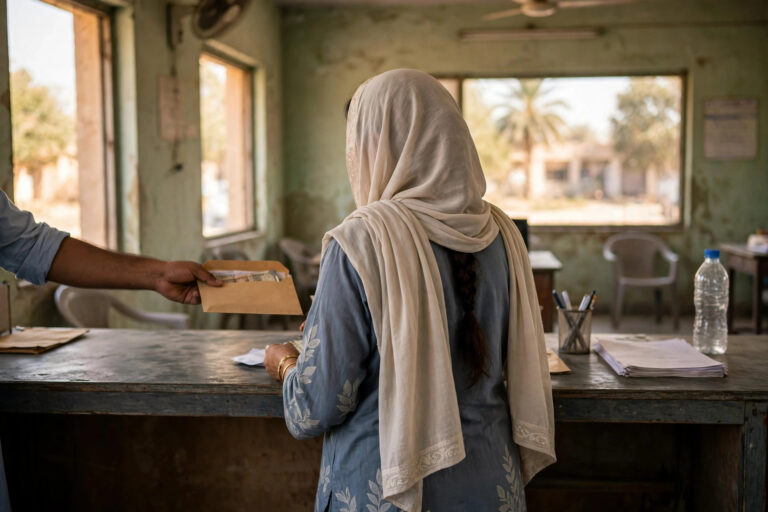
Example — the topper from a small town: A girl in a tehsil town scores 88% in her Matric exam from the local board. Her father earns Rs 45,000 a month as a driver. She never fills in a form, because PEEF takes her result from the board, checks her tehsil merit position, and contacts her through her college. She gets the PEEF scholarship Pakistan for Intermediate, with a monthly stipend and her tuition fee covered.
Example — the boy who almost missed it: A boy in Lahore scores 72% in Matric, but his family does not know about PEEF and he never looks for a scholarship. His college is a PEEF partner institution, and the college’s financial aid office flags his result to PEEF. He is contacted, his income documents are checked, and he joins the PEEF scholarship Pakistan in the same academic year as his exam.
PEEF Scholarship Pakistan — How Outreach Finds You
The Outreach part of the PEEF scholarship Pakistan is proactive by design. PEEF does not advertise a general application form, and there is no form to download for Outreach. Instead, the fund collects the annual exam results from the Punjab BISEs and the FBISE, ranks students by tehsil and by stream, and contacts the toppers directly through their institutions. The student’s college or school is the link between PEEF and the student, and the college’s financial aid office handles the paperwork.
This design matters for two reasons. First, it reaches students who would never apply for a scholarship themselves — the girl in a village school whose family has never heard of PEEF, the boy whose parents cannot read an application form. Second, it removes the middlemen. Because there is no general form, there is nothing for an agent to sell. Anyone who offers to “get you a PEEF scholarship” for a fee is selling something that does not exist. The PEEF scholarship Pakistan costs nothing to apply for, and no payment to anyone can create a place on the Outreach list.
What you can do is make sure you are findable. Enrol full-time in a PEEF partner institution in the same academic year as your qualifying exam, keep your marks high, and keep your family’s income documents ready — income certificate, salary slips, or a verified income statement. When PEEF contacts your institution, the institution will ask for those documents. A student whose documents are ready moves fast; a student who has to chase them may miss the verification window.
The Special Quota and Master’s level scholarships work differently, and they are covered in a later section. They DO use forms, but the forms go through your institution’s financial aid office, never directly to PEEF. The rule is the same everywhere in the PEEF scholarship Pakistan: your institution is your route in.
PEEF Scholarship Pakistan — Who Can Get It
The eligibility rules for the PEEF scholarship Pakistan Outreach Scholarship are fixed, and they are checked against documents. The table below gives the main conditions for Intermediate and Graduation levels.
| Condition | Requirement |
|---|---|
| Domicile | Punjab domicile (the student must be a Punjab resident) |
| Marks | 60% or more in the Matric or Intermediate annual exam (Punjab BISE or FBISE) |
| Family income | Parents’ monthly income Rs 60,000 or less from all sources |
| Enrolment | Full-time enrolment in a PEEF partner institution in the same academic year as the qualifying exam |
| Other scholarships | Not receiving any other scholarship in the same academic year |
Two details in this table deserve attention. First, the income limit is Rs 60,000 a month from ALL sources — salary, business, rent, everything added together. A family whose father earns Rs 40,000 but also earns Rs 25,000 from rent is over the limit. Second, there is one exception to the income rule: children of government employees in BPS 1–4 are exempt from the income limit if the parent’s salary is the family’s only income. A peon or a driver in a government office whose salary is the only money coming in can qualify even if that salary is above the usual limit.
The 60% marks rule is also strict. It is the annual exam result that counts — the board’s annual examination, not a supplementary or a re-take in the same year. And the enrolment rule matters: you must join a PEEF partner institution in the same academic year as the exam you qualified on. A student who takes a gap year and enrols the next year does not qualify on that result.
PEEF Scholarship Pakistan — Stipend Amounts
The PEEF scholarship Pakistan pays a monthly stipend, and the amount depends on your level of study and on whether you are a day scholar or a boarder. The table below gives the stipend as published by PEEF.
| Level | Day scholar (per month) | Boarder (per month) |
|---|---|---|
| Intermediate | Rs 1,500 | Rs 3,000 |
| Graduation (ADP) | Rs 2,500 | Rs 4,000 |
| Professional degree (BS / BSc Hons / MBBS / Engineering / BCom / IT) | Rs 3,000 | Rs 4,500 |
| Master’s | Rs 7,500 | Rs 9,000 |
The stipend is not the whole scholarship. The tuition fee is also covered, which is the part that matters most for a family that cannot pay a college fee. A boarder at Master’s level receives up to Rs 9,000 a month plus the tuition fee, which is a real support for a student living away from home. A day scholar at Intermediate level receives Rs 1,500 a month plus the fee — a smaller amount, but enough to cover books, transport and exam costs for a student living at home.
The stipend is paid for the duration of the course, as long as the student keeps meeting the conditions — staying enrolled full-time, passing the exams, and not taking another scholarship in the same year. If a student drops out or fails, the scholarship stops. That is why the PEEF scholarship Pakistan is sometimes called a performance scholarship: it starts on merit and it continues on performance.
Special Quota and Master’s Level Scholarships
Not every PEEF scholarship Pakistan place is filled through Outreach. The Special Quota scholarships and the Master’s level scholarships use a different route: forms, submitted through the institution. The Special Quota covers orphans, children of government employees in BPS 1–4, children from minority communities, special children, and children of civilians martyred in terrorist attacks. These categories are checked against documents — an orphan needs a death certificate, a BPS 1–4 child needs the parent’s service record.
The Master’s level scholarship is for students doing a Master’s degree, and it follows the same income and marks logic as Outreach, but with a form. The form is available through the institution’s financial aid office, and the institution sends it to PEEF. A student who applies directly to PEEF — by post, by email, by walking into the office — will be told to go back to the institution. The PEEF scholarship Pakistan does not take direct applications at any level.
If you belong to a Special Quota category, tell your institution’s financial aid office as soon as you enrol. The quota places are limited, and the office needs time to verify your documents and send the form. A student who mentions the quota in the last week of the deadline is usually too late.
Documents You Need for the PEEF Scholarship Pakistan
Whether PEEF finds you through Outreach or you apply through the Special Quota, the documents are the same kind. Keep them ready before anyone asks.
- Your CNIC or B-Form, and your father’s or guardian’s CNIC.
- Your Punjab domicile certificate — our guide to the Punjab domicile certificate 2026 explains how to get one.
- Your Matric and Intermediate result cards from the board (Punjab BISE or FBISE).
- Your family’s income proof: salary slips, an income certificate from the relevant office, or a verified income statement covering all sources.
- Your enrolment proof from a PEEF partner institution — admission letter or fee receipt for the current academic year.
- For Special Quota: the category proof — death certificate for orphans, service record for BPS 1–4 children, minority certificate, disability certificate, or martyrdom certificate as applicable.
- Your bank account details, because the stipend is paid into the student’s account.
- A passport-size photograph and your mobile number, because PEEF and the institution will contact you by phone and SMS.
The income proof is the document most families struggle with. A salaried father can get a salary slip from his employer. A self-employed father needs an income certificate from the local office. Whatever the source, the figure must cover all income — if the family also earns rent or runs a small shop, that income counts too. A wrong income figure is the most common reason a PEEF scholarship Pakistan verification fails.
How to Get the PEEF Scholarship Pakistan — Step by Step
The steps below follow the way the PEEF scholarship Pakistan actually works. There is no step for downloading a general form, because there is none.
Step 1: Score 60% or More in Your Board Exam
Take your Matric or Intermediate annual exam with the Punjab BISE or the FBISE and score 60% or more. The annual exam is the one that counts. Your result card is the first document in the chain, and without 60% there is no scholarship.
Step 2: Enrol in a PEEF Partner Institution the Same Year
Join a PEEF partner college or university full-time in the same academic year as your qualifying exam. Check with the institution whether it is a PEEF partner before you enrol — a non-partner institution cannot put you on the PEEF list. If you are unsure, ask the financial aid office directly.
Step 3: Let Your Institution Flag Your Result
Tell your institution’s financial aid office that you want to be considered for the PEEF scholarship Pakistan. The office checks your result against the tehsil and stream merit lists and flags you to PEEF. This is the step most students miss — they wait silently, and nobody flags them.
Step 4: Submit Your Income and Identity Documents
When the institution asks, submit your domicile, your income proof, your result cards and your bank account details. Be honest about the income. PEEF verifies the figures, and a false figure ends the application and can bar you from future cycles.
Step 5: Get Verified and Start Receiving the Stipend
PEEF verifies your documents and confirms your place. The stipend starts with the academic year, and the tuition fee is covered through the institution. Keep your grades up and stay enrolled — the scholarship continues as long as you do.
PEEF Scholarship Pakistan vs Honhaar Scholarship
Readers often confuse the PEEF scholarship Pakistan with the Honhaar Scholarship, because both are Punjab merit scholarships. They are different funds with different rules, and the table below separates them.
| Feature | PEEF Scholarship Pakistan | Honhaar Scholarship |
|---|---|---|
| Run by | Punjab Educational Endowment Fund (PEEF) | Chief Minister Punjab merit scholarship programme |
| How you get in | Outreach finds you from board results; Special Quota through the institution | Apply through the Honhaar portal when announced |
| Main levels | Intermediate, Graduation, Professional, Master’s | Undergraduate and selected levels |
| Income limit | Rs 60,000/month from all sources | Separate Honhaar criteria — see our Honhaar post |
| Stipend | Rs 1,500–Rs 9,000/month plus tuition fee | Honhaar covers tuition and a stipend under its own rules |
A student can be eligible for both, but the rules say you cannot take two scholarships in the same academic year. If you are offered both, compare them and take the one that covers more of your costs. Our Honhaar Scholarship post explains that programme’s rules in detail, and our guide to the HEC need-based scholarship 2026 covers the federal need-based route for university students.
Common Problems — and What to Do
You Scored Well but Nobody Contacted You
If you scored 60% or more and nobody contacted you, the most likely reason is that your institution did not flag you, or your institution is not a PEEF partner. Go to the financial aid office and ask directly whether your result was sent to PEEF. If the institution is not a partner, you cannot join through it — but you can still check the PEEF website, peef.org.pk, for the Special Quota route if you belong to a quota category.
Your Family Income Is Just Over Rs 60,000
The limit is a hard line for most applicants. There is no appeal for a family at Rs 62,000, unless the BPS 1–4 exemption applies to you. If your income is over the limit, the PEEF scholarship Pakistan is not your route — but the HEC need-based scholarship and the Ehsaas Undergraduate Scholarship use different criteria. Our guide to the HEC need-based scholarship 2026 and the Ehsaas Undergraduate Scholarship post explain those routes.
The 2026–27 Cycle Has No Announced Date
As of 9 November 2026, PEEF had not officially announced an opening or a last date for the 2026–27 cycle on peef.org.pk. The latest confirmed intake, the Special Quota 2025–26, showed CLOSED on the portal on 20 September 2026. Do not believe a date from a social media post or a paid agent. Check peef.org.pk and the student portal, student.peef.org.pk, and watch your institution’s notice board. No date in this article is invented, and no date should be invented by anyone else.
Someone Asks You to Pay for a PEEF Form
There is no PEEF form to buy. Outreach has no form at all, and Special Quota forms come free through the institution. Anyone who asks for money for a PEEF form, a PEEF place, or a PEEF “guarantee” is running a scam. The official site is peef.org.pk — and peef.com.pk is NOT the official site, it is a lookalike. Report the agent to your institution and to PEEF.
PEEF Scholarship Pakistan — Mistakes That Cost You the Scholarship
The first mistake is waiting for a form that does not exist. Students who spend months looking for a PEEF application form miss the verification window, because Outreach moves through the institution, not through a form. Go to the financial aid office in the first weeks of the academic year.
The second mistake is a wrong income figure. Families sometimes hide income to get under the Rs 60,000 limit, or forget to count rent and shop income. PEEF verifies the figures, and a false figure ends the application. Be honest — the limit is generous, and a truthful application that fails is better than a false one that is caught.
The third mistake is enrolling in a non-partner institution. A student who joins a college that is not a PEEF partner cannot be flagged for Outreach, whatever the marks. Check the partner status before you pay the admission fee, not after.
The fourth mistake is taking another scholarship in the same year. The rules are clear: no other scholarship in the same academic year. A student who accepts a small private scholarship and then gets the PEEF offer has to choose, and the choice is usually painful. Check the rules before you accept anything else.
The fifth mistake is believing a deadline from social media. The PEEF scholarship Pakistan has no announced 2026–27 date as of 9 November 2026, and any date circulating on WhatsApp or Facebook is invented. Check peef.org.pk, not a forwarded message.
What Happens After You Graduate — Staying in the PEEF Family
Graduation does not end the relationship with the fund. Scholars who received the award keep a connection with the fund through its alumni network, and that connection is worth keeping. The network is where former scholars share job openings, exam tips, and guidance for the next generation of applicants. A graduate who stays in touch is a graduate who can help a younger student from the same village apply — and that is how a fund that started in 2009 keeps growing, one village at a time.
The practical point is this: keep your records. Keep the letter that said you were selected, keep your bank statements, and keep the contact details of the officer who handled your file. If a future employer asks how you funded your degree, the answer is simple and it is a strength — you earned a merit-cum-need award from the province’s largest endowment fund. That is not a detail to hide. It is proof that a board, a committee, and a fund all judged you worth investing in.
There is no repayment, and there is no service bond. The fund does not ask you to work for it, and it does not ask you to pay anything back. What it asks, in practice, is that you use the degree well — and that you tell the next student how you did it.
What to Do If Your Application Is Rejected
A rejection is not the end of the story, but it is the end of that cycle. The first thing to do is find out why. The most common reasons are a score below 60%, a monthly income above Rs 60,000, or a missing document. If the reason is a document — a missing result card, a missing domicile, a missing income certificate — fix it and apply in the next cycle with a complete file.
If the reason is the score or the income, the answer is different: the score cannot be changed after the result, and the income limit is a rule, not a judgment. In that case, the useful step is to look at the other routes in this guide — the need-based scholarship, the laptop scheme, and the internship programme — because a door that is closed on one scheme is often open on another.
Do not pay anyone who promises to reverse a rejection. No agent can change a board result, a PMT score, or an income record. The only way back in is a complete application in the next cycle, with every document in place and every figure honest.
How the Fund Decides — Inside the Selection Process
Selection is not a lottery. For the Outreach route, the board result is the first filter: 60% or more, and the student is in the pool. For the institution route, the institution’s own shortlist is the first filter. After that, the income record is checked — Rs 60,000 or below for the family — and the domicile is checked. A student who passes all three filters is shortlisted, and the final list is published by the institution or the fund.
The process takes time, and the waiting is the hardest part. The useful thing to do while you wait is to keep studying and to keep your documents ready, because a shortlisted student who cannot produce an income certificate on time can lose the place to the next student on the list.
A Note for Parents — What the Award Means for the Family
For a poor family, the award changes more than the student’s fees. It changes the family’s planning: a parent who knows the fees are covered can stop saving for the next semester and start planning for the one after it. It changes the student’s choices: a student who is not worried about money can choose the subject they are good at, not the subject that is cheapest. And it changes the village’s view of the student — a scholar from a poor family is proof, to every younger child in the village, that study is a way out.
The money is modest — Rs 2,500 a month plus the tuition — but the signal is large. A family that has a scholar in it is a family that the province has invested in, and that investment is visible to everyone. Keep the letter, frame it if you like, and show it to the next child who asks how to get one.
Your PEEF Scholarship Pakistan Checklist
- I scored 60% or more in my Matric or Intermediate annual board exam.
- I have enrolled full-time in a PEEF partner institution in the same academic year as my exam.
- I have told my institution’s financial aid office I want to be considered for the PEEF scholarship Pakistan.
- My family’s total monthly income from all sources is Rs 60,000 or less — or the BPS 1–4 exemption applies.
- I have my domicile, result cards, income proof and bank account details ready.
- I know there is no general PEEF form and no fee — and I will not pay any agent.
- I will check peef.org.pk and student.peef.org.pk for the 2026–27 cycle, not social media dates.
- I am not taking any other scholarship in the same academic year.
Common Questions
What is the PEEF scholarship Pakistan? The PEEF scholarship Pakistan is the Punjab Educational Endowment Fund’s merit-cum-need scholarship for students in Punjab. Its main programme is the Outreach Scholarship, which covers about 80% of all PEEF scholarships and supports Intermediate and Graduation students with a monthly stipend plus tuition fee.
How do I apply for the PEEF scholarship Pakistan? For Outreach, you do not apply — PEEF takes your board result from the Punjab BISE or FBISE and contacts you through your institution. Enrol in a PEEF partner institution in the same year as your exam, score 60% or more, and tell your financial aid office. Special Quota and Master’s scholarships use forms through the institution.
What are the marks required for the PEEF scholarship Pakistan? You need 60% or more in the Matric or Intermediate annual exam from a Punjab BISE or the FBISE. The annual exam result counts.
What is the income limit for the PEEF scholarship Pakistan? Parents’ monthly income must be Rs 60,000 or less from all sources. Children of BPS 1–4 government employees are exempt if the parent’s salary is the only income.
How much stipend does the PEEF scholarship Pakistan pay? As published by PEEF: Intermediate Rs 1,500 (day scholar) / Rs 3,000 (boarder); Graduation Rs 2,500 / Rs 4,000; Professional degrees Rs 3,000 / Rs 4,500; Master’s Rs 7,500 / Rs 9,000 per month, plus the tuition fee.
Is there a last date for the PEEF scholarship Pakistan 2026–27? As of 9 November 2026, PEEF had not officially announced an opening or last date for the 2026–27 cycle on peef.org.pk. Do not trust a date from social media — check the official site and your institution.
Can I get the PEEF scholarship Pakistan and another scholarship together? No. You cannot receive any other scholarship in the same academic year as a PEEF scholarship. Choose the one that covers more of your costs.
Is the PEEF scholarship Pakistan free to apply for? Yes. There is no fee, no general form for Outreach, and no payment to any agent. The official site is peef.org.pk — peef.com.pk is a lookalike, not the official site.
Conclusion
The PEEF scholarship Pakistan is one of the best scholarships in Punjab for a bright student from a low-income family, and its strangest feature is also its best one: it finds you. Score 60% or more, enrol in a partner institution in the same year, tell your financial aid office, and keep your income documents honest and ready. The stipend of up to Rs 9,000 a month plus the tuition fee is real support, and it lasts as long as you keep performing.
Do not wait for a form, do not pay an agent, and do not believe a deadline from social media. The 2026–27 cycle has no announced date yet — check peef.org.pk and your institution’s notice board, and be ready when it opens. If you want a second route while you wait, our guide to the HEC need-based scholarship 2026 covers the federal need-based scholarship, and the Daanish School admission post explains the free boarding school route for younger students — see our Punjab Daanish School admission 2026 guide.